Restriction: You cannot use the 30-cm CH or 30-cm CHC module in conjunction
with the optional 30-cm column heater with active pre-heater module (CH-30A).
Restriction: You cannot use the 30-cm CH or 30-cm CHC module's passive pre-
heater in concert with the optional column-selection valve.
1.1.5.4 30-cm column heater-active (optional)
A standard, active pre-heater (APH) assembly heats the incoming solvent before it
enters the column, optimizing thermal performance and minimizing dispersion. The
CH-30A module can control compartment temperatures between 20 °C and 90 °C.
The set points for column temperatures range from 5 °C above the ambient
temperature to 90 °C. The column compartment accommodates LC columns of
dimensions as large as 4.6-mm ID and 30-cm long. A standard, active pre-heater
(APH) assembly heats the incoming solvent before it enters the column.
Restriction: If your system configuration includes multiple column compartments,
you can operate the system using only one column compartment at a time.
1.1.5.5 Detection
The optical detectors compatible with your system detect and quantify
concentrations of sample analyte. The system accommodates these detectors:
• 2998 PDA
• 2489 UV/Vis
• 2414 RI
• 2475 FLR
• 2424 ELS
Note: Although the same model number is utilized, each of these HPLC optical
detectors have specific part numbers to be ordered with the ACQUITY Arc System.
Specific chassis alterations and leak management features have been made
specifically to utilize these detectors on the ACQUITY Arc System. When ordering,
ensure that the detector is specific to, and compatible with, your LC system.
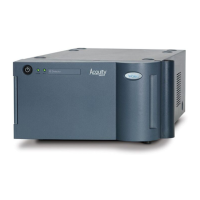
1.1.5.5.1 ACQUITY QDa
The ACQUITY QDa mass detector, which fits atop the system stack, characterizes LC-
separated analytes, determining their mass by means of a photomultiplier detection
system and chromatography data software. The instrument acquires data in one of
these operating modes:
• Scanning, where the instrument scans mass-to-charge (m/z) ratios, to produce a
mass spectrum.
• Selected ion recording (SIR), where the instrument records the signal intensity at
a static m/z ratio.
June 12, 2015, 715004747 Rev. A
Page 17



 To Next Page