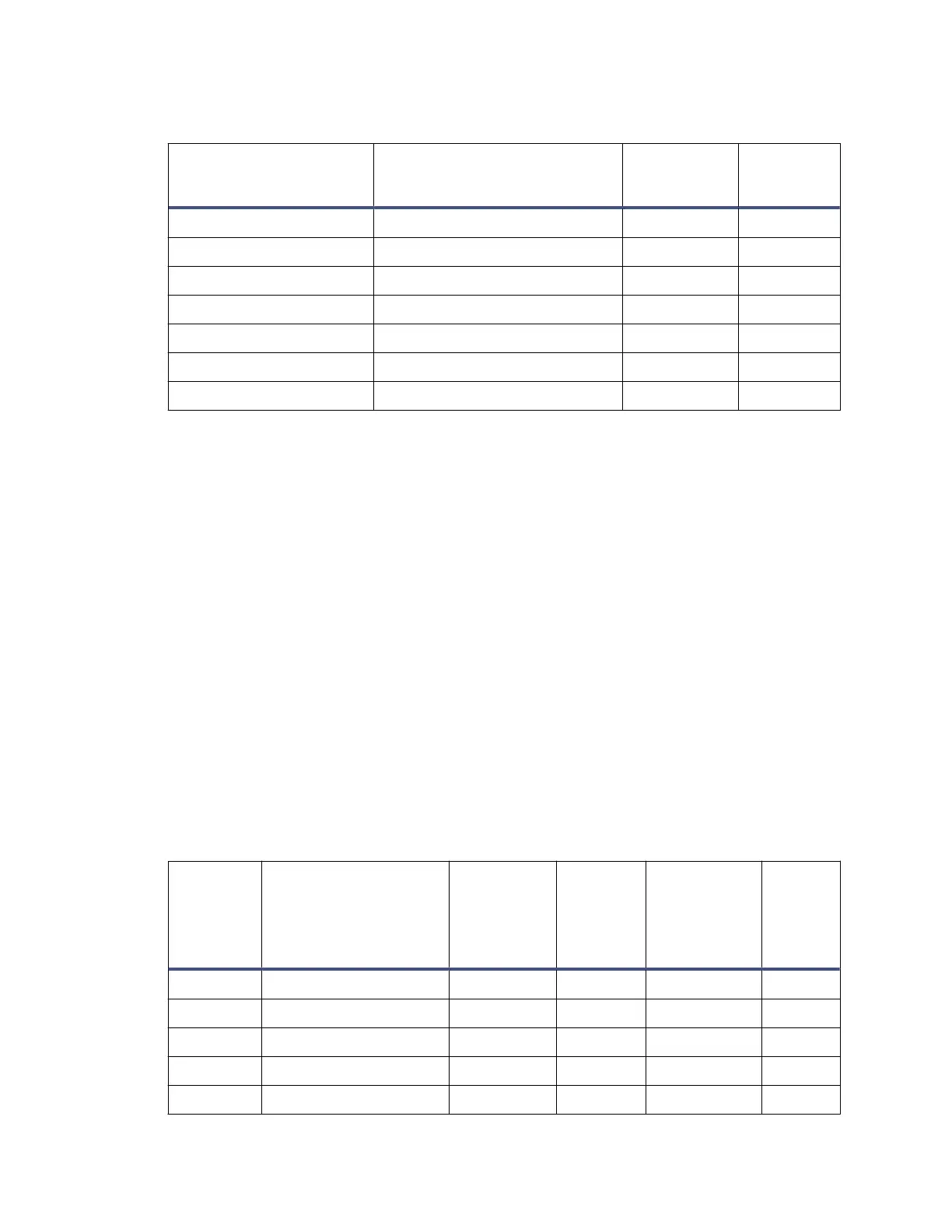
Table B–1: Properties of common solvents (continued)
Solvent Vapor pressure mm Hg
(Torr)
Boiling
point (°C)
Flash
point (°C)
Tetrahydrofuran 142 at 20 °C 66.0 -14
Toluene 28.5 at 20 °C 110.62 4
1,2,4-Trichlorobenzene 1 at 20 °C 213.5 106
Triethylamine 57 at 25 °C 89.5 -9
Trifluoroacetic acid 97.5 at 20 °C 71.8 -3
Water 17.54 at 20 °C 100.0
o-xylene 6 at 20 °C 144.41 17
B.2.1 Solvent miscibility
Before you change solvents, refer to the table below to determine solvent miscibility.
Be aware of these effects:
• Changes involving two miscible solvents can be made directly. Changes involving
two solvents that are not totally miscible (for example, from chloroform to water)
require an intermediate solvent like n-propanol.
• Temperature affects solvent miscibility. If you are running a high-temperature
application, consider the effect of the higher temperature on solvent solubility.
• Buffers dissolved in water can precipitate when mixed with organic solvents.
• When you switch from a strong buffer to an organic solvent, thoroughly flush the
system with distilled water before you add the organic solvent.
Note: λ cutoff is the wavelength at which the absorbance of the solvent equals 1
AU.
Table B–2: Solvent miscibility
Polarity
index
Solvent Viscosity
cP, 20 °C
(at 1 atm)
Boiling
point °C
(at 1
atm)
Miscibility
number
(M)
λ
cutoff
(nm)
0.0 N-hexane 0.313 68.7 29 —
1.8 Triethylamine 0.38 89.5 26 —
4.2 Tetrahydrofuran (THF) 0.55 66.0 17 220
4.3 1-propanol 2.30 97.2 15 210
4.3 2-propanol 2.35 117.7 15 —
June 12, 2015, 715004747 Rev. A
Page 72



 To Next Page