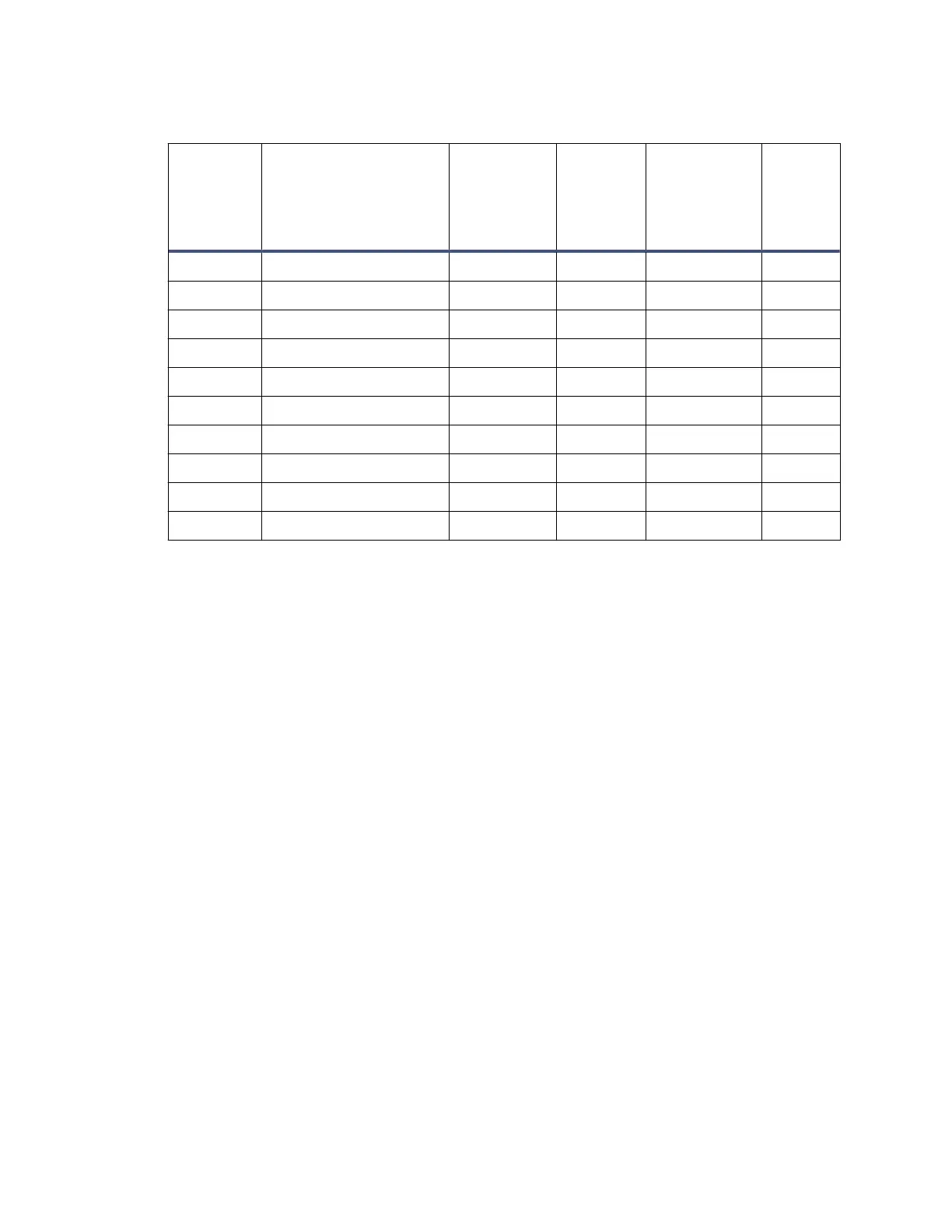
Table B–2: Solvent miscibility (continued)
Polarity
index
Solvent Viscosity
cP, 20 °C
(at 1 atm)
Boiling
point °C
(at 1
atm)
Miscibility
number
(M)
λ
cutoff
(nm)
5.2 Ethanol 1.20 78.3 14 210
5.4 Acetone 0.32 56.3 15, 17 330
5.5 Benzyl alcohol 5.80 205.5 13 —
5.7 Methoxyethanol 1.72 124.6 13 —
6.2 Acetonitrile 0.37 81.6 11, 17 190
6.2 Acetic acid 1.26 117.9 14 —
6.4 Dimaethylformamide 0.90 153.0 12 —
6.5 Dimethlysulfoxide 2.24 189.0 9 —
6.6 Methanol 0.60 64.7 12 210
9.0 Water 1.00 100.0 — —
B.2.1.1 Using miscibility numbers (M-numbers)
Use miscibility numbers (M-numbers) to predict the miscibility of a liquid with a
standard solvent.
To predict the miscibility of two liquids, subtract the smaller M-number value from
the larger M-number value.
• If the difference between two M-numbers is 15 or less, the two liquids are
miscible, in all proportions, at 15 °C.
• A difference of 16 indicates a critical solution temperature from 25 to 75 °C, with
50 °C as the optimal temperature.
• If the difference is 17 or greater, the liquids are immiscible, or their critical
solution temperature is above 75 °C.
Some solvents prove immiscible with solvents at both ends of the lipophilicity scale.
These solvents receive a dual M-number:
• The first number, always lower than 16, indicates the degree of miscibility with
highly lipophilic solvents.
• The second number applies to the opposite end of the scale. A large difference
between these two numbers indicates a limited range of miscibility.
For example, some fluorocarbons are immiscible with all the standard solvents and
have M-numbers of 0 and 32. Two liquids with dual M-numbers are usually miscible
with each other.
June 12, 2015, 715004747 Rev. A
Page 73



 To Next Page