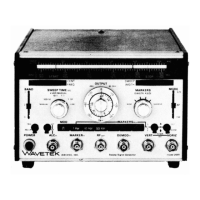
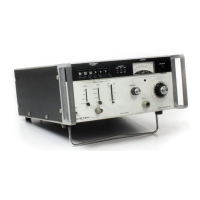
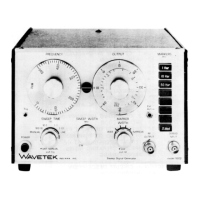
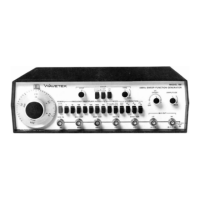
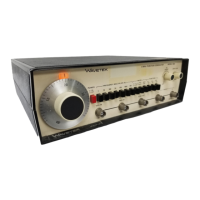
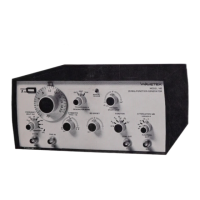
Model
2001
MAINTENANCE
rtlO MHz, and on band 2 and 3 520 MHz. Again, accuracy
on band 2 and 3
is
affected by the OUTPUT vernier control.
START/STOP MODE: Return to BAND 1 and set the
MODE to
S/S (Start/Stop). Set START
to -1 0 MHz and
STOP to 510 MHz. A pattern similar to Figure 5-5 should
be present on the scope display. Reduce STOP control
until the 500 MHz marker just disappears from the right
side of
its
scope display; read error of the STOP frequency
indicator (red), repeat
at
each 50 MHz interval.
Return STOP dial to 510 MHz and adjust START control
until the zero lock-in point just disappear from the left
side of the scope display; read error of the START frequency
indicator (green), repeat at each 50 MHz interval. Allowable
error
is
the same as band 1 in the af mode, k10 MHz.
Recheck for bands 2 and 3, vary OUTPUT vernier at each
50 MHz check point. Allowable error is 2% of indicated
frequency.
5.3.7 CW MODE CHECK
Turn MODE switch to CW. This position removes the re-
turn trace blanking and the sweep width drive from the
oscillator. The output frequency is controlled by the
CENTER FREQ control and the dial accuracy will be the
same as previously checked at the
af mode. The detected
pattern on the scope will be a negative voltage equal to that
produced in the
S/S and af mode with the absence of the
zero level return trace.
5.3.8 SPURIOUS SIGNAL CHECK
Checking for spurious signal content is not normally requir-
ed for periodic calibration, only for initial incoming inspec-
tion. The only practical way to measure the spurious signal
content
is
with a high quality spectrum analyzer covering
the frequency range of 10 MHz to 3
GHz. The spurious
check
is
made in accordance to the instructions furnished
with the particular spectrum analyzer.
The main spurious signals on all three bands
is
the second
and third harmonic of the output signal and should be
more than
26dB below the main output signal from 10 to
500 MHz on band 1 and 26dB below the output signal from
500 to 1400 MHz on bands
2
and 3. Harmonic content
is
not specified below 10 MHz on band 1 and an increase of
the second harmonic output to approximately
22dB below
the output in the 450 to 500 MHz area of band 2 is normal.
In
addition to
the
harmonically related spurious signals,
band 1 will have non-harmonic spurious signals due to the
hetrodyne method of obtaining the sweep output signal.
These spurious signals are typically 40 to
50dB below the
output from 10 to 400 MHz and increase to no more than
26dB below the output in the 400 to 500 MHz area.
5.3.9 RF OUTPUT FLATNESS (amplitude variations vs.
frequency)
Flatness can be checked with a negative polarity
RF detec-
tor or a power meter. The power meter method
is
to be
preferred since its own flatness is better than that of most
RF detectors. A
0.5dB detector flatness is typical of many
detectors over this frequency range. However, the power
meter has two limitations not present in the RF detector.
First, slow response time and second, not
useable below
20 MHz. The first limitation can be overcome by making
the flatness measurements in the CW mode, the second by
making flatness measurements with a detector in the
low
frequency area.
To measure flatness,
set
the MODE switch to CW, OUTPUT
control to
+lWBm, and connect the power meter to the
RF output connector. Tune the entire frequency range
from 20 to 1400 MHz and note the frequency where maxi-
mum output was obtained. With the OUTPUT VERNIER
control
set
the output at that frequency to exactly +lWBm.
Again tune the entire band and note the minimum output
reading. A minimum output of
8.5dBm or more
is
required
to meet the flatness specifications of
k0.75dB.
5.3.10 RF OUTPUT LEVEL
The MAX
R F output level
is
set to produce exactly
+
1 WBm
at 300 MHz. This produces the minimum error over the
greatest frequency range and can be checked by using the
power
meter while operating the instrument in the
CW
mode.
5.3.11 ATTENUATORS
20dB Vernier:
The accuracy of the
20dB vernier can be
checked using the power meter while operating the instru-
ment in the CW mode. The vernier dial
is
calibrated at 300
MHz. Dial accuracy is
*0.5dB to 500 MHz, LldB to 1000
MHz. and
k2dB to 1400 MHz. This error
is
contributed
by the vernier and does not include the basic flatness error
at
+lWBm.
70dB
Attenuator: The accuracy of the step attenuator can
be measured by using a suitable Attenuation Test Set or by
directly substituting precision
RF
attenuator pads for each
10dB step of the attenuator. The difference between the
two outputs represents the attenuator error. An
RF
Model 2001
± 10
MHz,
and on band 2 and 3
±20
MHz.
Again, accuracy
on band
2 and 3 is affected
by
the
OUTPUT
vernier
control.
START/STOP
MODE:
Return
to
BAND
1 and set the
MODE
to
SIS
(Start/Stop).
Set
START
to
-10
MHz
and
STOP
to
510
MHz.
A pattern similar
to
Figure 5-5 should
be
present on the scope display. Reduce STOP
control
until
the
500
MHz
marker
just
disappears
from
the
right
side
of
its
scope display; read error
of
the STOP frequency
indicator
(red), repeat at
each
50
MHz
interval.
Return STOP
dial
to
510
MHz
and adjust
START
control
until
the zero lock:-in
point
just
disappear
from
the
left
side
of
the scope display; read error
of
the
START
frequency
indicator
(green), repeat at each
50
MHz
interval.
Allowable
error
is
the
same
as
band 1 in the
0.
f mode, ± 10 MHz.
Recheck
for
bands 2 and 3, vary
OUTPUT
vernier
at
each
50
MHz
check
point.
Allowable
error
is
2%
of
indicated
frequency.
5.3.7
CW
MODE
CHECK
Turn
MODE
switch
to
CWo
This
position
removes the
re-
turn
trace blanking and the sweep
width
drive
from
the
oscillator.
The
output
frequency
is
controlled
by
the
CENTER
FREQ
control
and the dial accuracy
will
be
the
same
as
previously checked
at
the
0.
f mode.
The
detected
pattern on the scope
will
be a negative voltage equal
to
that
produced in the SIS and 0. f mode
with
the absence
of
the
zero level return trace.
5.3.8 SPURIOUS
SIGNAL
CHECK
Checking
for
spurious signal
content
is
not
normally
requir-
ed
for
periodic
calibration,
only
for
initial
incoming
inspec-
tion.
The
only
practical
way
to
measure the spurious signal
content
is
with
a high
quality
spectrum analyzer covering
the frequency range
of
10
MHz
to
3 GHz.
The
spurious
check
is
made in accordance
to
the
instructions
furnished
with
the
particular
spectrum analyzer.
The
main
spurious signals on all three bands
is
the second
and
third
harmonic
of
the
output
signal and should
be
more
than 26dB
below
the main
output
signal
from
10
to
500
MHz
on band 1 and 26dB below the
output
signal
from
500
to
1400
MHz
on bands 2 and 3.
Harmonic
content
is
not
specified
below
10
MHz
on band 1 and
an
increase
of
the second
harmonic
output
to
approximately
22dB below
the
output
in the
450
to
500
MHz
area
of
band 2
is
normal.
In
addition
to
the
harmonically
related spurious signals,
band 1
will
have
non-harmonic
spurious signals due
to
the
MAINTENANCE
hetrodyne
method
of
obtaining
the sweep
output
signal.
These spurious signals are
typically
40
to
50dB
below
the
output
from
10
to
400
MHz
and increase
to
no
more
than
26dB below the
output
in the
400
to
500
MHz
area.
5.3.9
RF
OUTPUT
FLATNESS
(amplitude
variations
vs.
frequency)
Flatness can be checked
with
a negative
polarity
Rf
detec-
tor
or
a
power
meter.
The
power
meter
method
is
to
be
preferred since its
own
flatness
is
better
than
that
of
most
RF detectors. A 0.5dB
detector
flatness
is
typical
of
many
detectors over th
is
frequency range. However, the power
meter
has
two
limitations
not
present in the R F detector.
First, slow response
time
and second,
not
useable below
20 MHz. The
first
limitation
can
be
overcome
by
making
the flatness measurements in the
CW
mode, the second
by
making flatness measurements
with
a
detector
in the
low
frequency area.
To
measure flatness, set the
MODE
switch
to
CW,
OUTPUT
control
to
+lOdBm,
and
connect
the
power
meter
to
the
RF
output
connector.
Tune
the entire frequency range
from
20
to
1400
MHz
and note the frequency where maxi-
mum
output
was obtained.
With
the
OUTPUT
VERNIER
control
set the
output
at
that
frequency
to
exactly
+1
OdBm.
Again tune the entire band and note the
minimum
output
reading. A
minimum
output
of
8.5dBm
or
more
is
required
to
meet the flatness specifications
of
±0.75dB.
5.3.10
RF
OUTPUT
LEVEL
The
MAX
R F
output
level
is
set
to
produce
exactly
+ 1 OdBm
at
300
MHz. This produces the
minimum
error
over the
greatest frequency range and can
be
checked
by
using the
power
meter
while operating the
instrument
in the
CW
mode.
5.3.11
ATTENUATORS
20dB Vernier:
The
accuracy
of
the 20dB vernier can
be
checked using the
power
meter
while
operating the instru-
ment
in the CW mode. The vernier
dial
is calibrated
at
300
MHz. Dial accuracy
is
±O.5dB
to
500
MHz,
± 1dB
to
1000
MHz,
and
±2dB
to
1400
MHz.
This
error
is
contributed
by the vernier and does
not
include the basic flatness error
at
+lOdBm.
70dB
Attenuator:
The
accuracy
of
the step
attenuator
can
be
measured
by
using a suitable
Attenuation
Test Set
or
by
directly
substituting precision RF
attenuator
pads
for
each
lOdB step
of
the attenuator. The difference between the
two
outputs
represents the
attenuator
error.
An
RF
5-5


 To Next Page
 Loading...