36 Welch Allyn
Monitor Mode
1. Remove the probe from the probe holder and take a rectal predictive temperature (the
temperature display must show “ALY”).
2. When the thermometer is finished and a temperature is displayed, leave the probe in place
and press the “Mode” button once. An “M” appears on the temperature display to indicate
Monitor mode.
3. Maintain probe contact with the tissue for at least 3 minutes to obtain an accurate rectal
Monitor mode temperature.
4. Record the Monitor mode temperature before placing the probe back in the probe holder.
The Spot Vital Signs does not save the Monitor mode temperature.
If the thermometer is in Normal mode, you can easily switch to Monitor mode without taking a
predictive temperature first. To do this, remove the probe from the probe holder, attach a new
probe cover, and wait one minute (do not place probe in patient’s mouth, underarm, or rectum at
this time). After one minute the thermometer automatically switches to Monitor mode. You may
now proceed to take a rectal temperature. After the probe is replaced in the holder, the device
reverts back to Normal temperature mode.
Measuring SpO
2
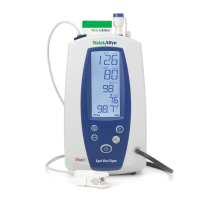
The Spot Vital Signs incorporates the Nellcor
Puritan Bennett™ pulse oximetry system which
determines arterial oxyhemoglobin saturation (SpO
2
%) by measuring the absorption of red and
infrared light passed through the tissues. Changes in absorption caused by pulsation of blood in
the vascular bed are used to determine arterial saturation and pulse rate.
Oxygen saturation percent is calculated with each pulse detected, and the Spot Vital Signs dis-
play is continually updated. The pulse signal bar graph is an indicator of the strength and quality
of the detected pulses.
SpO
2
is normally measured via pulses detected using a finger clip sensor. For certain situations,
measurement and alternate site measurements for SpO
2
can include the earlobe, forehead, and
toes. Use special sensors in these situations (see Appendix A).
Factors that may degrade the performance of the pulse oximeter:
• Excessive ambient light
• Excessive motion
• Electrosurgical interference
• Arterial catheters, blood pressure, and infusion lines, etc.
• Moisture in the sensor
• Improperly attached sensor
• Incorrect sensor for patient
• Poor patient perfusion
• Venous pulsations
• Anemia or low hemoglobin concentrations
• Cardiovascular dyes
• Sensor not at heart level
• Fingernail polish (if finger sensor is used)


 To Next Page
 Loading...