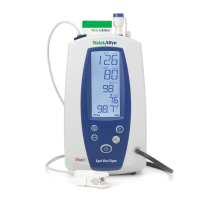
Spot Vital Signs 41
Troubleshooting: General Guide to Problems and Corrective Actions
Quick Guide to Taking Manual (Auscultatory) Blood Pressure
Action Explanation
Use a certified accurate sphygmomanometer and
quality stethoscope.
Many sphygmomanometers are inaccurate. Low
quality stethoscopes do not transmit sound well
enough to accurately hear blood pressure sounds.
Select a blood pressure cuff of a suitable size.
Use a blood pressure cuff of the largest appropri-
ate size for patient (see markings on inside of
cuff).
A cuff that is either too large or too small may
cause inaccurate readings.
Have the patient assume a comfortable position
with the upper arm relaxed at heart level and the
lower arm passively supported.
Inaccurate readings result if the arm is not at the
proper level.
Expose the area of the brachial artery by removing
clothing, or move a sleeve, if not too tight, above
the area where the cuff is placed.
Clothing over the artery hinders the ability to hear
and may cause inaccurate readings. Tight clothing
may cause vessel congestion and inaccurate read-
ings
Center the cuff bladder so the lower edge is at
least 1 inch (2.5cm) above the bend of inner arm
of the elbow.
This places the cuff in the best position for occlud-
ing the blood flow through the brachial artery.
Palpate the brachial or radial pulse. Determines the most accurate location for assess-
ment and approximation of systolic pressure.
Inflate the cuff until the pulsation disappears.
Continue to inflate until the pressure reads 30
mmHg above the point where the pulse disap-
peared.
Facilitates identification of Phase One Korotkoff
sounds.
Listen carefully with stethoscope over brachial
artery while controlling the release of air at a rate
of 3 mmHg per second.
One of the major sources of error in auscultatory
blood pressure measurement is deflating the cuff
too quickly. It is a normal operation of the Welch
Allyn Spot Vital Signs to deflate at the American
Heart Association recommended 3 mmHg per
second.
Systolic is determined by reading the manometer
gauge when the first faint but clear tapping sound
is heard with the stethoscope.
Follows AHA recommended standards.
Diastolic, in adults, is determined by reading the
manometer gauge to the closest even number
when the last sound is heard. Release the air
quickly after at least 10 to 20 mmHg of silence.
Diastolic blood pressure in children is the point at
which the sound becomes muffled.


 To Next Page
 Loading...