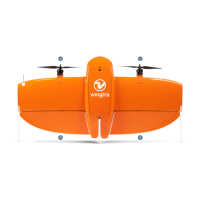
5. Forward and backward transition are most stable if you face forward transition into the wind. Within the specified wind bounds, WingtraOne can handle all orientations
but if you have the space, orient forward transition into the wind during planning and place WingtraOne onto ground such that it does not need to turn during ascent.
Flight Direction
The selection of the most appropriate flight direction requires the consideration of different parameters. Flying parallel to the longest edge decreases the number of turns,
which leads to the minimal flight duration. With this strategy, the maximal coverage can be reached. In case of notable wind, it is further advisable to fly orthogonally to the
wind direction. Thus, the front overlap is not being influenced by the wind and regular stitching is ensured. Another method to improve stitching, especially for
homogeneous areas, is not to fly aligned with linear structures (such as roads or cultivated fields). As a consequence, the number of similar looking images can be
reduced. The most important fact, which needs to be considered when choosing the flight direction, is that there is enough space for the turns, so that they do not interfere
with objects close by.


 To Next Page