3-5
PREPARING FOR THE ROAD
BREAKAWAY CABLE
The law requires that any trailer with a
MTPLM (GVW) exceeding 750 kg must have
a braking system and it must work. If such a
trailer becomes detached from the tow vehicle
then these brakes must be applied
automatically by way of the breakaway cable.
This breakaway cable is an important part of
the management of the braking system and
when the trailer is built the braking system is
part of the certification process for the safe
use of the trailer - so any replacement parts
must be equivalent to the original parts fitted.
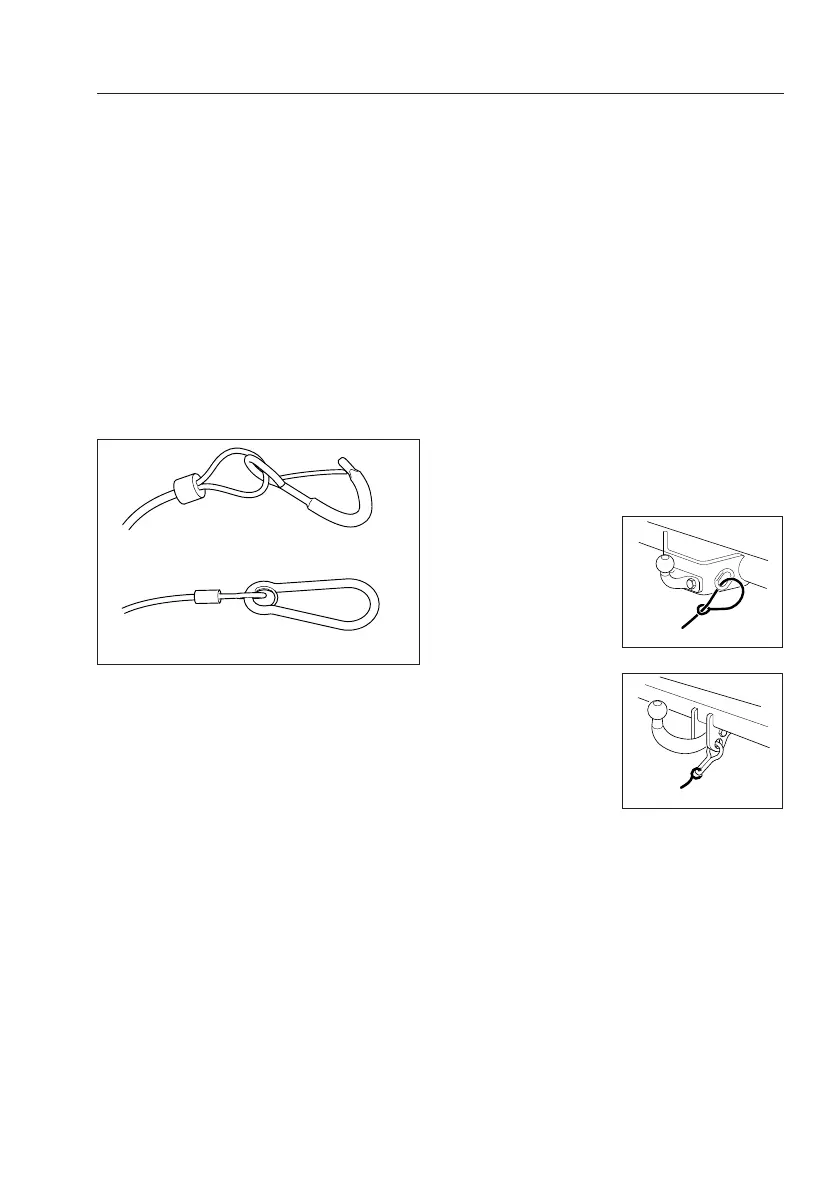
There are two types of breakaway cable in
use in the UK. One uses a spring clip, the
other uses a Karabiner clip.
Looking at the two clips it is easy to see that
there is a difference.
The spring clip type is designed to be hooked
back over the breakaway cable when it is
fitted to the tow vehicle and must always be
used this way.
The Karabiner type is designed to be secured
onto a mounting point on the tow vehicle, it
does not need to pass back over the cable to
secure it in place (but can if necessary).
So how should the breakaway cable be
secured to the tow vehicle? In the absence of
specific advice from the manufacturer/supplier
follow these simple guidelines:
Fixed tow ball systems
The cable with spring clip should be passed
behind the towbar assembly (where cable
length is sufficient) and then clipped back on
itself. The cable should be in as straight a
path as possible to ensure correct operation.
When the breakaway cable is attached,
check to ensure:
a) that the cable cannot snag in use on the
trailer coupling head, jockey wheel, or
any accessory e.g. a stabiliser, bumper
shield, cycle carrier etc.
b) that there is sufficient slack in the cable
to allow the towing vehicle and trailer to
articulate fully without the cable ever
becoming taut and applying the brakes.
Where a designated attachment point is
provided on the towbar:
Either
a) Pass the cable
through the
attachment point
and clip it back on
itself (Fig. 1).
Or:
b) Attach the clip
directly to the
designated point
(Fig. 2). This
alternative must
be specifically
permitted by the
trailer
manufacturer since the clip may not be
sufficiently strong for use in this way.
Karabiner type clip
Spring type clip
Fig. 1
Fig. 2



 To Next Page