Need help?
Do you have a question about the Yamaha DR2E17 and is the answer not in the manual?
Explains the safety alert symbol used for potential personal injury hazards.
Details hazardous situations that could result in death or serious injury.
Provides special precautions to avoid vehicle or property damage.
Offers key information to make procedures easier or clearer.
Details various safety and instruction labels found on the golf car.
Provides crucial warnings and operating instructions for safe use of the golf car.
Safety warnings to reduce the risk of accidents, injury, or death.
Illustrates the main switch and provides vehicle identification details.
Details warnings related to battery handling, charging, and electrical hazards.
Provides notice on the correct operation of the tow switch for towing or storage.
Explains the location and structure of the golf car serial number for model identification.
Covers essential safety checks and precautions before driving the golf car.
Details safe operating practices to follow while the golf car is in motion.
Provides guidance on safe driving, speed control, and avoiding modifications.
Specifies requirements for authorized drivers and placement of safety instructions.
Recommends regular safety surveys to identify hazardous areas.
Addresses hazards on steep grades and provides warnings.
Covers hazards like sharp turns and blind corners, with precautions.
Advises on operating in wet or loose terrain to maintain traction and stability.
Discusses managing traffic and pedestrian interactions to prevent accidents.
Outlines essential preventative maintenance and personnel requirements for safety.
Details critical safety procedures to follow when performing maintenance.
Provides safety guidelines for storing the vehicle and charging the batteries.
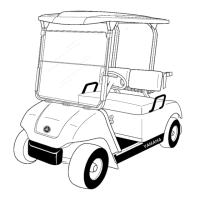
Identifies and lists the main features and components of the golf car.
Explains the OFF position of the main switch, disabling the ignition circuit.
Details the ON position of the main switch, enabling electrical circuits for driving.
Describes how to use the drive select switch for forward and reverse movement.
Explains how the accelerator pedal controls the golf car's speed.
Details how to use the brake pedal to stop the golf car.
Explains how to engage and disengage the parking brake pedal.
Warns about the automatic release of the parking brake when the accelerator is depressed.
Instructs to ensure the tow switch is in the 'RUN' position before operating the car.
Provides notice and procedure for setting the tow switch to 'TOW' before towing.
Warns about the risk of unexpected movement during pre-operation checks.
Refers to periodic maintenance charts on pages 7-1 and 7-2 for detailed checks.
Details how to open the seat for checking and servicing.
Covers checks for battery security, caps, and terminal corrosion.
Warns about the hazards of battery electrolyte and necessary precautions.
Instructs to check the tire air pressure before operating the golf car.
Details checking the tire surface for damage and the wear limit for replacement.
Explains how to check the steering system for excessive free play.
Describes how to check if the reverse alarm is functioning correctly.
Details checking the accelerator pedal for smooth operation when the main switch is off.
Ensures the brake pedal feels firm and returns to its original position.
Verifies the parking brake pedal locks and releases correctly.
Visually inspects the golf car body and chassis for damage or missing parts.
Step-by-step instructions for starting the golf car safely.
Warns against shifting drive select while the car is moving.
Warns about potential unexpected movement when turning on the main switch.
Instructions on gradually pressing the brake pedal to stop the golf car.
Advises using the brake, not the accelerator, to hold the car on an incline.
Presents a schedule of maintenance tasks based on usage intervals.
Warns to turn off the main switch and apply parking brake during maintenance.
Disapproves high-pressure washers for cleaning due to potential damage.
Details maintenance tasks for annual and every four years intervals.
Details hazards of battery electrolyte and provides antidotes and safety measures.
Instructs on cleaning battery tops and checking fluid levels.
Warns not to allow cleaning solution into battery cells to prevent damage.
Guides on adding distilled water before and after charging batteries.
Warns that tap water contains harmful minerals and to use only distilled water.
Explains how to check battery fluid specific gravity using a hydrometer.
Recommends preparing for emergencies and reading charger instructions.
Summarizes the steps for charging the golf car batteries.
Advises placing the tow switch in 'TOW' position before charging to prevent damage.
Warns against disconnecting the DC output cord while the charger is on.
Details safety precautions for battery installation, avoiding arcs and explosions.
Provides precautions for placing battery cables and holddowns, and cable connection order.
Warns against overtightening battery holddown nuts to prevent casing damage.
Warns about using the specified fuse to prevent electrical damage and fire hazards.
Advises turning off the main switch before replacing a fuse to prevent short-circuits.
Describes how to locate in-line fuse holders on the main wire harness.
Details pulling fuse holder covers and inspecting/replacing fuses.
Recommends keeping essential items handy for possible battery charger emergencies.
Highlights features like switch-mode design, LED display, and charge protection.
Explains the I-E-I charge profile and multi-charge steps.
Specifies AC line requirements for the charger to avoid overloading circuits.
Warns to use 15-amp or higher protection for circuits with the charger.
Advises using a grounded 3-wire, 12-AWG cord no longer than 15m for extension.
Warns that chargers with >48 volts output may pose an energy or shock hazard.
Provides guidelines for mounting the charger with adequate ventilation.
Recommends keeping charger fins free of oil, dirt, and dust for efficiency.
Suggests locating the charger's AC plug at least 46cm above ground for visibility.
Warns that chargers can ignite flammable materials and vapors.
Details grounding requirements for the charger to reduce electric shock risk.
Warns about the risk of electric shock from improper connection of the grounding conductor.
Instructs to connect only to a properly grounded outlet and avoid uninsulated parts.
Warns that surfaces may be hot and to avoid touching them.
Advises charging only 48-volt systems to prevent charger and battery damage.
Details visual and manual inspection of the DC cord, plug, and receptacle.
Warns against using the charger with damaged or poorly connected parts.
Instructs to pull plugs from the body, not the cords, when removing them.
Provides daily reference operating instructions for the battery charger.
Instructs how to stop charger operation by first disconnecting AC power.
Explains the amber LED indication for current output and charger temperature.
Details the amber LED indication for 80% charge completion and algorithm selection.
Explains the green LED indication for charging complete and storage mode.
Describes the amber LED indication for AC power status and overheating.
Explains the red LED indication for charger errors and troubleshooting.
Warns that incorrect reassembly can lead to electric shock or fire.
Instructs to disconnect power and battery before maintenance or cleaning.
Warns against operating a malfunctioning charger to prevent injury or damage.
Details solutions for battery high voltage and low voltage faults.
Provides solutions for charge timeout and reduced output due to high temperatures.
Explains how to check for shorted or damaged cells affecting trickle charging.
Details solutions for over-temperature shutdowns and internal charger faults.
Advises having a qualified service technician inspect if problems persist.
Addresses issues where the charger does not start or LEDs do not illuminate.
Covers problems with starting charging, including wiring and battery voltage.
Discusses chargers running longer than 20 hours, possibly due to boosting.
Reiterates the need for a qualified technician if problems persist.
Details the steps for checking the transaxle oil level.
Warns against allowing foreign material into the transaxle to prevent damage.
Guides on adding Yamalube SAE 90 gear oil if the level is low.
Provides instructions for removing and installing a wheel on the golf car.
Specifies the correct torque for tightening wheel nuts.
Explains that brakes are self-adjusting and how to check their function.
Advises consulting a dealer for suspected brake problems.
Details how to measure the brake pedal free play.
Guides on adjusting the brake pedal free play using lock and adjusting nuts.
Warns against over-tightening brake cables to prevent wear and performance issues.
Advises adjusting brake pedal free play before parking brake release adjustment.
Provides steps for adjusting the parking brake release mechanism.
Reiterates disapproval of high-pressure washers for cleaning.
Provides tips on setting switches and storing the key safely for storage.
Details chassis preparation steps including tire pressure and rust inhibitor.
Outlines battery preparation steps for extended storage periods.
Lists the overall dimensions, wheelbase, tread, and ground clearance.
Specifies the dry weight of the golf car without the battery.
Provides vibration levels for the footboard and steering wheel.
Lists the acceleration and constant speed noise levels.
Details factory speed settings, maximum speed, turning radius, and seating capacity.
Details the type of battery used and its minimum run time (RC).
Covers steering system, brakes, parking brake, wheels, and tire pressure.
Details the differential/reduction gear, ratios, and lubricant requirements.
Lists DC output voltage, current, battery type, and protection features.
Details AC input voltage, frequency, current, and power factor.
Covers dimensions, weight, environmental ratings, and operating temperatures.
Illustrates the top and side mechanical dimensions of the battery charger.
Shows the main power supply, fuses, switches, and control board connections.
Illustrates wiring for the DC motor, throttle position sensor, and tachometer.
 General
| Category | Golf Cars |
|---|---|
| Manufacturer | Yamaha |
| Model | DR2E17 |
| Seating Capacity | 2 |
| Battery Voltage | 48V |
| Battery Type | Lead-Acid |
| Charger Type | Onboard |
| Front Suspension | Independent |
| Warranty | 4 years |


 To Next Page