EasyManua.ls Logo

Yamaha RX21 - Quantize

Yamaha RX21
59 pages
Print Icon
To Next Page IconTo Next Page
To Previous Page IconTo Previous Page
Loading...
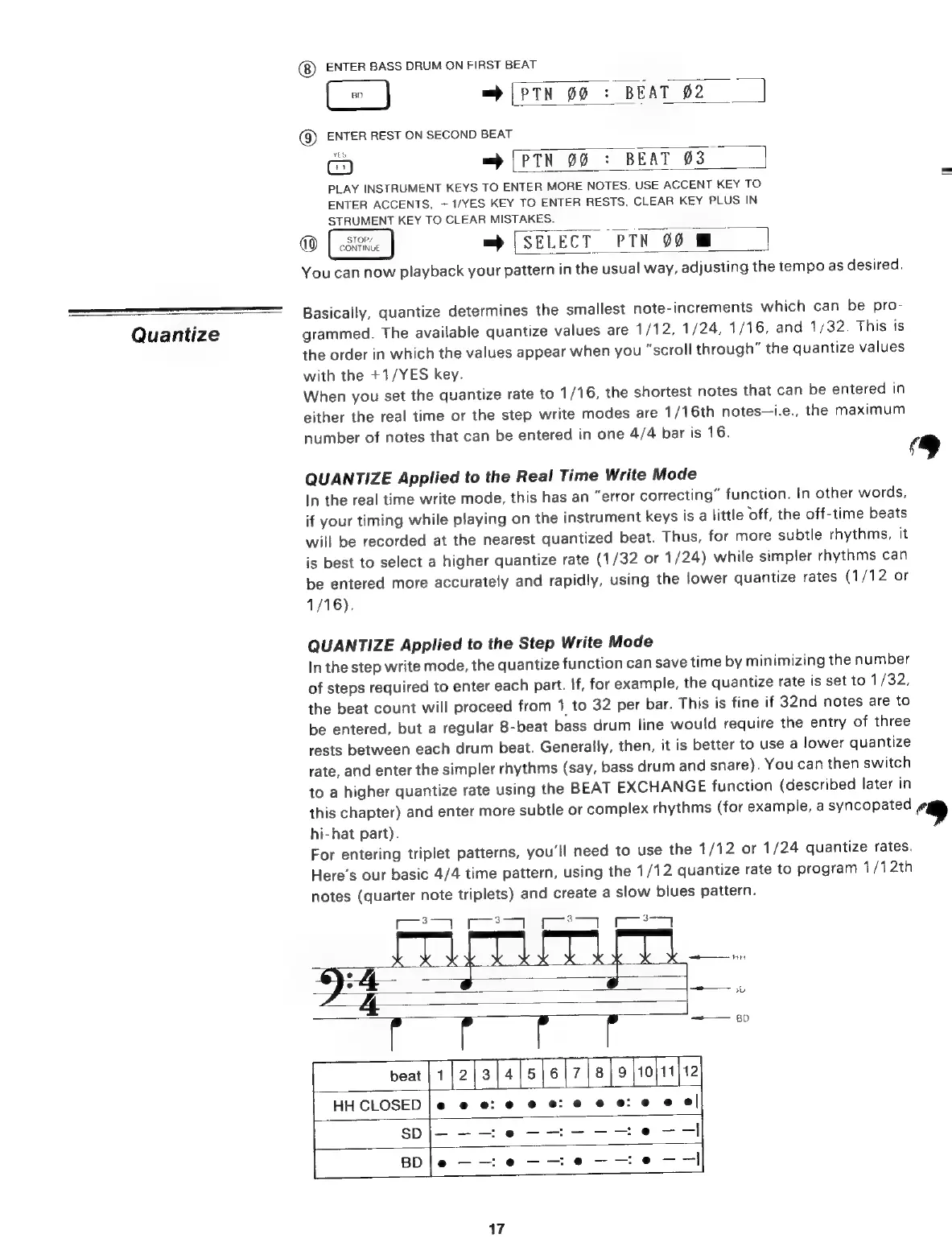
ENTER
BASS
DRUM
ON
FIRST
BEAT
=
[РТН
00
:
BEAT
02
@
ENTER
REST
ON
SECOND
BEAT
=>
[РТН
00
:
BEAT
03
PLAY
INSTRUMENT
KEYS
TO
ENTER
MORE
NOTES.
USE
ACCENT
KEY
TO
ENTER
ACCENTS,
~
1/YES
KEY
TO
ENTER
RESTS,
CLEAR
KEY
PLUS
IN-
STRUMENT
KEY
TO
CLEAR
MISTAKES.
=
[SELECT
РТН
00
M
You
can
now
playback
your
pattern
in
the
usual
way,
adjusting
the
tempo
as
desired.
Basically,
quantize
determines
the
smallest
note-increments
which
can
be
pro-
Quantize
grammed.
The
available
quantize
values
are
1/12,
1/24,
1/16,
and
1/32.
This
is
the
order
in
which
the
values
appear
when
you
“scroll
through”
the
quantize
values
with
the
+1/YES
key.
When
you
set
the
quantize
rate
to
1/1
6,
the
shortest
notes
that
can
be
entered
in
either
the
real
time
or
the
step
write
modes
are
1/16th
notes—i.e.,
the
maximum
number
of
notes
that
can
be
entered
in
one
4/4
bar
is
16.
9
QUANTIZE
Applied
to
the
Real
Time
Write
Mode
In
the
real
time
write
mode,
this
has
an
“error
correcting”
function.
In
other
words,
if
your
timing
while
playing
on
the
instrument
keys
is
a
little
off,
the
off-time
beats
will
be
recorded
at
the
nearest
quantized
beat.
Thus,
for
more
subtle
rhythms,
it
is
best
to
select
a
higher
quantize
rate
(1/32
or
1/24)
while
simpler
rhythms
can
be
entered
more
accurately
and
rapidly,
using
the
lower
quantize
rates
(1/12
or
1/16).
QUANTIZE
Applied
to
the
Step
Write
Mode
In
the
step
write
mode,
the
quantize
function
can
save
time
by
minimizing
the
number
of
steps
required
to
enter
each
part.
If,
for
example,
the
quantize
rate
is
set
to
1/32,
the
beat
count
will
proceed
from
1
to
32
per
bar.
This
is
fine
if
32nd
notes
are
to
be
entered,
but
a
regular
8-beat
bass
drum
line
would
require
the
entry
of
three
rests
between
each
drum
beat.
Generally,
then,
it
is
better
to
use
a
lower
quantize
rate,
and
enter
the
simpler
rhythms
(say,
bass
drum
and
snare).
You
can
then
switch
to
a
higher
quantize
rate
using
the
BEAT
EXCHANGE
function
(described
later
in
this
chapter)
and
enter
more
subtle
or
complex
rhythms
(for
example,
a
syncopated
«ву
hi-hat
part).
For
entering
triplet
patterns,
you'll
need
to
use
the
1/12
or
1/24
quantize
rates.
Here’s
our
basic
4/4
time
pattern,
using
the
1/12
quantize
rate
to
program
1/12th
notes
(quarter
note
triplets)
and
create
a
slow
blues
pattern.
fees
И
Deh
[on]
|
Е
_
4
[57е
[7
[89
joju
beat
HH
CLOSED
SD
BD
17
||

Related product manuals