GENERAL SERVICE INFORMATION
TNV IDI Service Manual
4-19
Engine Coolant
5. Remove the cap of the reserve tank
(Figure 4-7, (3)), and fill it to the LOW (COLD)
mark (Figure 4-7, (4)) with engine coolant.
Reinstall the cap.
6. Check the hose (Figure 4-7, (5)) that connects
the reserve tank (Figure 4-7, (3)) to the
radiator. Be sure it is securely connected and
there are no cracks or damage. If the hose is
damaged, engine coolant will leak out instead
of going into the reserve tank.
7. Run the engine until it is at operating
temperature. Check the level of engine coolant
in the reserve tank. When the engine is running
and the engine coolant is at normal
temperature, the coolant level in the tank should
be at or near the FULL (HOT) mark
(Figure 4-7, (6)). If the engine coolant is not at
the FULL (HOT) mark (Figure 4-7, (6)), add
additional engine coolant to the reserve tank to
bring the level to the FULL (HOT) mark.
Engine Coolant Capacity (Typical)
Note: Capacities listed are for engine only
without a radiator. Refer to the operation
manual provided by the driven machine
manufacturer for actual engine coolant
capacity on your machine.
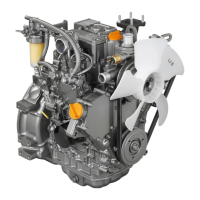
The following are the engine coolant capacities for
various Yanmar TNV engines.
Engine Model
Engine Coolant
Capacity
2TNV70 0.6 qt (0.6 L)
3TNV70 1.0 qt (0.9 L)
3TNV76 1.0 qt (0.9 L)
TNV_IDI_ServiceManual_A4.book 19 ページ 2012年2月24日 金曜日 午前10時24分



 To Next Page