Pagina 8
3 INSTALLATION3 INSTALLATION
3 INSTALLATION3 INSTALLATION
3 INSTALLATION
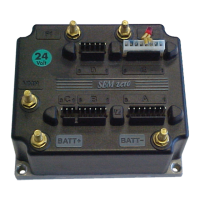
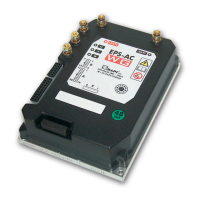
Install the chopper with the base-plate on a flat metallic surface that is clean and unpainted.
Apply a light layer of thermo-conductive grease between the two surfaces to permit better heat
dissipation.
Despite the protection provided against external agents, the continuous attack of corrosive
substances may cause the connector contacts to oxidise, thus jeopardising good functioning.
Keep this in mind when choosing the installation position on the vehicle.
Use the special holes on the base-plate for fastening the chopper.
Make sure that the wiring of the cable terminals and connectors is carried out correctly.
Fit anti-jamming filtres on the horn, solenoid valves, and contactors not connected to the
chopper such as those for activating the pump motor or hydrodrive motor, if the latter is not
handled by the chopper itself.
3.1 CONNECTION CABLES3.1 CONNECTION CABLES
3.1 CONNECTION CABLES3.1 CONNECTION CABLES
3.1 CONNECTION CABLES
For the auxiliary circuits, use cables of 0.5mm² section.
For power connections to the motor and to the battery, use cables having sections of 35 - 5mm².
For the best chopper performance, the cables to the battery should be run side by side and be as
short as possible.
3.2 CONTACTORS3.2 CONTACTORS
3.2 CONTACTORS3.2 CONTACTORS
3.2 CONTACTORS
Choose the type of contactors on the basis of the maximum operating current of the motor and
the specific chopper configuration.
- The current absorbed by the coil must not be greater than 3 amp.
- The coil suppressors are inside the chopper; do not use contactors with arc suppressors.
- For contactors with magnetic suppressors, make sure you respect the polarity indicated on the
cap.
3.3 FUSES3.3 FUSES
3.3 FUSES3.3 FUSES
3.3 FUSES
- Use a 10 amp fuse for auxiliary circuit protection.
- For protecting the power unit, see the diagrams.
The value shown is the maximum allowable. For special applications or requirements this
value can be reduced.
For safety reasons, we recommend that you use protected fuses in order to prevent the spread
of
fused particles in the event of blowout.



 To Next Page