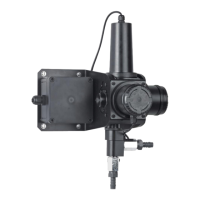
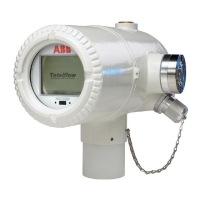
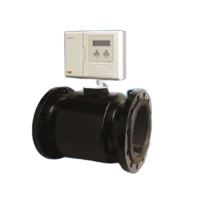
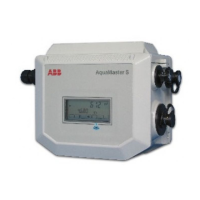
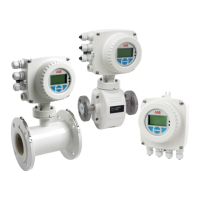
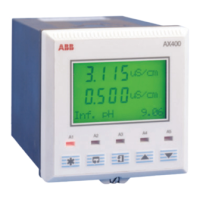
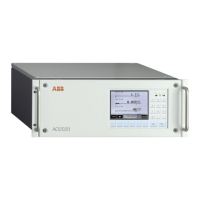
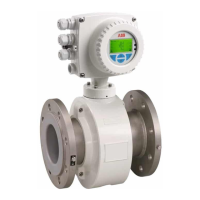
The ABB pH/Redox (ORP) Analyzers, Models 4630 & 4635 (incorporating Water Wash Versions 4631 & 4636), are designed for continuous monitoring and control of pH and Redox (ORP). These instruments offer a comprehensive solution for industrial process control, liquid analysis, and environmental applications.
Function Description:
The analyzers function as transmitters for pH and Redox (ORP) measurements. They are designed to continuously monitor and control pH, with the electrode system being standardizable using a built-in calibration facility. A single-point buffering facility allows for easy re-calibration after initial standardization. All models feature a single programmable pH input channel and a single temperature input channel. For temperature-compensated measurements, a Pt100 resistance thermometer can be integrated into the electrode system to sense sample temperature.
Models 4631 and 4636 include a water wash facility for automated system cleaning. During a wash cycle, the Alarm 1 status and the retransmission value are held at their pre-cycle condition, ensuring uninterrupted process control data. Instrument operation and programming are managed via four tactile membrane keys on the front panel, with programmed functions protected by a five-digit security code to prevent unauthorized alterations.
The pH measurement mode includes an Operating Page, which allows viewing of parameters but not alteration, and a pH Calibration Page for adjustments. Three calibration procedures are available: Single Point, Two-point (Manual Mode), and Two-point (Automatic Mode). The automatic mode offers recognition of ABB or non-ABB buffers (4, 7, 9, and 10 pH) and automatically adjusts buffer values for temperature changes. The Redox (ORP) measurement mode primarily uses an operating page for viewing parameters.
Important Technical Specifications:
- Display: 5-digit x 7-segment back-lit LCD for measured values; 16-character, single-line, dot matrix back-lit LCD for information.
- Ranges: 0 to 14 pH, -1000 to 1000 mV. Minimum range: any 5 pH units or 300 mV.
- Resolution: 0.01 pH, 1 mV.
- Accuracy: ±1% f.s.d.
- Linearity: ±0.2% f.s.d.
- Temperature Compensation: -10 to 110°C (14 to 230°F), manual or automatic using Pt100 resistance thermometer.
- Set Points and Relays: Two programmable set points with ±1% f.s.d. fixed hysteresis. Local set point annunciation via red LED. Two single-pole changeover relays with rating: 250V a.c., 3A a.c. (non-inductive 750VA, inductive 30W max.); 250V d.c. max., 3A d.c. max. (non-inductive 75VA, inductive 3W max.). Insulation, contacts to earth: 2kV r.m.s.
- Retransmission: One fully isolated (standard), two fully isolated (optional) signals. Output current: 0 to 10, 0 to 20, or 4 to 20 mA programmable. Accuracy: ±0.25% f.s.d. or ±0.5% reading. Output ranges: Retransmission 1 programmable for pH or Redox (ORP), -1000 to 1000mV (min. span 150mV). Retransmission 2 (optional) programmable for pH, Redox (ORP), or Temperature (-10 to 150°C / 32 to 302°F, min. span 20°C / 36°F). Resolution: 0.1% of f.s.d. Maximum load resistance: 750Ω (20mA max.).
- Serial Communication: RS422/RS485 (optional).
- Power Supply: 100 to 130V or 200 to 260V, 50/60Hz. Power consumption: < 6VA. Error due to power supply variations: less than 2% for +6% -20% variation from nominal supply voltage. Insulation, mains to earth: 2kV r.m.s.
- Environmental Data: Operating temperature limits: -20 to 55°C (-4 to 130°F). Storage temperature limits: -25 to 70°C (-13 to 158°F). Operating humidity limits: Up to 95%RH non-condensing.
- Mechanical Data: Mounting: Model 4630/31 wall-mounting, Model 4635/36 panel-mounting.
- Protection: Model 4630/31 – IP66, Model 4635/36 – IP66 front.
- Overall Dimensions: Model 4630/31: 160 x 250 x 68mm (6.3 x 9.84 x 2.68in.). Model 4635/36: 96 x 96 x 191mm (3.78 x 3.78 x 7.52in.).
- Panel Cut-out: 92+0.8/-0.0 x 92+0.8/-0.0 mm (3.62+0.03/-0.00 x 3.62+0.03/-0.00 in.).
- Weight: Model 4630/31 – 2kg (4½ lb). Model 4635/36 – 1.5kg (3¼ lb).
Usage Features:
- User Interface: Intuitive operation and programming via four tactile membrane keys and a clear display with upper (5-digit, 7-segment) and lower (16-character dot-matrix) lines.
- Security: Five-digit security codes protect programmed functions and calibration settings from unauthorized access.
- Calibration Flexibility: Supports Single Point, Two-point (Manual), and Two-point (Automatic) pH calibration modes, accommodating various buffer solutions (ABB and non-ABB). The automatic mode simplifies calibration by recognizing buffer values and compensating for temperature.
- Temperature Compensation: Automatic or manual temperature compensation using a Pt100 sensor ensures accurate measurements across varying sample temperatures.
- Alarm Functions: Two programmable alarms with configurable types (Fail, Temp, pH, Redox) and actions (High, Low, Off) to alert operators to process deviations. Alarm LEDs provide visual annunciation.
- Retransmission Outputs: Configurable current outputs (0-10, 0-20, 4-20 mA) for seamless integration with peripheral devices, monitoring pH, Redox, or temperature.
- Water Wash Facility (Models 4631 & 4636): Automated cleaning cycle with programmable frequency and duration, maintaining sensor performance and reducing manual intervention. During wash, alarm status and retransmission values are held.
- Diagnostic Information: Error messages (e.g., FAULTY PT100, pH/INPUT O/C, LAST CAL. FAILED, NV MEMORY ERROR) and calibration messages (e.g., CALIBRATION PASS, SLOW RESPONSE, CALIBRATION FAIL) provide clear indications of instrument or electrode system issues.
- pH Check Value and % Slope Value: These parameters offer additional insights into electrode system condition and response, aiding in proactive maintenance.
Maintenance Features:
- Calibration Procedures: Detailed instructions for electrical calibration using millivolt sources and decade resistance boxes ensure instrument accuracy.
- Troubleshooting Guide: Comprehensive fault-finding section addresses common issues, including error messages, calibration failures, and temperature input problems, with recommended actions.
- Component Access: Wall- and panel-mounted instruments allow for easy access to terminals for electrical connections and maintenance.
- Relay Contact Protection: Guidelines for fitting arc suppression components (resistor/capacitor networks for AC, diodes for DC) to protect relay contacts and minimize radio frequency interference (RFI).
- Cable Management: Recommendations for separate routing of signal and mains cables, use of earthed metal conduit, and moisture-tight cable glands to ensure reliable operation and prevent damage.
- Factory Settings: Ability to access and restore factory settings for electrical calibration and other parameters, useful for re-commissioning or after extensive troubleshooting.
- Electrode System Checks: Instructions for checking electrode system response to millivolt inputs and impedance checks to diagnose issues with electrodes or cabling.
- Temperature Input Verification: Procedure for checking temperature input accuracy using a resistance box to simulate Pt100 readings.

 Need help?
 General

 To Next Page