ABEM Terraloc Pro 2
74
FIR Filter
The FIR filters (Finite Impulse Response) are used to reduce noise from the recorded
data.
Note! The abbreviation FIR in this filter context is not the
same as FIR used in the first breaks context
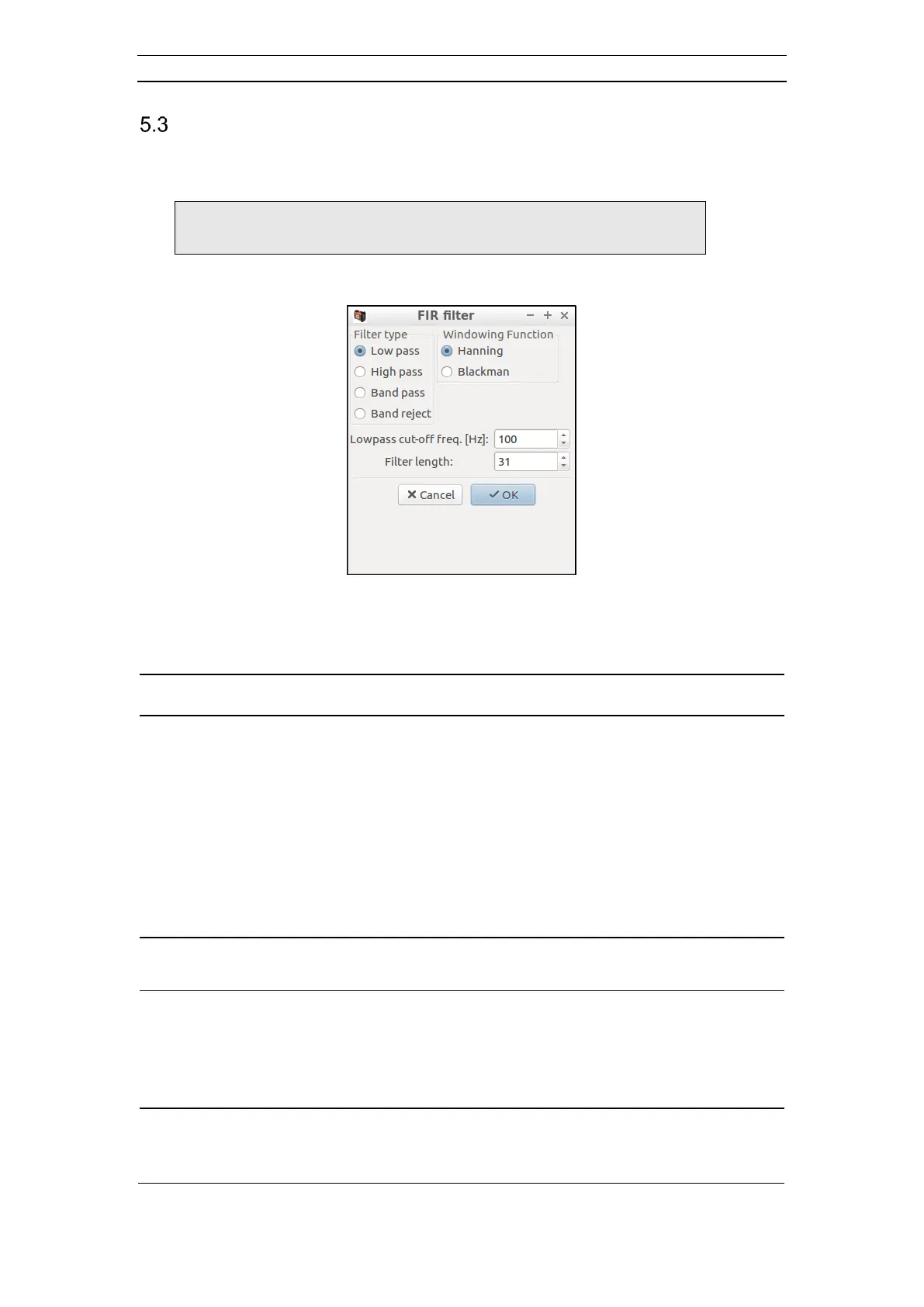
The FIR filter dialog (Figure 62) is accessed from the data Context Menu (Figure 36).
Figure 62 The FIR filter dialog
Clicking OK will apply the filter to the current data.
- Selects the type of filter to apply to data. The following types are
available:
Rejects frequencies higher than the high cut-off
Rejects frequencies lower than the low cutoff
Rejects frequencies lower than the low cut-off and higher
than the high cut-off
Rejects frequencies between the low cut-off and high
cut-off
- Data windowing function to apply to the data when filtering.
Available values are: Hanning and Blackman
- The cut-off frequencies are specified as the frequency where the pass
band signal has been reduced by 3 dB and the transition band starts.
The low- and high pass filters only specifies a single cut-off
frequency, while the band pass and band reject filters specifies two
frequencies, low- and high cut-off
- The number of filter coefficients used to realize the filter. The longer
the filter, the steeper its slope, i.e. it will cut the signal more abruptly.
A longer filter also takes longer to apply, especially to long records


 To Next Page