WISE-4610(P) User Manual 28
4.1 System Structure
LoRaWAN (Long Range Wide Area Network) system structure consists of several
key components that work together to enable long-range communication between
IoT devices. Here's an overview:
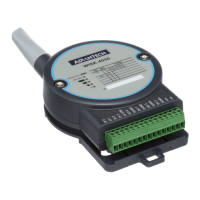
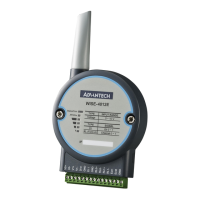
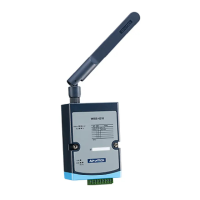
1. End Devices (WISE-4610)
Function: WISE-4610 Industrial Wireless I/O solution can connect to any kinds
of sensors or meters to collect data, such as flow, pressure, level, energy usage
for different kinds of applications
Communication: End devices use LoRa modulation to send data to gateways.
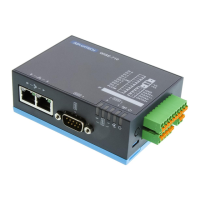
2. Gateways (WISE-6610)
Function: Gateways act as a bridge between the end devices and the network
server. They receive LoRa-modulated signals from the end devices and forward
them to the network server via a standard IP connection (e.g., Ethernet or cellu-
lar).
Communication: Gateways are typically connected to the network server
through a high-bandwidth connection, allowing them to handle multiple data
streams from various devices simultaneously.
3. Network Server (Embedded in WISE-6610)
Function: The network server manages the network, ensuring that data is cor-
rectly routed between end devices and the application server. It handles tasks
such as:
De-duplication: Ensuring only one copy of a message is processed if multiple
gateways receive the same message.
Security: Managing encryption keys and ensuring secure data transmission.
Device Management: Tracking all devices, their status, and configuration.
4. Application Server
Function: The application server processes data received from the end devices
via the network server. It interprets this data, making it available for applications,
dashboards, or triggering other actions (e.g., sending alerts).
Communication: The application server communicates with the network server
to receive data and can send commands back to the devices if necessary.



 To Next Page