22
The correction factors of the cooling
capacity and input power take account
of the presence of glycol. The water
flow rate and pressure drop correction
factors must be applied directly to the
data obtained for operation without
glycole. The water flow rate correction
factor is calculated in such a way as to
have the same ∆t that it would have in
the absence of glycol. The pressure drop
correction factor already takes account
of the different flow rate deriving from
the application of the water flow rate
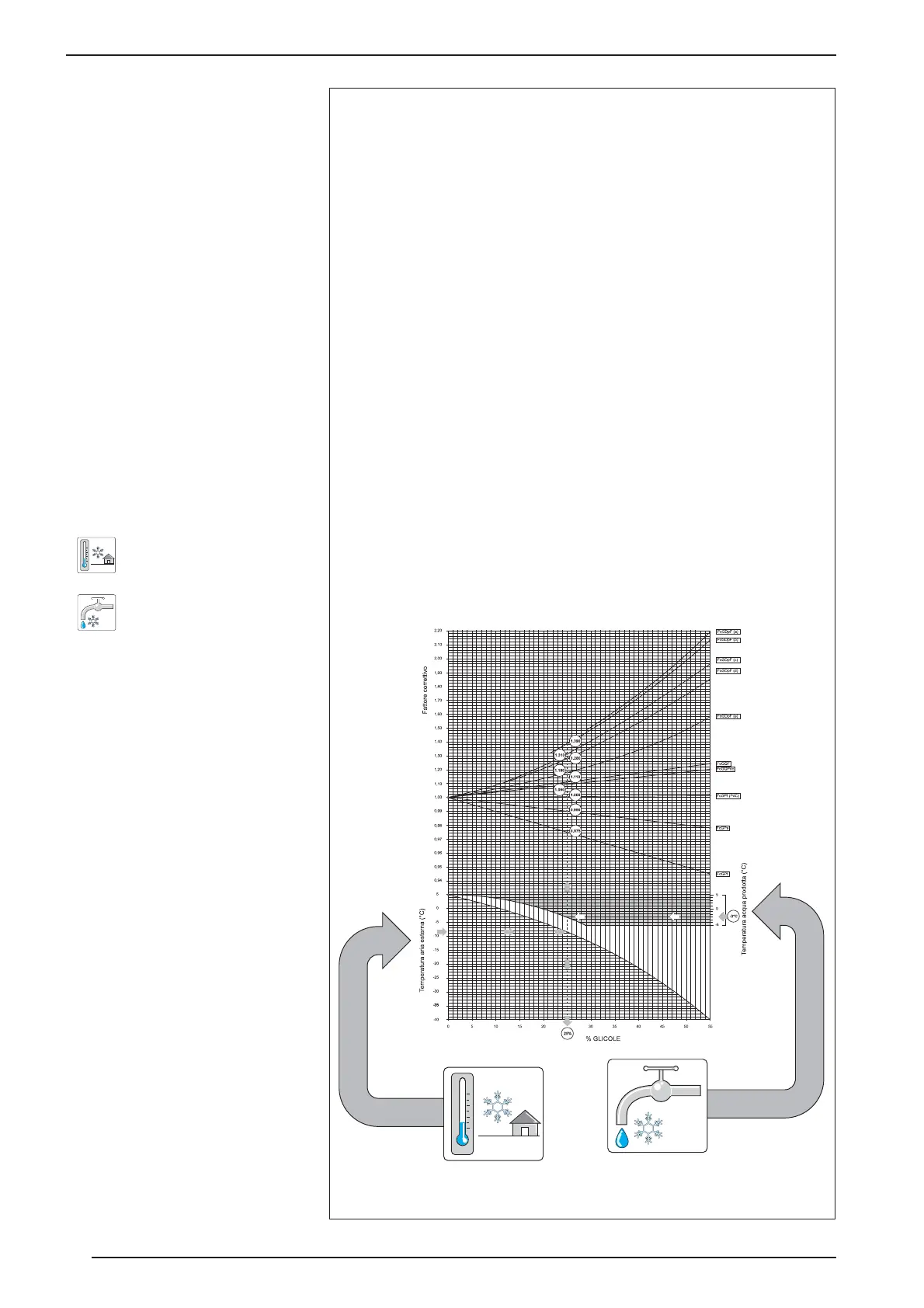
correction factor. In using the diagram
opposite it is possible to establish
the percentage of glycol necessary:
this percentage is can be calculated
by taking the following factors into
consideration:
Outside air temperature
Processed water temperature
On the basis of fluid considered (water
or air), one must enter the graph on
the right or the left-hand side, from
the intersection of the outside air
temperature or processed water lines
and the relative curves, a point is
obtained though which the vertical
line passes that shows both the glycol
percentage and the relative correction
coefficients.
fig. 03A
How to read glycol curves:
The curves shown in figure 03 subsume a considerable amount of data each of
which is represented by a specific curve, To use these curves properly it is necessary
to make some initial considerations.:
• If you wish to calculate the percentage of glycol on the basis of the outside air
temperature (figure 03A), you have to enter from the left-hand axis and once you
have intersected the curve you draw a vertical line which will intersect all the other
curves in its turn, The points obtained from the upper curves will represent the
coefficients for the correction of the cooling capacity and input power for the flow
rates and pressure drops (do not forget that these coefficients will anyway have to
be multiplied by the rated value of the size examined); while the lower axis advises
the percentage value of glycol necessary on the basis of the outside air temperature
considered.
• If you want to calculate the percentage of glycol on the basis of the processed
water temperature (figure 03A), you have to enter from the right-hand axis and
once the curve has been intersected draw a vertical line which in its turn intercepts
all the other curves; The points obtained from the upper curves will represent the
coefficients for the cooling capacity and input power for the flow rates and pressure
drops (do not forget that these coefficients will anyway have to be multiplied by the
rated value of the size examined); while the lower axis advises the percentage value
of the glycol necessary to produce water at the required temperature.
It must be remembered that the initial “Outside Air Temperature” and “Processed
Water Temperature” sizes, are not directly linked to each other therefore it will not be
possible to enter the curve of one of these sizes and get the corresponding point on
the other curve.


 To Next Page