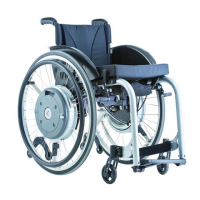
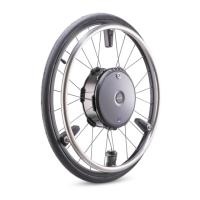
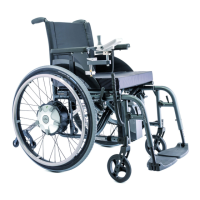
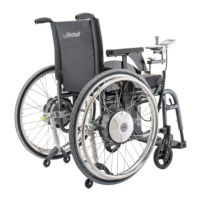
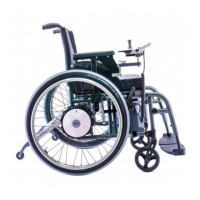
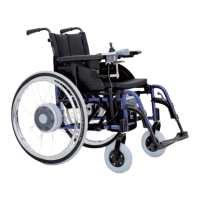
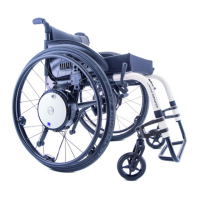
Brake the e-motion gently, uniformly, and according to your speed (not abruptly or in a jerky manner). •
White driving in vehicles, sit only on the seats installed there using the pertaining restraint systems. Disregarding these instructions •
bears the risk that both you and the other passengers could be injured in case of an accident.
Secure your wheelchair and the e-motion wheels according to the respective applicable legal stipulations and rules when driving in
•
vehicles.
When driving on public roads and paths, observe the instructions of the Highway Code and the Federal Motor Safety Standards (StVZO).
•
The e-motion is only intended for persons with limited mobility and must not be used for any other purpose, e.g. for playing children, •
carry loads or to transport goods. Do not allow children to play with the e-motion. Do not transport material or loads with the e-
motion.
Operating the e-motion in the vicinity of strong magnetic fields as they may be caused by magnetic clamps, transformers, tomography,
•
etc. is not permitted.
Do not drive the e-motion during adverse conditions, for example, during storm, snow and ice, hail and tall brushwood.
•
Always move the push rims gently, smoothly and uniformly. Never move them suddenly, abruptly or in a jerky manner. •
Observe the following after completing the ride with your e-motion:
When not in operation, switch off the e-motion straightaway to avoid unintentionally triggering a drive movement through contact with
•
the push rims and battery from self-discharging.
Apply the parking brakes of the wheelchair at each stop.
•
If possible, charge the battery pack on your e-motion after each ride. •
11.2 Requirements and instructions on using the e-motion together with the wheelchair as a seat in vehicles
The usage of a wheelchair as a seat in vehicles (e.g. cars, vans,..) is regulated by local law and the specifications of the wheelchair manu-
facturer. The combination Alber e-motion and manual wheelchair doesn’t change the behavior of the wheelchair significantly in crash situ-
ations, therefore the manual wheelchair is the leading element relating to this. Due to this we can agree to the passenger transportation in
vehicles while sitting in the wheelchair only under following conditions:
1. Local law allows the usage of wheelchairs as seats in vehicles.
2. The manufacturer of the manual wheelchair has given clearance for passenger transportation in vehicles regarding the affected
wheelchair.
3. An appropriate tie-down system for the manual wheelchair (ISO 10542), an appropriate head-rest and an appropriate belt system
(three-point safety belt) are available, respectively used in adherence to the user manual of the wheelchair and the tie-down system
4. The tie-down system doesn’t dock at the e-motion wheels.
5. The manual wheelchair used is covered in the Alber compatibility list for e-motion.
Crash tests are typically the basis for the manufacturer of wheelchairs to release a wheelchair for passenger transport in vehicles but these
crash tests (according to ISO 7176-19) don’t simulate all possible situations e.g. a side impact. Due to this we strongly recommend to
re-seat the wheelchair user in the fixed seat of the vehicle where he is protected by the safety systems of the vehicle like airbag or side
impact protection.
If the vehicle is equipped with an elevating or lift platform, use extreme caution when driving the e-motion on the platform. Drive very
slowly, gently and smoothly. Make no sudden, abrupt, or jerky movements. Always look directly into your direction of travel and avoid all
distractions.
Ulrich Alber GmbH rejects any liability for accidents and their consequences or for damages to the wheelchair or the e-motion wheels which
arise as a result of the non-observance of these requirements and instructions.
11.3 Obstacles
Overcome obstacles (e.g. curbs) only while driving backward. The maximum permitted height of the obstacle is 50 mm. Attention! When
driving over obstacles in reverse, the full function of the Alber anti-tippers is not guaranteed! Therefore, drive slowly, smoothly and care-
fully in reverse until the wheels of your e-motion touch the obstacle. Then, carefully drive over the obstacle. We recommend the assist-
ance of an accompanying person.


 To Next Page