
 Need help?
Do you have a question about the Allied Telesis AT-FS750 and is the answer not in the manual?
Provides an overview of the manual's structure and content.
Defines key terms and conventions used throughout the manual.
Details copyright, reproduction restrictions, and trademarks.
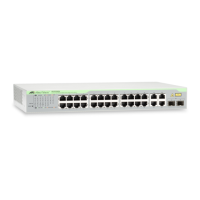
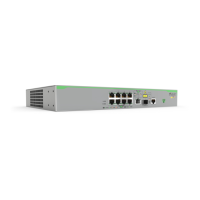
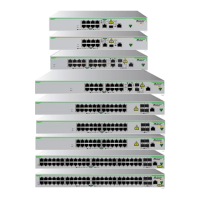
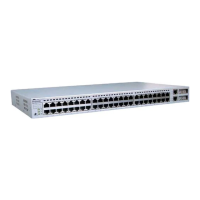
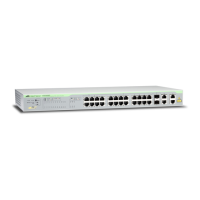
General overview of the AT-FS750/24-41 L2 Managed Switch.
Description of the physical components and indicators on the switch's front panel.
Description of the physical components on the switch's rear panel.
Instructions for unpacking the switch and verifying all included items.
Guidelines for safely installing the switch on a desktop, shelf, or rack.
Important safety instructions for operation and environmental considerations.
Steps for connecting the power cord and advice for power failure scenarios.
Lists the web browsers compatible with the switch's management interface.
Instructions on connecting a PC to the switch for web-based management.
Steps to access and log in to the switch's web management interface.
Overview of the Device Status, Function Tree, and Main Configuration Screen.
Lists the available basic system configuration functions.
View and edit general system information like hardware and firmware versions.
Create, manage, and set privileges for user accounts.
Configure the VLAN ID used for management access.
Configure the IP address, subnet mask, and default gateway for management.
Specify authorized source IP addresses and allowed services/VLANs.
Configure SNMP settings, including user/group tables and access.
Configure Secure Shell (SSH) server settings for secure remote access.
Configure Secure Sockets Layer (SSL) server settings.
Configure system logging parameters, syslog server, and logging level.
Configure SNTP for time synchronization and set the system time.
Save, restore, and erase switch configurations.
Initiate a system reboot for the switch.
Lists all available Layer 2 management functions.
Configure basic port settings, monitoring, and control parameters.
Configure VLAN modes, port settings, and static VLAN assignments.
Configure global, port-specific, and timer settings for dynamic VLANs.
Configure Multiple Spanning Tree Protocol settings and port states.
Configure Rapid Spanning Tree Protocol settings and port status.
Configure LA basic settings, port channels, and load balancing.
Configure 802.1X authentication, ports, timers, and servers.
Configure IGMP snooping, timers, interface settings, and statistics.
Configure static unicast and multicast MAC address entries.
Configure port security to control MAC address access.
Lists the available Access Control List functions.
Create and configure rules for MAC-based Access Control Lists.
Configure standard IP Access Control Lists based on IP addresses.
Configure extended IP ACLs with more granular matching criteria.
Configure classmaps to group traffic based on ACL rules.
Configure policymaps to define actions for traffic classes.
Lists the available Quality of Service functions.
Configure ingress and egress rate limits for each port.
Configure storm control to mitigate network broadcast storms.
Map 802.1p priorities to specific QoS queues.
Configure 802.1p priority for untagged packets on ports.
Map DSCP values to specific QoS queues.
Configure the scheduling algorithm for egress queues.
Lists the available Remote Network Monitoring functions.
Enable or disable the overall RMON function.
Configure and display RMON statistics for network traffic.
Configure RMON history collection intervals and parameters.
Set up RMON alarms based on variable thresholds and events.
Configure RMON events to trigger logs or SNMP traps.
Lists the categories of switch statistics available.
Display detailed traffic statistics for each port.
Display detailed Ethernet-related statistics for ports.
Display current VLAN information and member port status.
Display MSTP configuration, states, and port statistics.
Display RSTP configuration, states, and port statistics.
Display traffic and neighbor statistics for Link Aggregation ports.
Display statistics for current authenticated users.
Display traffic statistics related to the RADIUS server.
Display IGMP snooping counters and V1/V2 statistics.
Display ARP cache and ICMP statistics.
Display RMON Ethernet statistics.
Display MAC addresses learned in the L2 forwarding database.
Display SNMP traffic statistics.
 General
| Type | Fast Ethernet Switch |
|---|---|
| Layer | Layer 2 |
| Jumbo Frame Support | No |
| Operating Temperature | 0°C to 40°C (32°F to 104°F) |
| MAC Address Table Size | 8K entries |
| Power Supply | AC 100-240V, 50/60Hz |
| Weight | 2.5 kg |
| Humidity | 10% to 90% (non-condensing) |
| Storage Temperature | -40 to 70 °C |



 To Next Page