
 Need help?
Do you have a question about the Allied Telesis AT-GS950/24 and is the answer not in the manual?
Procedure to connect to the switch's web interface using its IP address, typically 192.168.1.1.
Procedure to manually configure the switch's IP address, subnet mask, and gateway address.
Create, modify, or delete user accounts and passwords for web interface access.
Procedures for rebooting the switch and resetting configuration parameters to factory defaults.
View and configure parameter settings for individual or all switch ports on one page.
Procedure to set up port mirroring by enabling the feature and selecting source and mirroring ports.
Assigns ports to tagged or port-based VLANs, displaying current VLAN assignments.
Procedure to create and delete tagged VLANs, defining VLAN ID, name, and port assignments.
Procedure to create and delete port-based VLANs, defining VLAN Index and name.
Create and delete Voice VLAN OUI settings to identify IP phones for auto-detection.
Task of selecting a root bridge based on bridge priority and MAC address.
Procedure to configure basic STP and RSTP settings, including global status and protocol version.
Configure basic RSTP port settings like STP status, priority, and path cost.
Configure MSTP parameters including global status, MST instances, region name, and timers.
Create, modify, and delete MSTP settings by mapping VLANs to MST instances.
Configure MSTP parameters for individual ports, including status, priority, and path cost.
Configure MSTP port settings such as MSTP Instance ID, Port State, Priority, and Cost.
Procedure to create a static port trunk by selecting ports and trunk status.
Change the status of a port trunk or add/remove ports from an existing trunk.
Mechanism for resolving LACP conflicts by setting a system LACP priority value.
Map CoS priorities to egress queues for traffic prioritization, requires Jumbo frame disable.
Assign port priority values (0-7) for untagged frames at ingress for switch internal processing.
Map DSCP values (0-63) to egress queues (0-3) for relevant traffic control.
Select scheduling algorithms (Strict Priority or WRR) for egress queues.
Specify packet settings for filtering Ethernet traffic by defining criteria like MAC, IP, VLAN, DSCP.
Define priority parameters for policing on DSCP (layer 3) and/or class of service (layer 2).
Specify Permit or Deny privilege for packets in the ingress queue based on Profile Action Index.
Configure DHCP Snooping feature, including Option 82, MAC address verification, and database backup.
Configure Loopback Detection feature to detect and disable ports with connected Tx/Rx pairs.
 General
| Brand | Allied Telesis |
|---|---|
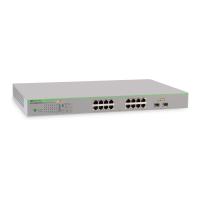
| Model | AT-GS950/24 |
| Category | Network Router |
| Language | English |





 To Next Page


