
 Need help?
Do you have a question about the Allied Telesis AT-GS950/8 and is the answer not in the manual?
Details the steps to connect to the switch's web management interface using a browser.
Guides manual IP configuration, subnet mask, and gateway settings for the switch.
Details enabling/disabling the switch's DHCP client for automatic IP configuration.
Covers creating, modifying, and deleting user accounts and passwords for access.
Guides viewing and configuring individual or all switch port parameters.
Details setting up port mirroring by selecting source and mirroring ports.
Guides assigning ports to tagged or port-based VLAN modes.
Details creating and deleting tagged VLANs, including VLAN ID and name.
Guides creating port-based VLANs, assigning VLAN Index, name, and ports.
Details how bridges select a root bridge based on priority and MAC address.
Guides configuring basic STP/RSTP protocols and viewing feature settings.
Details configuring basic RSTP port settings like STP Status, Priority, and Path Cost.
Guides configuring MSTP parameters like Global MSTP Status, Instances, and Region Name.
Details creating, modifying, and deleting MSTP VLAN mappings to MST instances.
Guides configuring MSTP parameters for each port, including Point-to-Point, Edge Port, and MSTP Status.
Guides creating a static port trunk by selecting ports and trunk status.
Details setting the priority value for LACP ports to manage active/standby states.
Guides assigning port priority values to influence traffic handling based on CoS.
Guides selecting the egress queue scheduling algorithm (Strict Priority or WRR).
Guides specifying packet settings like MAC, IP, VLAN, and protocol for traffic filtering.
Defines priority parameters for policing DSCP and CoS levels on packets.
Guides specifying Permit or Deny privilege for packets in the ingress queue.
Guides specifying Permit/Deny privilege and bandwidth restrictions for egress queue packets.
Guides creating filtering policies by defining classifier, action, and port list indexes.
Details setting bandwidth levels and status for restricting traffic into a port.
Details setting bandwidth levels and status for restricting traffic out of a port.
Guides adding static unicast MAC addresses to the table and assigning port members.
Guides configuring DHCP Snooping status, Option 82 handling, and MAC address verification.
Guides configuring specific switch ports as trusted or untrusted for DHCP Snooping.
Guides enabling IGMP snooping and setting the age-out timer for MAC addresses.
Explains port-based access control using IEEE 802.1x for user authentication.
Guides creating and deleting SNMPv1/v2 user and group names for community definitions.
Covers creating SNMPv1/v2 community names to control access and permissions.
Guides creating SNMPv3 user and group names, specifying authentication and privacy protocols.
Guides creating entries in the SNMPv3 View Table for MIB object access criteria.
Guides enabling or disabling the RMON feature, requiring SNMP agent activation.
Guides upgrading the switch's firmware image using an HTTP server.
Guides upgrading the switch's firmware image using a TFTP server.
Details downloading or uploading configuration files using HTTP.
Details downloading or uploading configuration files using TFTP.
Guides configuring Loopback Detection feature, enabling/disabling it globally and per port.
 General
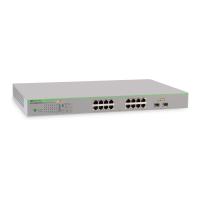
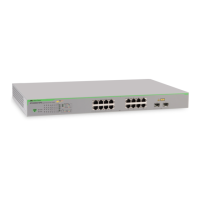
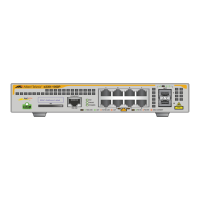
| Ports | 8 x 10/100/1000BASE-T |
|---|---|
| Switching Capacity | 16 Gbps |
| Forwarding Rate | 11.9 Mpps |
| MAC Address Table Size | 8K |
| Power Supply | Internal AC power supply |
| Operating Temperature | 0°C to 40°C (32°F to 104°F) |
| Uplink Ports | 2 x 1000BASE-X SFP |
| Jumbo Frame Support | 9K bytes |
| Dimensions | 440 x 44 mm |
| Storage Temperature | -40 to 70 °C |
| Humidity | 10% to 90% non-condensing |





 To Next Page


