Chapter 5 Detailed Function Introductions
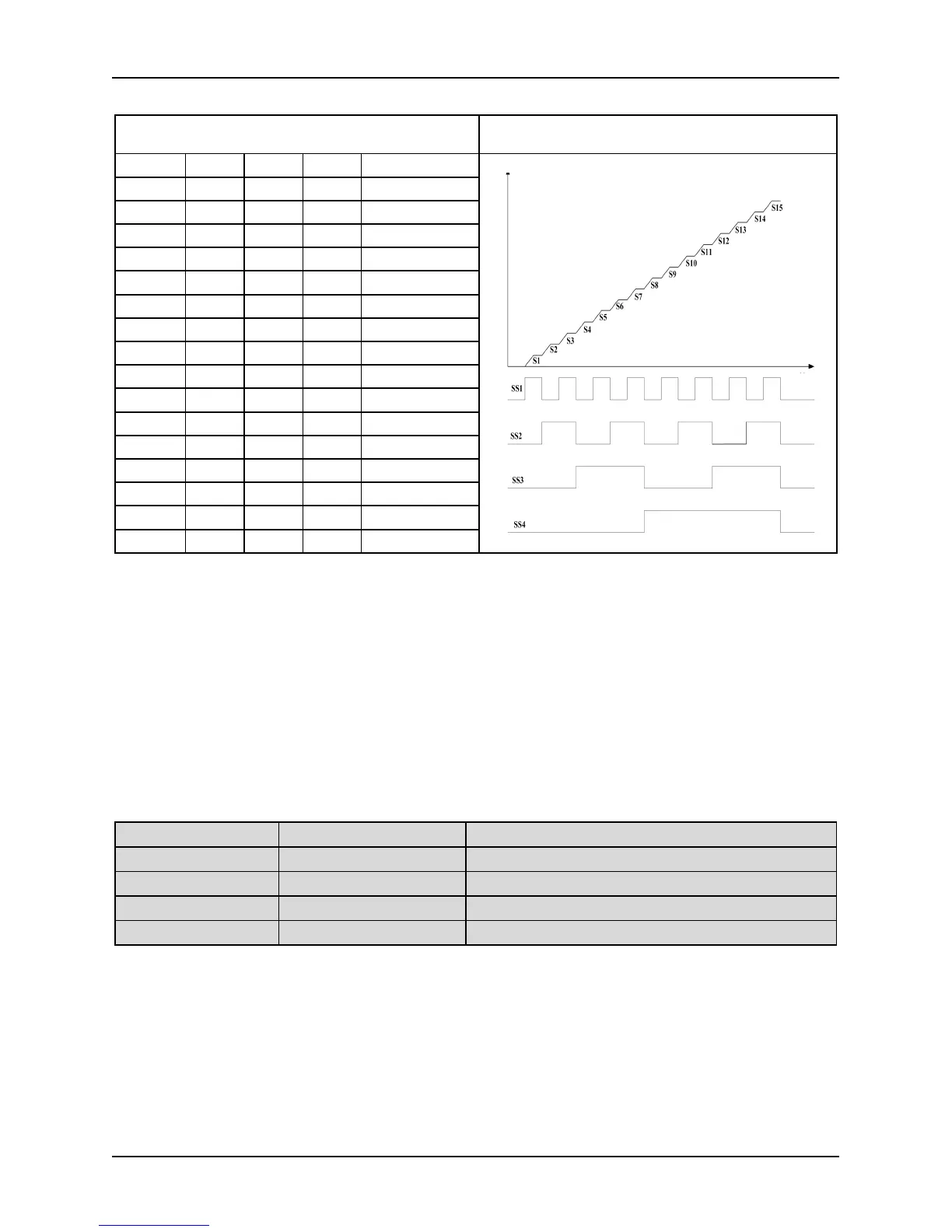
Table 5-3-2 Multi-stage frequency
If one or more terminal(s) among the 4 terminals is (are) not set, the terminal(s) not set is (are) default as OFF. Allow
duplicate definitions, among repeatedly defined terminals, when one terminal is active, this function is enabled.
If you define both S1 ~ S7 and SS1 ~ SS4 at the same time, then terminals S1 ~ S7 take precedence.
25: Command to switch to the terminal control 2, when this function is enabled, the command channel is switched to
terminal control 2.
79: Command to switch to the keypad control, when this function is enabled, the command channel is switched to
keypad control.
30~35: Default acceleration and deceleration
T1 ~ T4: individually specify the acceleration and deceleration time during running. If two or more
acceleration and deceleration times are active, the terminal of smaller number takes precedence.
TT1 ~ TT2: Combination specifying the acceleration and deceleration time of the running time. As shown in
Table 5-3-3.
Table 5- 3- 3
T2 TT1 The selected acceleration and deceleration time
OFF OFF Acceleration and deceleration time 1
OFF ON Acceleration and deceleration time 2
ON OFF Acceleration and deceleration time 3
ON ON Acceleration and deceleration time 4
If simultaneity defined T1~T4 and TT1~TT2, T1~T4 is prior.
37~40: External fault signal / External interrupt signal (normally open / normally close
EH0 - External fault signal normally open / EH1 - External fault signal normally close: External fault
command. If the setting is 37-40, the fault signal of external equipment can be input by the terminal. Once the
inverter receives the fault signal, it stops output immediately, and displays last fault code. After the external
fault signal is removed, the inverter needs to be reset before restarting. Tips: Inverter can’t reset if external
fault signal isn’t released. EH0 and EH1 are not influenced by P3.00 (Terminal function mode), Shown in
Figure.5-3-6.


 To Next Page