HPF (High Pass Filter): intercepts lower
frequencies a nd allows higher freque ncies to
pass.
LPF (low pass filter): intercepts higher
frequencies and allows lower freque ncies to
pass.
Slope: th e level cha nge of one-octave
frequency change (dB ).
The larger the slope value, the steeper the
slope.
Do n ot use t weeters that have not set HPF to
on or have been set to low frequencies,
otherwise the speakers may be da maged
due to low freque ncy content.
The frequency of the divider cann ot be
adjusted to be hi gher than HPF or lower than
LPF.
It should be a djusted according to the
recommended crossover frequency of the
connected speakers. Please determine the
recommended crossover frequency of the
speaker. Adjusting beyond the
recommended frequency range may damag e
the s peakers.
We are not responsible for speaker damage
or malfunction caused by using a crossover
beyond the recommen ded value.
About T ime Correction
The distance between the listener and the
speakers in t he car ca n vary greatly due to the
complex speaker placement. This difference in
distance bet ween the speaker and th e listener
will cause deviations in the sound image and
frequency characteristics. This phenomenon is
caused by the t ime delay for the sound to reach
the listener's right an d left ears.
To solve thi s problem, this unit can delay the
audio s ignal sent to the speaker close st to t he
listener. This can effectively create a feeling of
extended distance for these speakers. The
distance bet ween the listener an d the left and
right speakers can be equal to obtain the best
results. Each speaker will be adjusted wit h
3.4cm as a step difference.
Examples of listening positions are as follows:
Example 1: Front left s eat
Adjust th e time correction level of th e left front
speaker to a larger value, and adjust the right
rear speaker to zero or a smaller value.
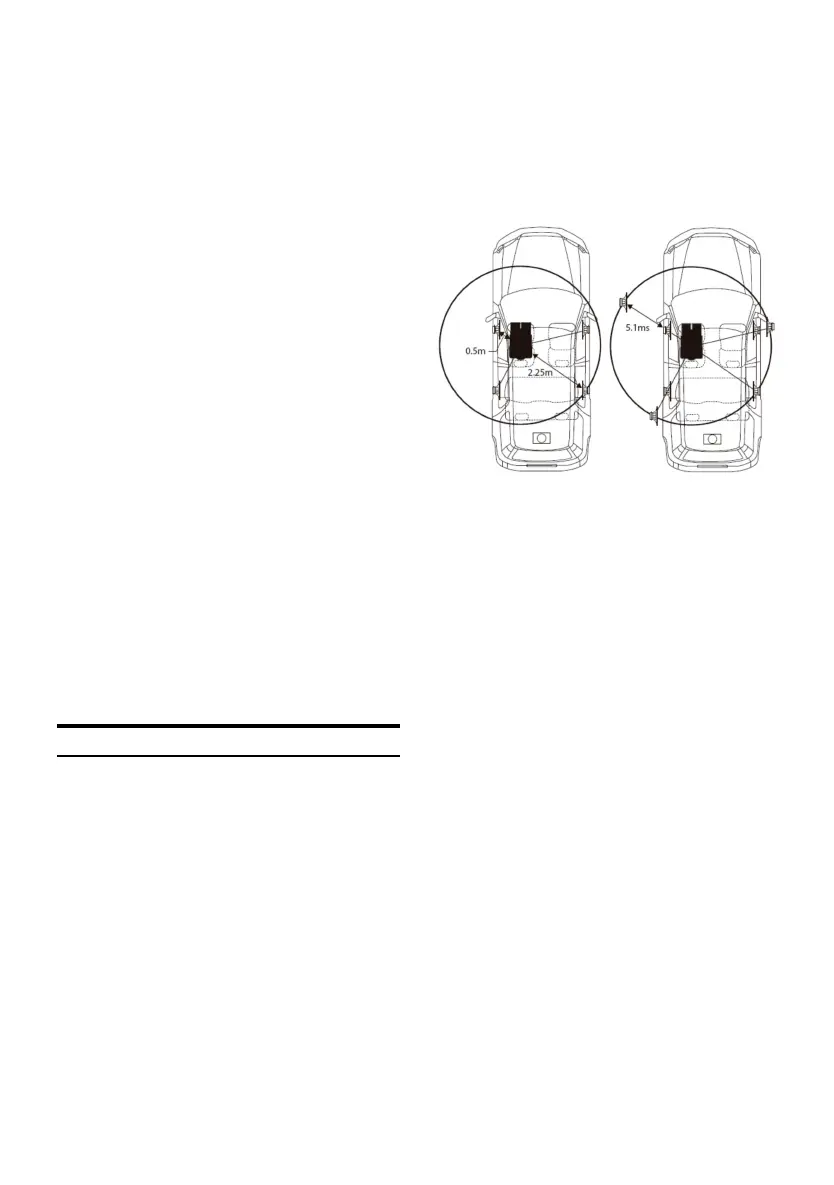
he distance between the listening posit ion and
each speaker is different, so the s ound i s
unbalanced.
The distance difference between the front left
speaker an d the rear right speaker is 1.75m
(68-7/8").
Here we will ca lculate th e time correction value
of t he left front s peaker in t he figu re a bove.
condition:
The farthest spea ker-listening posi tion:
2.25m (88-9/16" )
Left front speaker-listening position: 0.5m
(19-11/16")
Calculation: L=2.25m– 0.5m=1.75m (68-7/8")
Time correction=1.75÷343*×10 00=5.1(ms )
* Speed of sound : 34 3m/s (765mph) at 20 ℃
In other words, setting the time correction
value of the front left speaker to 5.1ms can
make the distance bet ween it and the listener
seem to be th e same as the distance bet ween
the listener and the farthest speaker. Time
correction can eliminate the time difference
required for the sound to reach the listening
position.
The time of the left front speaker is corrected
by 5.1ms, so that its sound will reach the
listening position at the same time as the


 To Next Page