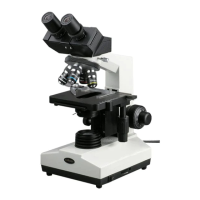
The AmScope 330 Series is a line of precision microscopes, including models B330 and T330, designed for detailed observation and analysis. These microscopes are suitable for various applications, from educational settings to professional laboratories, offering robust construction and versatile features.
Function Description:
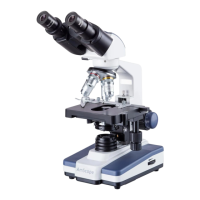
The primary function of the AmScope 330 Series microscopes is to magnify small specimens, allowing users to observe intricate details not visible to the naked eye. The B330 model features a binocular head, providing comfortable viewing through two eyepieces. The T330 model, on the other hand, is equipped with a trinocular head, which includes two eyepiece tubes and a third photo port on top. This trinocular port allows for simultaneous viewing through the eyepieces and attachment of a digital or video camera for image capture, video recording, or live display on a computer or television. The microscopes utilize a light source directed towards the slide, with adjustable illumination and focusing mechanisms to achieve clear and detailed images at various magnifications.
Important Technical Specifications:
General:
- Models: B330 (Binocular), T330 (Trinocular)
- Power Supply: 100V~224V, 50/60Hz
- Operating Temperature: 32-100 degrees F (0-40 degrees C)
- Maximum Relative Humidity: 85%
- Mechanical Tube Length: 165mm
- Object to Primary Image Distance: 195mm
- Fine Focusing Sensitivity: 0.002mm
Eyepieces:
- Standard Extreme WF Eyepieces: WF10X/23mm (included in B/T330, B/T330A, B/T330B, B/T330C models)
- Optional Eyepieces:
- 20x (EP20X30) for 80x, 200x, 800x, and 2000x magnification
- 25x (EP25X30) for 250x and 2500x magnification
- 10x w/ Pointer (EP10X30P) for easier object identification
- 10x w/ Reticle (EP10X30R) for measuring objects
- Field of View: Ф0.8mm~Ф4.5mm
Objectives:
- DIN Achromatic Objectives:
- 4X/0.10 (PA4X-INF)
- 10X/0.25 (PA10X-INF)
- 40X(spring)/0.65 (PA40X-INF)
- 100X(spring, oil)/1.25 (PA100X-INF)
- DIN Plan Objectives (Optional):
- Plan 4X (PL4X/.10)
- Plan 10X (PL10X/0.25)
- Plan 40X (PL40X/0.65)
- Plan 100X (PL100X/1.25)
- Parfocal Distance: 45mm for all objectives
- Magnification Marks (Color Ring): Red (4X), Yellow (10X), LightBlue (40X), White (100X)
Viewing Head:
- 45 Degree Viewing Head:
- Binocular Sliding, 360 Degree Swiveling (for B- models)
- Trinocular Sliding, 360 Degree Swiveling (for T- models)
- Adjustable Interpupillary Distance: 52-75mm
Trinocular Port (T330 models only):
- C-Mount Photoport: For attaching C-mount cameras
- 23mm Photo Port: For attaching 23mm mounting size cameras
Focusing:
- Coaxial Focusing System: For precise focusing
- Coarse Focusing Knob: For initial focus adjustment
- Fine Focusing Knob: For refining focus to a clear image
Nosepiece:
- Quadruple Nosepiece: Houses the objective lenses
Stage:
- Mechanical Stage: 120mm x 110mm
- Movement Range: 70mm x 30mm
- Stage Clip: Secures the slide in place
- Limit Stop Knob: Limits upward movement of the mechanical stage to prevent damage
Condenser & Diaphragm:
- Condenser: Abbe, NA=1.25
- Iris Diaphragm: Controls the amount of light hitting the slide
- Condenser Up/Down Knob: Adjusts distance between condenser and stage
Illumination:
- Lamp: 6V/20W Halogen (standard) or LED (optional)
- Dimmer: Controls the amount of light escaping from the base lens
- Filters: Blue/Green (standard), Blue (optional)
Magnification Range:
- -A Model: 40x-1600x
- -B Model: 40x-2000x
- -C Model: 40x-2500x
Optional Cameras:
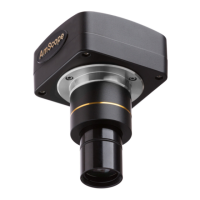
- CMOS Digital Cameras: MU035 (350k), MU130 (1.3mp), MU300 (3mp), MU500 (5mp), MU800 (8mp), MU900 (9mp), MU1000 (10mp) for image/video capture and live display on PC/Mac OS X.
- CCD Digital (VGA, Trinocular Only): CCD-MT for live display on a computer monitor (VGA).
- CCD TV/Video (Trinocular Only): CCD-NP for live display on a television (RCA).
Optional Accessories:
- Calibration Micrometer (MR400): To calibrate camera software for on-screen measurements.
- Stage Warmer (TCS-100): For controlling stage temperature.
Usage Features:
- Assembly: The microscope is designed for straightforward assembly. Users need to attach the head, eyepieces, and objectives. The head lock screw secures the microscope head, and the condenser screw secures the condenser.
- Diopter Adjustment: Allows individual focus adjustment for each eye, ensuring a clear image for users with different visual acuities. The diopter adjustment ring has ±5 diopters.
- Interpupillary Distance Adjustment: The binocular and trinocular heads can be adjusted from 52mm to 75mm to match the user's eye distance, providing a single, comfortable field of view.
- Focusing: Coarse and fine focusing knobs allow for initial and refined image clarity. The limit stop knob prevents the mechanical stage from moving too high, protecting slides and objectives from damage.
- Specimen Placement: Slides are placed on the mechanical stage and secured by metal clips. The mechanical stage controls allow for precise movement of the slide along X and Y axes to center the specimen.
- Illumination Control: The dimmer knob adjusts the light intensity. The condenser up/down knob and iris diaphragm slider control the concentration and amount of light hitting the slide, optimizing brightness and contrast.
- Filter Usage: A swiveling filter holder allows for the insertion of color filters to enhance observation.
- Camera Attachment (T330 only): The trinocular port accommodates C-mount cameras directly or 23mm mounting size cameras by removing the C-mount. The middle portion of the tube can be turned to focus through the trinocular port.
- Simultaneous Viewing (T690 model mentioned in manual): Some trinocular models allow simultaneous viewing through eyepieces and the photo port, though magnification may differ if not using 20x eyepieces to match the camera.
Maintenance Features:
- Cleaning:
- All glass surfaces must be kept clean. Fine dust should be blown off with a hand blower.
- Lenses should be gently wiped with a soft lens paper tissue/nonabrasive lint-free cloth.
- Oil or fingerprints on lens surfaces should be removed with tissue moistened with a small amount of lens cleaner (Sparkle brand optical cleaner recommended).
- Do not use harsh chemicals or solvents on painted surfaces.
- Storage: Keep the microscope indoors in a dry and clean place, away from direct sunlight or high heat. Store with the provided dust cover.
- Bulb Replacement:
- For halogen bulbs, ensure the power is off and the unit is cool before changing. Pull out the electrical socket and wait for the lamp to cool down.
- Access the bulb by removing the door at the bottom of the microscope.
- Ensure the correct wattage bulb (6V/20W for halogen) is used to prevent damage.
- Fuse Replacement:
- Ensure the power is off and disconnected.
- Unscrew the fuse housing at the bottom of the microscope and replace with a new one.
- Troubleshooting: The manual provides a comprehensive troubleshooting guide for common issues, including:
- Optical Issues: Image color incorrect (due to filters or condenser height), stains/dust on lenses/condenser/eyepieces.
- Mechanical Issues: Objective touching cover slip (incorrect cover slip size, limit-stop setting), slide not moving smoothly (not secured, mechanical stage not secured), focusing knobs not raising stage (limit-stop engaged).
- Electrical Issues: Bulb flickering (bulb near end of life), microscope not lighting up (unplugged, bulb not inserted correctly, bulb burned out, fuse burned out, incorrect voltage, wrong bulb wattage).
- For circuit board malfunctions (LED models), professional repair is recommended.
- Handling: The microscope is a precision instrument and should be handled with care, avoiding impact or abrupt movement during transportation.
- Technical Support: AmScope offers support via email (info@amscope.com) for additional questions or assistance. Users are encouraged to familiarize themselves with the manual before operation and keep it for future reference.

 Need help?
 General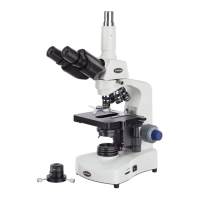


 To Next Page