134
Exercise T - Temperature input with time proportional
control
Objective
To control the temperature in the process vessel using a time-proportional controller
connected to a temperature sensor, with a heating element raising the temperature of
the fluid within the vessel.
Overview
The control system in this exercise consists of a temperature sensor with an output
proportional to the temperature detected by the sensor. The output is sent to a time
proportional controller which switches the power supply to the heating element on or
off. The time proportioning controller turns the output on and off at intervals. This
ratio of time “on” to time “off” may be set manually, or may be set automatically by
the controller which then varies the ratio according to the difference between the
current control variable and the required Set Point value.
Equipment Required
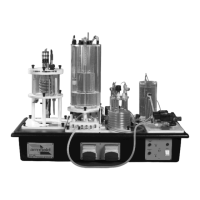
PCT40 bench with small process vessel containing a heating coil.
Equipment set up
Ensure that the apparatus has been set up according to the Installation section. The
lid with heating coil should be in position on the small process vessel, with the coil
surrounding the heating element. The PC should be connected to a suitable PC on
which the PCT40 software has been installed using the grey USB cable supplied.
Switch on mains power to the apparatus.
Run the PCT40 software and select ‘Section 6: Temperature Control (direct
continuous heating)’.
Fill the small process vessel with water:
Using a length of tubing with a quick release fitting at both ends, connect the PSV to
the upper fitting on the side of the small process vessel. Ensure that the lower fitting
on the side of the process vessel is not connected.
Close the drain valve on the process vessel.
In the software, set the PSV to 100% and watch as the small process vessel fills with
water.
Wait until the coil inside the vessel is fully covered with water, then set the PSV to
0%.
Check that the drain valve on the end of the plinth is open and that it is connected to
a suitable drain.
Select a second length of tubing with a self-sealing fitting on one end and an open
end at the other, and direct the open end to a suitable drain. Connect the quick-
release fitting to the lower connection on the side of the small process vessel. Water
will drain from the free end. Half close the drain valve on the end of the tube.


 To Next Page