139
Exercise U - Proportional temperature input with PID
control
Objective
To control the temperature in the process vessel with PID control of a heating
element, using a temperature sensor to monitor the temperature.
Overview
As for time proportional control, the temperature sensor sends a signal to the
controller that varies with the temperature of the sensor. The controller sends a
signal to the heater that is proportional to the signal from the sensor. The heater
power may only be on or off, so the controller varies the time for which power is
supplied to the heater.
PID control adds two extra control parameters, Integral and Derivative, which may
already have been investigated in the Level Control exercises:
With proportional control action, the controller produces a signal that is proportional
to the error (the difference between the monitored variable and the set point value).
This creates an offset between setpoint value and actual value (the controller only
supplies an output when there is an error, so there is no controller output when the
value is not at the set point). It also generates an overshoot (the system will oscillate
above and below the setpoint value at the start of the control period until stability is
attained).
With integral control action, the controller gives an output that is proportional to the
time integral of the error. Integral control action can potentially be used alone to
control a process, but is normally used in conjunction with proportional action. When
used with proportional action it can eliminate offset. It can also cause higher
maximum deviation and a longer response time than with proportional action alone.
With derivative control action, the controller gives an output that is proportional to the
derivative of the rate of change of the error. The output is related only to the rate of
change, not to the magnitude of the error. Derivative control action cannot be used
alone, but must be combined with another action such as proportional control action.
When used with proportional action, derivative control can eliminate excessive
oscillation. It cannot eliminate offset errors inherent in proportional action
Proportional, integral and derivative control actions may be combined to eliminate
offset, reduce maximum deviation and minimise the frequency of oscillation. Finding
the optimum values of P, I and D for a particular process is often referred to as tuning
or optimisation.
Equipment Required
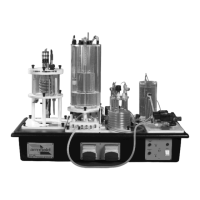
PCT40 bench with small process vessel containing a heating coil.
Equipment set up
Ensure that the apparatus has been set up according to the Installation section. The
lid with heating coil should be in position on the small process vessel, with the coil
surrounding the heating element. The apparatus should be connected to a suitable
PC which has the PCT40 software installed, using the grey USB cable supplied.
Fill the small process vessel with water:


 To Next Page