Armfield Instruction Manual
92
Effect of Vessel Volume
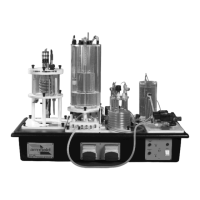
In the software, close the valve SOL1. This will stop flow into the large process
vessel.
Fully open the drain valve in the base of the large process vessel and allow the water
to drain from the vessel.
Carefully remove the lid on top of the large process vessel and remove the inner
cylinder. This increases the effective volume of the process vessel.
Replace the lid and partially close the drain valve.
Repeat the procedure described at the start of the exercise, remembering to create a
new results sheet before commencing data logging.
If there is sufficient laboratory time then the investigations of Set Point value, feed
rate, inlet/outlet flow rates and cycle time may be repeated at this increased volume.
Results
For easy identification or results, it is suggested that each results sheet is renamed
with a descriptive title (e.g. ‘Flowrate’, ‘Volume’, etc.). The entire workbook should be
saved with a suitable filename for future reference (e.g. PCT40 Exercise I).
Each set of data should be plotted on a graph of fluid level against time.
Make a comparison of each variation in the experimental conditions against the
graph of the initial set of results, noting the difference in response.
Give examples of industrial control situations in which each type of variation in
starting conditions might occur. For each example, consider the suitability of the
switch and type of controller used for that particular application.


 To Next Page