Arturia MiniBrute User's Manual 26 6 Legal notes
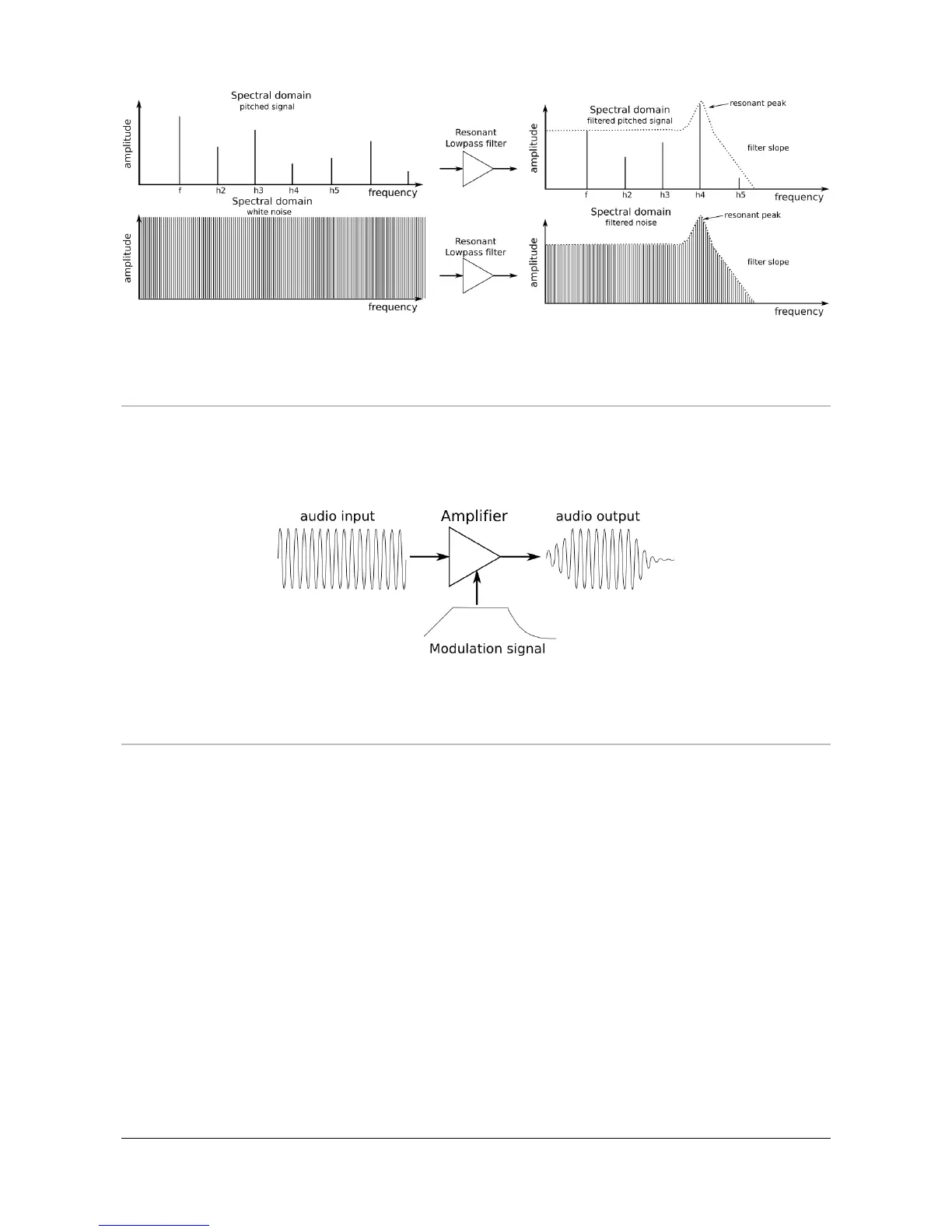
4.1.4 Amplifier
The amplifier generally follows the filter, and determines the signal’s overall
amplitude. Its gain is controllable through various modulation sources such as an
LFO, envelope generator, or some kind of external control (like a foot-pedal). The
amplifier is primarily responsible for shaping a sound’s dynamics.
4.1.5 Modulators
Modulators provide signals that are designed specifically to control the behavior of
oscillators, filters and amplifiers. Unlike audio oscillators, modulators are low-
frequency signals. For example, when you sing with vibrato, you are “modulating”
your voice with a low-frequency change in pitch, typically around 5Hz or so. The
tremolo circuit in a guitar amplifier modulates the amplifier’s level.
Modulators are useful to create dynamic pitch changes (like “wobulation” or
creating chirps), timbre sweeps, and level variations. The main modulators are the
LFO (low frequency oscillator) and envelope generator, but they can also be
provided by external sources that generate control voltage (CV) signals that
provide modulation, and gate signals that turn modulators or notes on and off.
An LFO is low frequency oscillator that can produce various waveforms at sub-
audio frequencies (0.05Hz up to 100Hz). In general the waveform options are sine,
sawtooth, square, random steps, and random waves. These waves’ amount and
polarity (i.e., whether they go positive or negative) can be controlled before being
fed to the target devices.



 To Next Page