Arturia MiniBrute User's Manual 31 6 Legal notes
[4.2.6.4] in the front panel’s LFO section.
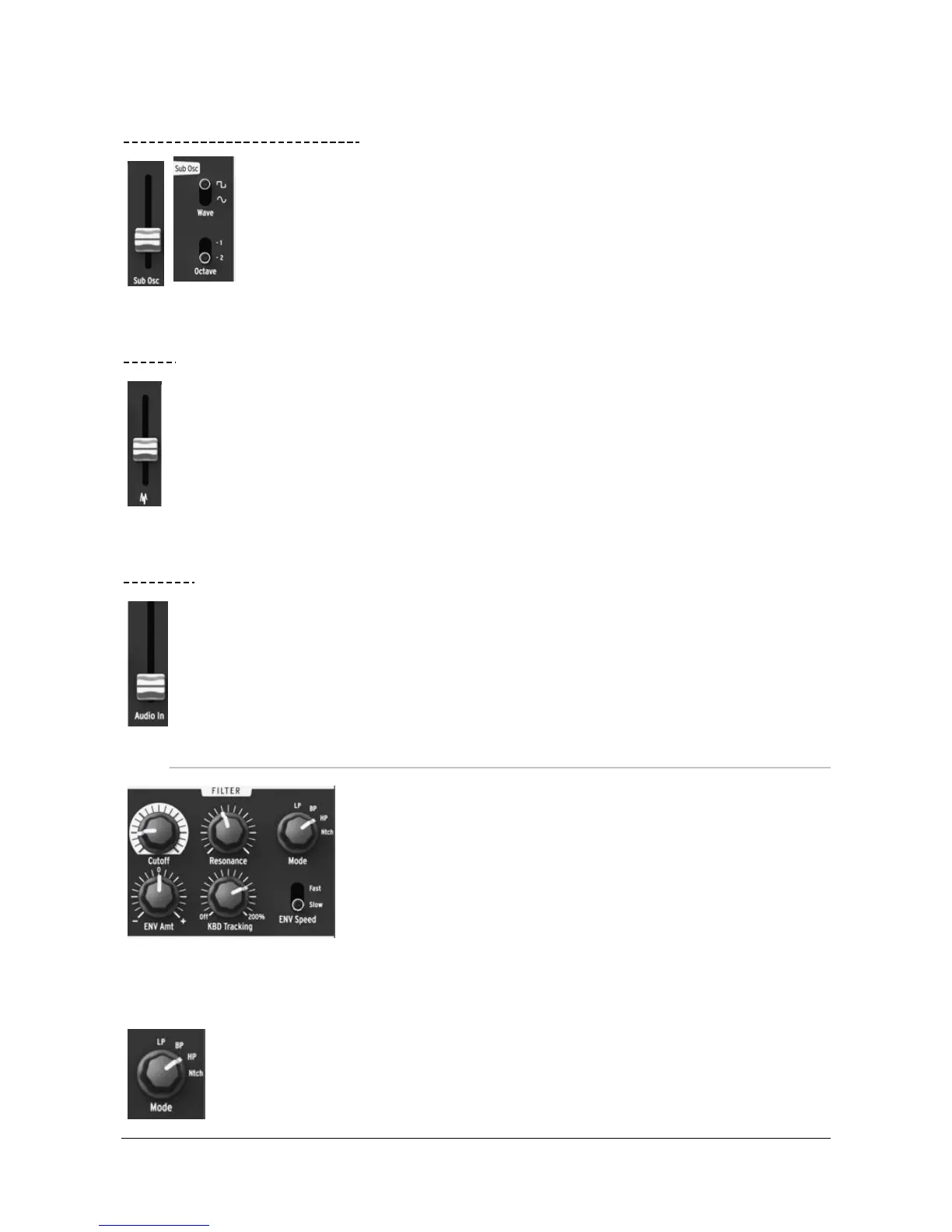
The sub-oscillator (Sub Osc)
The Sub-oscillator level is controlled with the slider potentiometer
labeled Sub Osc. Pulling it down completely mutes the sub-bass
signal and moving it up increases its level. The Sub Osc Section
contains two toggle switches. The Wave switch selects the sub-
oscillator’s waveshape, which can be either a square wave (grinding
sub-bass sounds) or a sine wave (deep mellow sub-bass sounds). The
Octave switch sets the sub-bass to either one octave (-1) or two octaves (-2)
below the oscillator’s pitch.
Noise
The signal mixer also provides the control of other signals which aren’t
generated by the Oscillator. The Noise slider potentiometer adjusts the
amount of white noise signal sent to the filter. Mixing a small amount of noise
with oscillator waves creates a kind of breathing, natural quality. For example,
mixing the Triangle wave with a small quantity of noise creates a credible
flute sound. Noise is also useful on its own to create various special effects or
nature sounds such as wind, water streams, and rain, as well as percussive
sounds such as cymbals.
Audio In
The Audio In slider potentiometer adjusts the amount of an external audio
source (guitar, microphone, etc.) that can be plugged into the MiniBrute
signal chain via the rear panel Audio In jack [4.3.3]. This makes it possible to
process an external audio signal with the filter and amplifier; also note that
this signal can trigger the envelopes.
4.2.2 The filter
The filter alters the oscillators’ timbre via the four response
modes described previously (LP, BP, HP & Notch). Its
cutoff and resonance can be adjusted manually. The
cutoff can also be controlled by the keyboard and
modulated by various modulation generators. The
MiniBrute filter is based on Nyle Steiner’s Sallen & Key
architecture (designed in the 70s) and offers -
12dB/octave slopes in LP and HP modes, and -
6dB/octave slopes in BP and Notch modes.
4.2.2.1 Mode
This selects among the four filter modes: LP (low-pass), BP (band-pass),
HP (high-pass), and Notch. The LP mode is the most commonly-used,
and provides sounds which are full/fat and round. The BP and HP modes
provide thinner and harsher sounds. When modulated by the LFO, the



 To Next Page