Arturia MiniBrute User's Manual 28 6 Legal notes
key after it’s down. You can use this signal to modulate vibrato, filter cutoff,
and other parameters.
Velocity corresponds to the dynamics of your playing, and similarly to
aftertouch, can modulate multiple parameters.
Transposition allows shifting the keyboard’s note range over six octaves.
The pitch bend wheel allows adding real-time pitch changes, like bending
strings on a guitar.
The modulation wheel allows applying real-time modulation changes to
various parameters. For example, it could add vibrato, or change the filter
cutoff as you move it.
An arpeggiator automates the creation of repeating sequences of notes.
Alternative ways of playing the synthesizer are available through MIDI control and
external CV/GATE signals.
4.1.7 Inputs and outputs
In order to hear the MiniBrute, its audio output needs to connect to an audio
amplifier either directly or through a mixer console (or use the Headphones
output).
As to control, the MiniBrute can accept control voltage signals from devices like an
analog step sequencer or MIDI controller (e.g., a MIDI drum pad or wind
controller), or even audio signals from an external sound source such as a
microphone or electric guitar.
The means to control other instruments, or be controlled by other instruments, is
provided by the collection of inputs and outputs such as MIDI in and out, an
external audio input, and CV and GATE inputs and outputs.
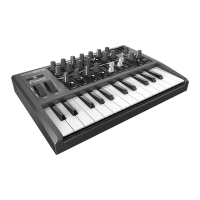
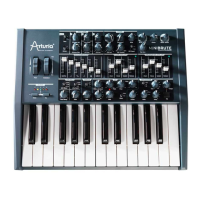
4.1.8 MiniBrute diagram



 To Next Page