Arturia MiniBrute User's Manual 35 6 Legal notes
on the keyboard or by the Arpeggiator). With this knob fully counter-clockwise,
there is no glide and the note pitch transitions instantly to the next note. Turning this
knob clockwise increases the portamento effect. At the maximum setting, it takes
approximately 4s to glide from the lowest C of the MiniBrute keyboard to the
highest C (two octaves above).
4.2.5 Vibrato
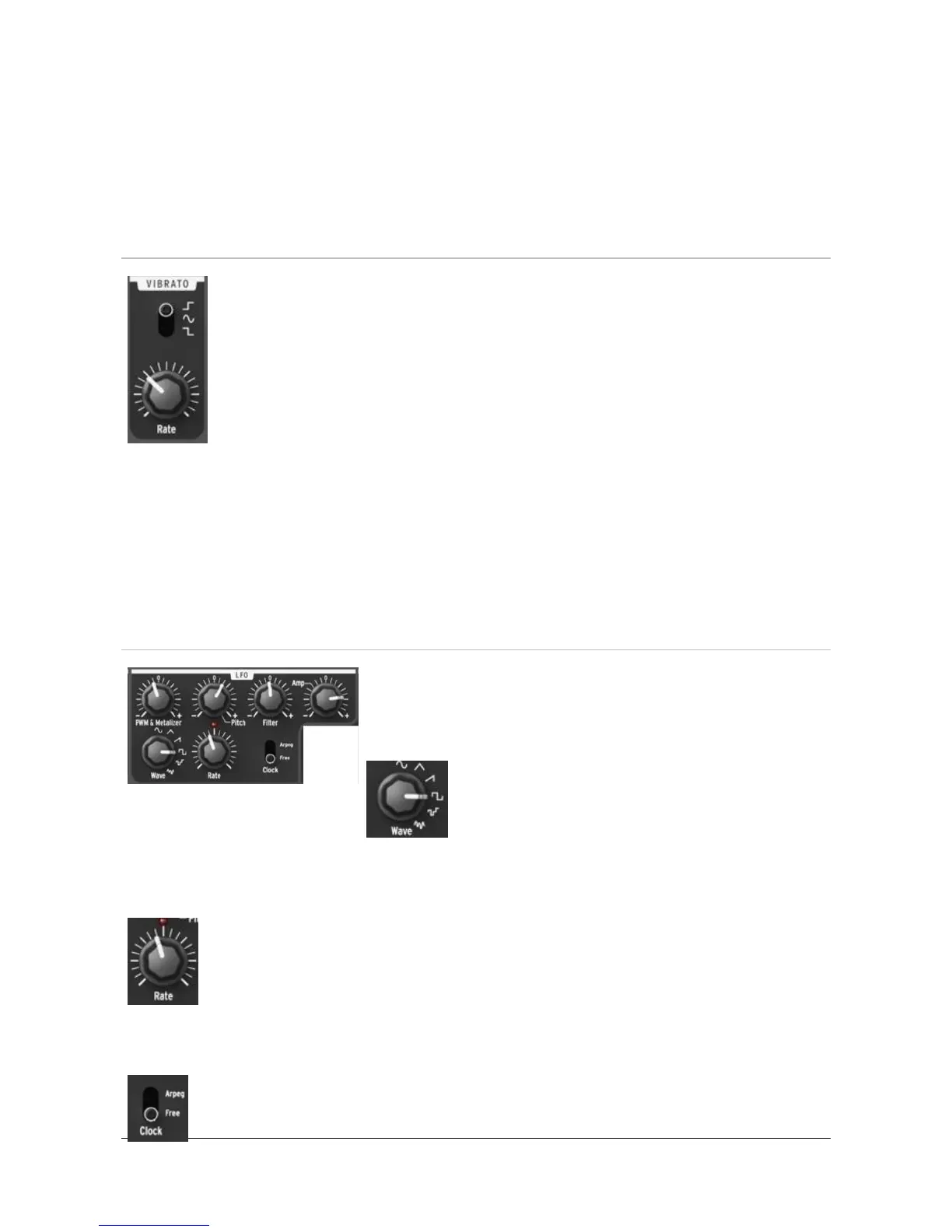
The Vibrato is a specialized low frequency oscillator dedicated to
oscillator pitch modulation. It’s completely independent from other
modulation sources, and its modulation depth and triggering are
controlled by the Modulation wheel [4.2.4.1] and the Aftertouch switch
[4.2.4.2] respectively. It provides different modulation waveforms,
selectable with a three-position switch:
a positive square wave useful to create a trill-up effect (the pitch
jumps alternatively between the keyboard pitch up to a higher
pitch depending on the Modulation wheel setting);
a sine wave for the classical vibrato effect;
a negative square wave for trill-down effect.
The Rate knob controls the Vibrato’s modulation rate, and ranges from 3Hz to
30Hz.
4.2.6 LFO
The LFO is a low frequency oscillator. It is the primary
modulation source for the MiniBrute’s other sections.
4.2.6.1 Wave
The LFO offers several modulation
waveforms, selected by the Wave knob:
sine, triangle, sawtooth, square, random
stepped (also referred to as Sample &
Hold), and random gliding.
4.2.6.2 Rate
The Rate knob set the LFO oscillation rate, and ranges from very slow
rates (0.1Hz) up to quite fast rates (100Hz). The red LED located above the
knob blinks in time with the rate. Note that the LFO rate may be
superseded by the arpeggiator tempo clock if the Clock switch is set to
Arpeg (see below).
4.2.6.3 Clock
The Clock switch sets the LFO rate’s operating mode. It can be slaved to



 To Next Page