Arturia MiniBrute User's Manual 30 6 Legal notes
be adjusted with the slider potentiometers. A sub-oscillator is available to create
sub-bass sounds. The mixer also controls the level of noise and of external audio (if
an external source is plugged in the rear panel’s audio in jack). The mixed signals
then feed the filter. The waveforms can also be modified using signal enhancers
(Ultrasaw, Pulse Width Modulation and Metalizer).
4.2.1.1 The waveforms
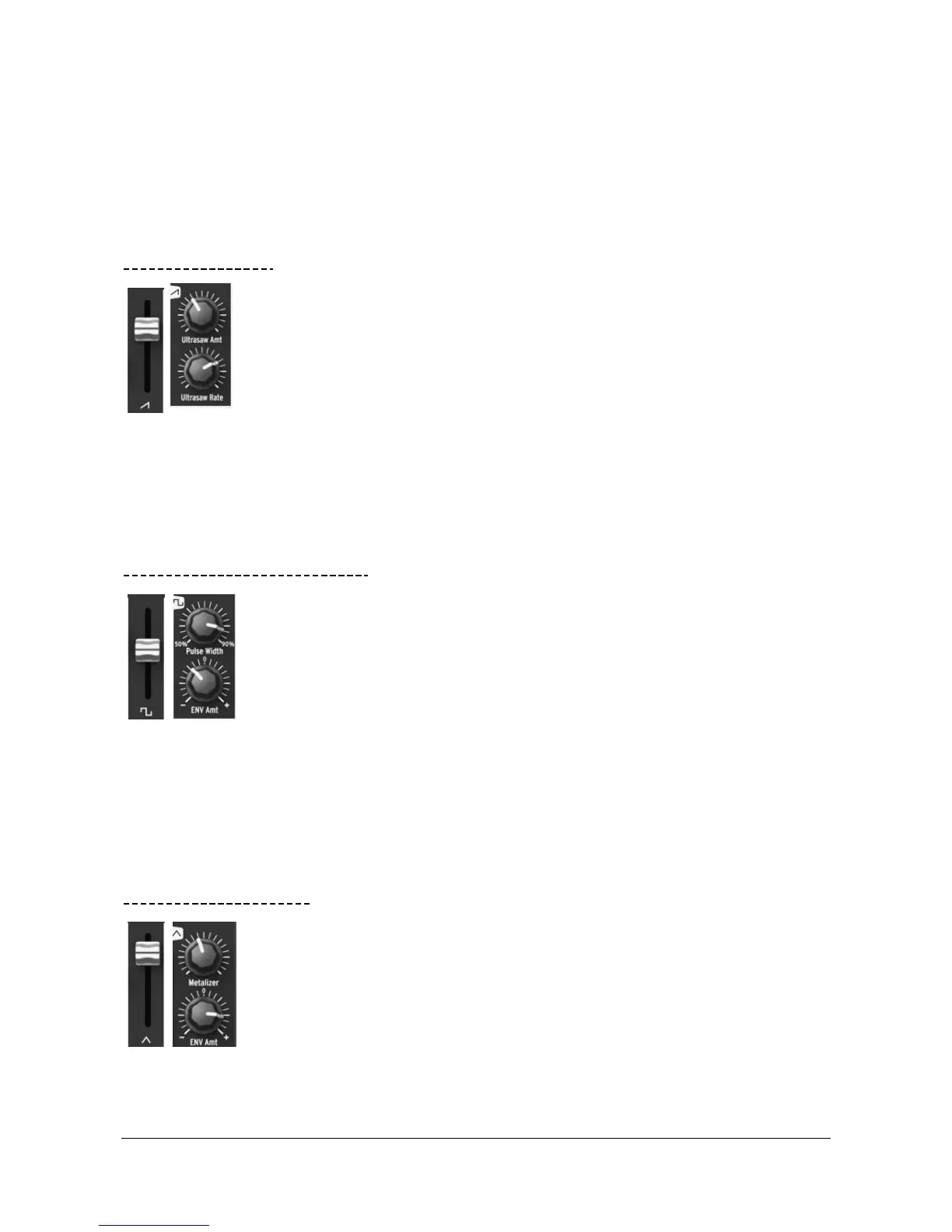
Saw and Ultrasaw
The level of the plain Saw (sawtooth) and Ultrasaw signals is
controlled with the slider potentiometer labeled with the saw icon.
Pulling it down completely mutes the signals, while moving it up
increases their level. When the Ultrasaw Amount knob is fully counter-
clockwise, only the saw signal is audible. Turning this knob clockwise
mixes more Ultrasaw sound in with the plain saw signal. The Ultrasaw
consists of two copies of the plain saw that are independently phase-shifted
using their own LFO. The phase shift of one copy is modulated at a constant rate
(1Hz), while the second copy’s phase shift modulation rate can be controlled with
the Ultrasaw Rate knob from a rate of 0.1Hz (tick 0) for slow beating frequency
effects, to 1Hz (tick 13) for chorus-like effects, to 3Hz (tick 15) for house-like
supersaw effects, and up to 10Hz (tick 18) for “trembling” sounds.
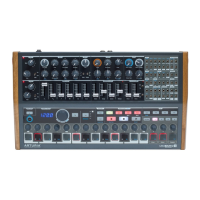
Square and Modulated Pulse
The level of the plain Square wave and Pulse width modulated
signals is controlled with the slider potentiometer labeled with the
square symbol. Pulling it down completely mutes the signals and
moving it up increases their level. When the ENV Amt (envelope
amount) knob is set to 12 o'clock (0 mark) and the Pulse Width knob
is fully counter-clockwise (50% tick), the square wave is audible.
Turning the Pulse Width knob clockwise transforms the square wave
into an asymmetrical pulse whose width can be increased up to 90%, giving a very
“acid” sound (like a oboe). The pulse width is also under the control of two
modulators: the Filter Envelope [4.2.2.7], the polarity and amount of which can be
adjusted with the ENV Amt knob; and the LFO [4.2.6], the polarity and amount of
which can be adjusted with the PWM & Metalizer knob in the front panel’s LFO
section.
Triangle and Metalizer
The level of the Triangle wave and Metalizer is controlled with the
slider potentiometer labeled with the Triangle symbol. Pulling it down
completely mutes the signals and moving it up increases their level.
Turning the Metalizer knob from fully counter-clockwise to fully
clockwise warps the triangle wave’s smooth, flute-like sound into
complex, metallic-sounding waves. The wave warping/folding is also
under the control of two modulators: the Filter envelope, the polarity
and amount of which can be adjusted with the ENV Amt knob; and the LFO [4.2.6],
the polarity and amount of which can be adjusted with the PWM & Metalizer knob

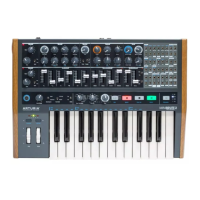



 To Next Page