#3941 Green 12 lbs/in
softer
#3942 Silver 14.5 lbs/in
(std rear)
#3943 Blue 17 lbs/in
#3944 Gold 19.5 lbs/in
(std front)
#3945 Red 22 lbs/in
#3946 Copper 25 lbs/in
#3952 Purple 30 lbs/in
#3953 Yellow 35 lbs/in
#3954 White 40 lbs/in
stiffer
SHOCK SPRINGS try to keep your car level
during acceleration, deceleration, and cornering.
Stiffer springs will help your suspension respond
more quickly, but because of their stiffness will not
absorb bumps as well. Use stiffer springs in high trac-
tion conditions such as carpet racing.
Softer springs are best for slippery or bumpy
conditions.
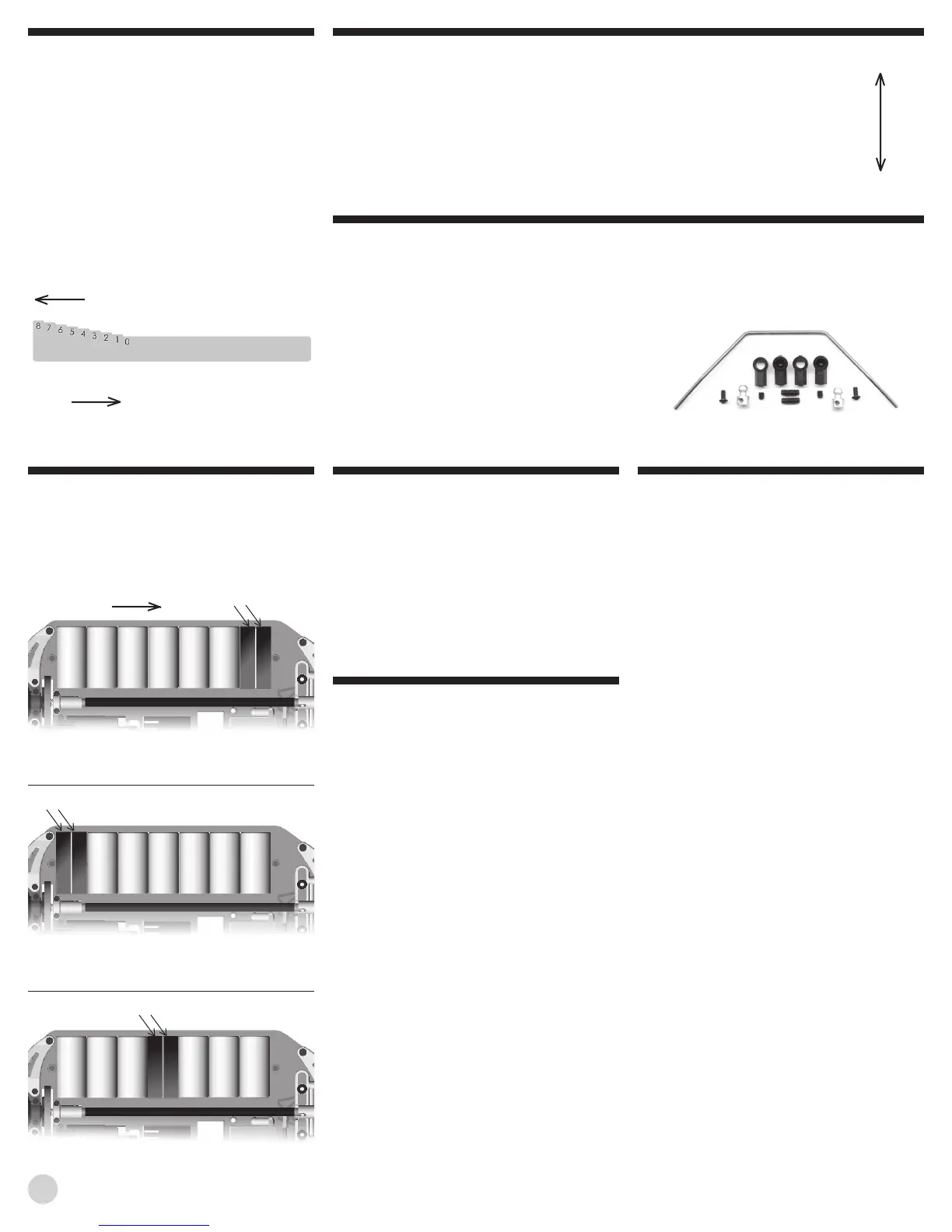
SHOCK TRAVEL can be adjusted on the TC3
to help speed up or slow down how fast the car
changes direction when cornering. The TC3 standard
setup is setting 6 on your droop gauge in the front
and 4 on the rear. This setup will work best in almost
any condition.
If your track is bumpy, you may want to add droop
to your car by going to a lower droop gauge step.
If your track has very high traction, such as oc-
curs with carpet, then you may want to take droop
out of your car by going higher on the droop gauge.
Too little droop will cause a loss of traction.
ANTI-ROLL BARS are used to stabilize a
car from excessive chassis roll (which occurs when
your car leans through the turns by centrifugal force).
Anti-roll bars are generally used on smooth, high trac-
tion track conditions. If the conditions are very bumpy,
then anti-roll bars are probably not necessary.
If you are driving on a high traction surface and
your car wants to oversteer, then use the optional
#3960 anti-roll bar kit on the front only. This will de-
crease the front chassis roll and decrease steering
throughout the corner. This has the feeling of increas-
ing rear traction.
If your car is understeering, then try the optional
#3960 anti-roll bar kit on the rear only. The rear anti-
roll bar will decrease rear chassis roll and decrease
rear traction (this has the feeling of increasing steer-
ing).
BATTERY PLACEMENT in the TC3 al-
lows you to slide your batteries forward or back to
change the handling characteristics of your car. There
are many combinations, but here are three we sug-
gest trying.
TIRES & INSERTS are two of the most in-
fluential changes you can make to your car. The TC3
comes standard with Pro-Line S-2 compound V-Rage
tires. This is a good traction, long-wearing tire for all
around use.
If you would like more traction, try the Pro-Line
#1091 S-3 compound tires with Pro-Line tire inserts.
For racing conditions, try the Pro-Line #1089S2 S-2
slicks or #1089S3 S-3 racing slicks. These optional
tires are available from Pro-Line.
SETUP SHEET for the TC3 is included. Set
up your TC3 with the standard settings at right, then
deviate from them in response to your track condi-
tions and driving style, as noted below.
Tips for beginners:
For best results, make only one setup change
at a time, testing it before making another change.
Make a copy of the setup sheet included in this
manual to help keep track of your changes.
Before you make any changes to the standard
settings, make sure you can get around the track with-
out crashing. None of your setup changes will work if
you cannot stay on the track.
Your goal is consistent lap times. Inconsistent
lap times may indicate poor control. When you have
consistent lap times, then make changes to your car.
If the change results in a faster lap, then mark
the change in your setup sheet. If performance is
worse, then revert back to the previous setup and try
another change.
Fill out your setup sheet thoroughly when you
are satisfied with it and file it away. It can be a practi-
cal guide for future track layouts and conditions you
encounter.
STANDARD SETTINGS of the TC3 are
presented below.
1. Front camber: -2°.
2. Front camber link: inside lower hole on tower.
3. Front block carrier: 0°.
4. Front toe: 0° to 1° toe-out.
5. Front ride height: 1/4” (6.3mm).
6. Kickup: +2°.
7. Bump steer spacers: none.
8. Ackerman: #3858 ball ends, no spacers.
9. Front anti-roll bar: none.
10. Rear camber: 1° to 2° negative.
11. Rear camber link: tower: inside lower hole. Hub
carrier: outside hole.
12. Rear toe-in: 3°.
13. Rear ride height: 1/4” (6.3mm).
14. Rear Anti-squat: 2°.
15. Rear anti-roll bar: none.
16. Driveshafts: MIP CVD’s.
17. Wheelbase: hub carriers centered.
18. Shock body: macro shock.
19. Shock oil: front, 40wt. Rear, 40wt.
20. Shock shaft: front, #8844. Rear, #8844.
21. Shock pistons: front, #2. Rear, #2.
22. Shock springs: front, Gold. Rear, Silver.
23. Shock limiters: front, 4. Rear, 2.
24. Shock mounting, front tower, outside hole.
25. Shock mounting, rear tower, outside hole.
26. Batteries: 6-cell.
27. Battery placement: rear.
28. Motor: varies.
29. Speed control: varies.
30. Radio: varies.
31. One way, front diff: none.
32. Tires, front: Pro-Line V-Rage S-2 compound.
33. Tires, rear: Pro-Line V-Rage S-2 compound.
34. Tire additive: none.
35. Inserts: incl. with tires.
36. Wheels: Pro-Line.
37 Spur gear: 72 (from Kimbrough)
38. Pinion gear: varies.
39. Lead weights: none.
40. Chassis: Composite.
41. Body: varies.
42. Wing: varies with body.
Batteries to rear:
More traction.
Less steering.
Batteries to front:
Less traction.
More steering.
FRONT
Batteries separated:
Slightly more steering than full rear.
Slightly less rear traction than full front.
Easy to drive.
Foam spacers
Foam spacers
Foam spacers
higher traction
less droop
more bumps
more droop
droop gauge
26
Antiroll bar (sway bar) kit #3960.




 To Next Page