Bandit
51Copyright 12/17
MODEL 20XP
If anvil is not too worn, the two
working edges can be ground or
machined to repair.
NOTE: Make sure the anvil clearance will still be
obtainable after grinding or machining.
FIGURE 1
TROUBLE SHOOTING CHIPPER PROBLEMS
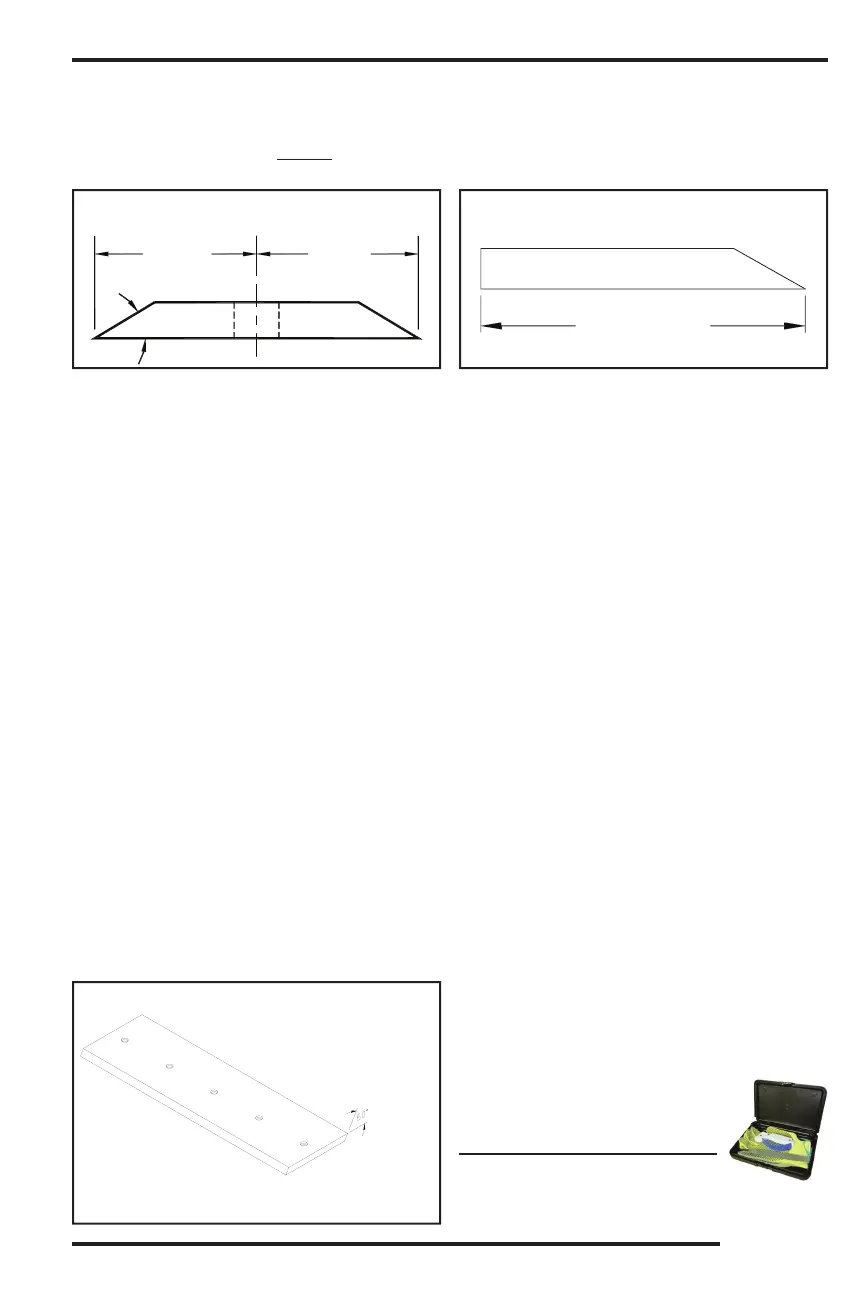
Knives should be replaced in sets. These sets are determined by the amount of resharpening done to the knives.
It should be reinstalled with another knife of comparable usage. It helps to keep the disc/drum balanced, and
it helps maintain chip quality. NEVER allow these knives to wear or be sharpened beyond absolute speci ed
minimum distance from the center line of bolt.
CHIPPER DRUM
KNIFE SAVER KIT
Through various tests, Bandit has found that using
the Knife Saver will increase the life span of chipper
knives if used during the recommended times. Each
knife installed in every new machine at Bandit has
the Knife Saver used on it before leaving the factory.
The Knife Saver can be purchased from your local
Bandit dealer.
- Use the Knife Saver on brand new knives.
- Use the Knife Saver on freshly resharpened knives.
- Use the Knife Saver every day during the Daily
Start-Up & Maintenance while the knives are checked.
- Use the Knife Saver when the machine is shut
down for a break during the day.
PART NO. DESCRIPTION
900-9901-68 Knife Saver Kit
900-9901-65 File For Knife Saver Kit Only
900-9901-63 Replacement Blades For Knife Saver
900-9901-66 Knife Changing Gloves
MAINTENANCE
1. Chipper makes poor quality chips or does not
feed properly.
A. Knives have lost their edge. File, grind or
replace knives. DO NOT operate the Bandit
with dull knives.
B. Knife anvil worn or needs adjustment. Rotate,
repair or replace (see Figure 1).
C. Feedwheel(s) are not operating correctly. (SEE
HYDRAULIC TROUBLE SHOOTING).
D. The throat/base opening is a high-wear area.
The feed plate anvil takes much of this wear
but other areas wear as well. Attention must
be paid to any areas where outer, noncutting
edges of chipper knife are exposed. These
areas must be built up with weld to maintain the
original integrity.
E. Knives are at the wrong angle. Knives must be
ground at a 30° to 30 1/2° angle.
F. Feedwheel teeth worn (REPLACE).
G. Material being chipped is very small, dry or
rotting. This type of material does not produce
good chip quality.
2. Chipper Knife Hits Anvil.
A. Check the anvil clearance at both sides of the
knife by using a feeler gauge, the clearance
should be the speci ed distance from the highest
knife (SEE ANVIL ADJUSTMENT).
B. Check the chipper bearing shaft lock nut for
tightness.
3. Discharge Plugs or Does Not Throw Chips
Properly.
A. Lugging engine on large material - keep engine
RPM up.
B. Knives are dull or worn to minimum size.
C. Obstruction in discharge chute. Patches welded
into the chute can cause obstruction of chip
ow. Anything causing an obstruction will cause
the chute to plug.
D. Chipping rotting material that has little substance
can also plug the discharge chute.
E. Worn fan blades.
4. Chipper Bearings Running Too Hot.
A. Improper lubrication - purge bearings once a
day with EP-2 Lithium type grease.
B. Chipper drum operating at too high RPM’s. DO
NOT exceed recommended RPM’s.
C. Check the chipper bearing locking collars for
tightness.
D. Bearings worn out (REPLACE).
5/8” x 5 1/2” x 12” (15.9 mm x 139.7 mm x 304.8 mm)
Chipper Knife
Min.
2 3/8”
(60.3 mm)
30°
Min.
2 3/8”
(60.3 mm)
Min.
5”
(127 mm)
5/8” x 6” x 12” (15.9 mm x 152.4 mm x 304.8 mm)
Chipper Knife


 To Next Page