30 After Implantation
Rate decrease The decrease of basic rate and magnet rate is defined as follows:
• In the following pacing modes the pacing rate decreases by 11%: DDD(R);
DDT(R); DOO(R) VDD(R); VDI(R); VVI(R), VVT(R) AAI(R); AAT(R); AOO(R).
• In the pacing modes DDI(R) and DVI(R), only the VA interval is extended by 11%.
This reduces the pacing rate by 4.5 to 11%, depending on the configured AV
delay.
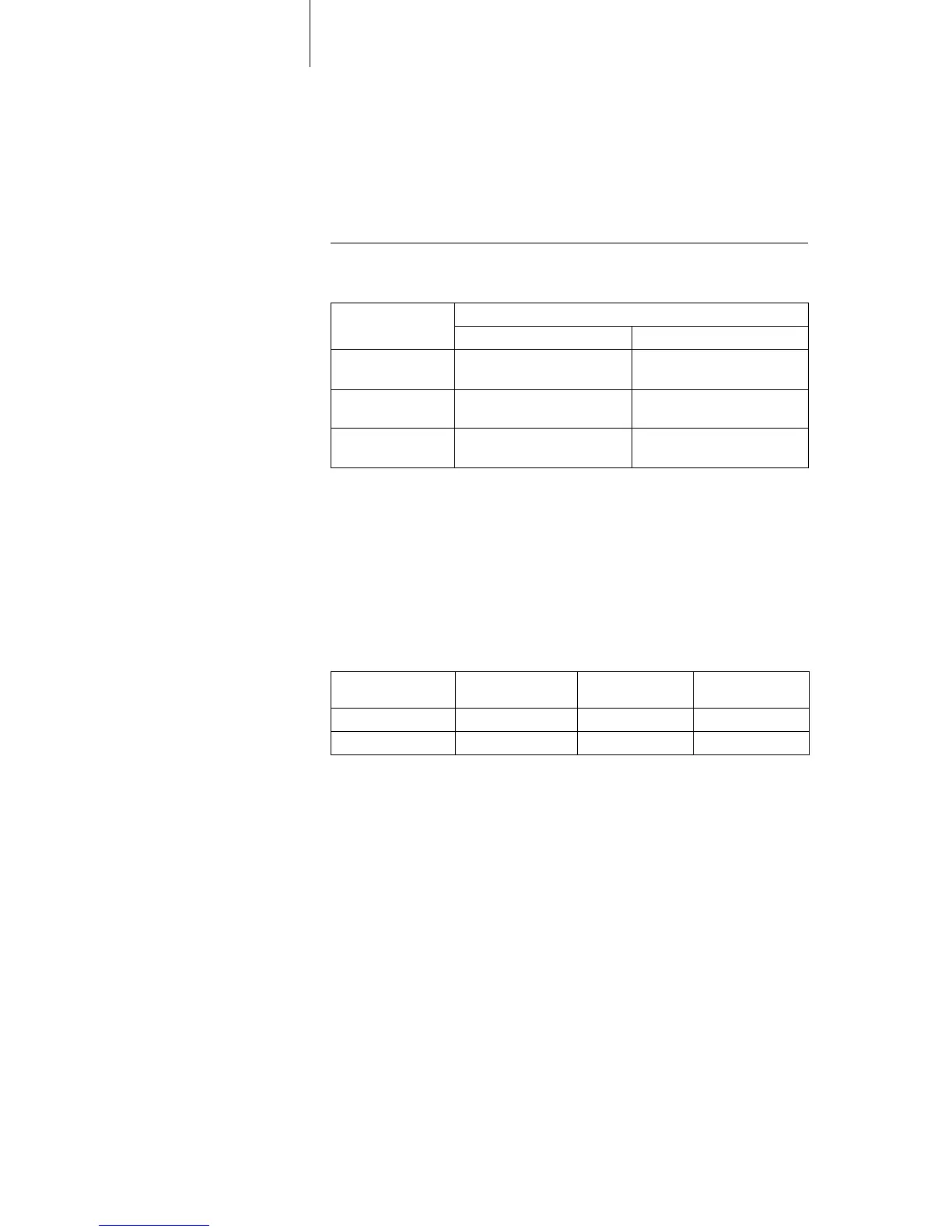
Magnet response at ERI After reaching ERI pacing is performed as follows after applying the magnet or pro-
gramming head:
Expected service time
after ERI
• The information is based on a lead impedance of 500 Ohm at 100% pacing and
the data of the battery manufacturer.
• For a lead impedance of 300 Ohm instead of 500 Ohm, these times decrease by
max. 30%.
• Parameter with high pulse energy: 110 ppm; 4.6 V; 1.5 ms; 500 Ohm
• Parameter with low pulse energy: 30 ppm; 0.2 V; 0.1 ms; 500 Ohm
• Dual-chamber implant in DDDR mode; single-chamber implant in
AAIR/VVR mode:
[in months]
Magnet mode
Cycles 1 to 10: After 10th cycle:
Automatically Asynchronous with rate at
80 ppm
Synchronous with basic rate
reduced by 4.5 to 11%
Asynchronous Asynchronous with rate at
80 ppm
Asynchronous with rate at
80 ppm
Synchronous Synchronous with basic rate
reduced by 4.5 to 11%
Synchronous with basic rate
reduced by 4.5 to 11%
ERI to EOS interval Standard program With high pulse
energy
With low pulse
energy
Mean value 8 8 8
Minimum value 6 6 6



 To Next Page