ES Range Product Manual
Version 2.9
© Copyright Brainboxes Limited 2013
Page 34 of 66
o For example, this will enable you to force baud rates that your application does not
allow you to select. This can be useful for interfacing to equipment which uses higher
baud rates or unusual baud rates, which your application does not support.
o In a case where you want to use hardware handshaking, but your application is not
capable, you can select CTS Always True – Hardware state ignored and choose to
Override it.
o NB with the use of Override Settings, you need to ensure that the equipment you are
connecting to be setup to match the communications settings you are forcing.
CTS / DSR Always True
• CTS and DSR are incoming hardware handshaking lines. This means they receive signals
from the connected device which tell the Ethernet to Serial device when it is and isn’t OK to
send data.
o Sometimes these signals may want to be ignored. By forcing CTS or DSR True, the
Ethernet to Serial device will ignore those signals and always send data.
o These settings are especially helpful when CTS and DSR are not physically
connected (such as in a 3 wire setup) and it is not acceptable for the data flow to stop
and start due to arbitrary variances on the unconnected signal lines.
o NB: Some ES devices do not support RTS/CTS or DTR/DSR handshaking and as a
result, “CTS Always true” or “DSR Always true“will be enabled by default. Please
check the product datasheet for your device to see what hardware handshaking is
available.
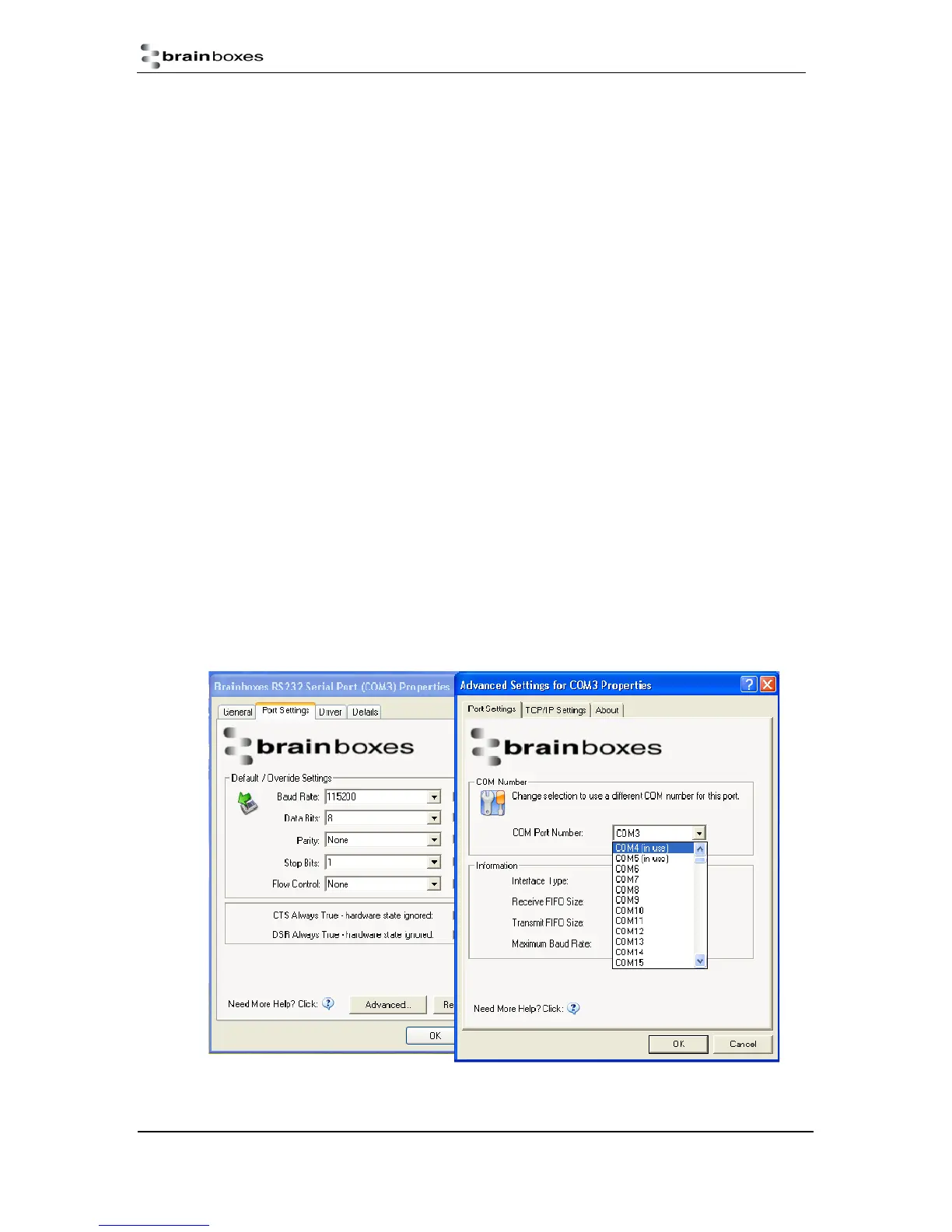
Changing your COM label
1. If you need to change the COM label, Double click on the Port entry in Boost.LAN Manager
2. Click on the ‘Port Settings’ tab and click Advanced



 To Next Page