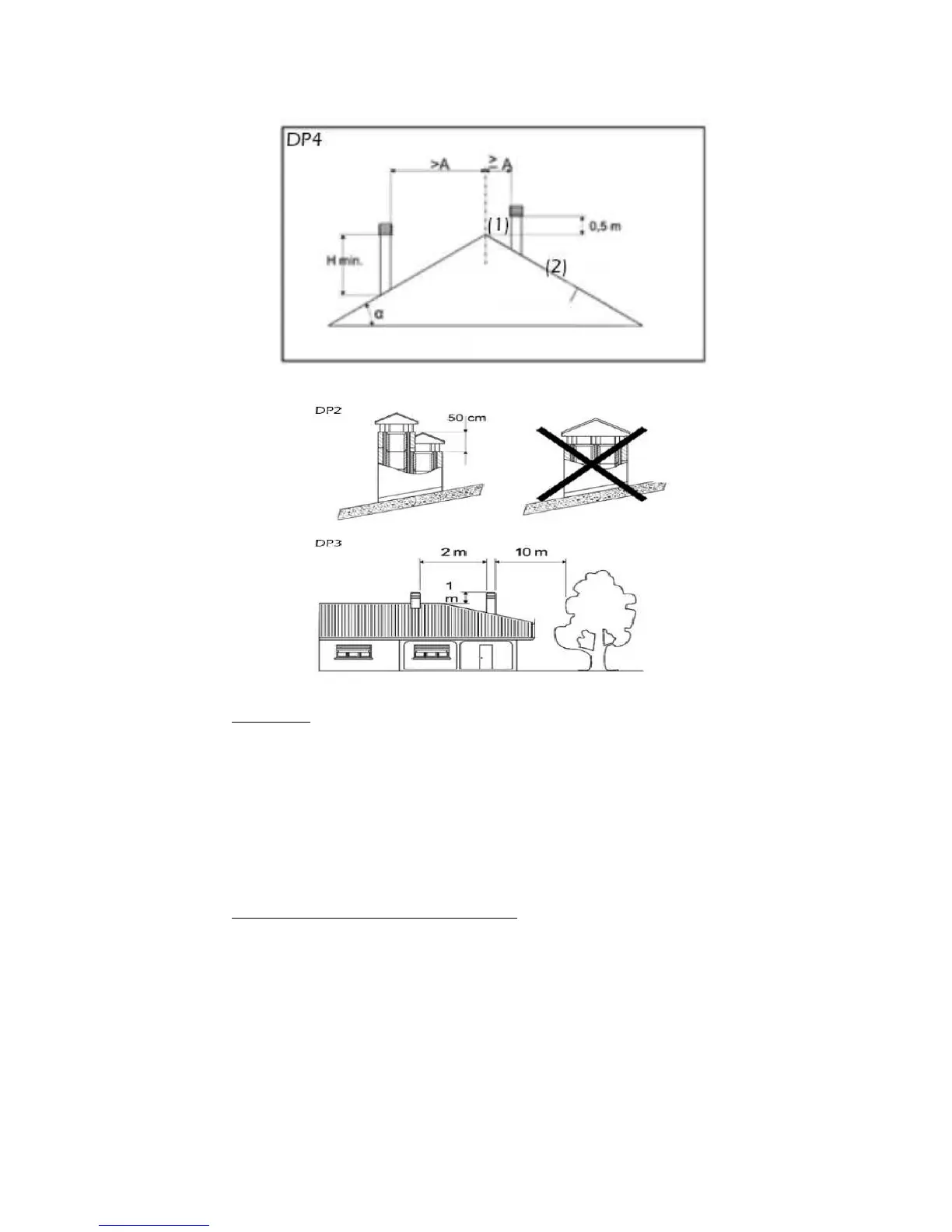
(1) Axis top
(2) Roof
5.4
5.45.4
5.4
Chimney cowl
Chimney cowlChimney cowl
Chimney cowl
The pull on the flue pipe depends on the suitability of the chimney cowl. It is essential that the sectional area
of the cowl exit is at least twice (preferably 2.5 times) that of the flue pipe. The termination of the flue pipe
must always exceed the top level of the roof so that the chimney is able to discharge even in windy conditions
(DP7)
Any cowl must comply with the following conditions:
• The outlet area must be at least double that of the interior section of the chimney.
• It must be constructed to prevent the entry of rain, snow or foreign bodies
• It must have easy access for inspection, maintenance and cleaning.
• The interior section must be equal to the chimney one.
5.5
5.55.5
5.5
Connection to chimney
Connection to chimneyConnection to chimney
Connection to chimney
/
//
/
Combustion air (air
Combustion air (air Combustion air (air
Combustion air (air intake
intakeintake
intake)
))
)
The immediate connection of the device to the chimney/flue system must be made using stainless steel flue
pipe.
Flexible tubing must never be used as the joints will be subject to damage and lead to smoke leaks.
Flexible tubing must never be used as the joints will be subject to damage and lead to smoke leaks.Flexible tubing must never be used as the joints will be subject to damage and lead to smoke leaks.
Flexible tubing must never be used as the joints will be subject to damage and lead to smoke leaks.
The flue pipe must be hermetically sealed to the device and have a maximum bend of 45 degrees. This will
avoid excessive condensation during lightning, prevent soot deposits and avoid impeding the release of
smoke from the fire box. If the seal is not properly connected, the stove will not function properly.
The inside diameter of the connection tube must equal the exterior diameter of the flue pipe. Flue pipes
conforming to DIN 1298 will ensure this. The pull on the chimney must be between 10 and 14 Pa
The pull on the chimney must be between 10 and 14 PaThe pull on the chimney must be between 10 and 14 Pa
The pull on the chimney must be between 10 and 14 Pa.
..
.
The measuring must always be done with the device hot (nominal calorific output).
If the pull is over 15 Pa, it will be necessary to reduce it by installing an additional regulator.


 To Next Page