8
5.3
5.35.3
5.3
The chimney
The chimneyThe chimney
The chimney
The chimney has a fundamental importance for the correct operation of the device and has two purposes:
• It channels smoke and gasses harmlessly away from the room
• It provides a sufficient draw to keep the fire alight.
It is essential that the chimney is correctly built and is subject to regular maintenance to keep it in good order.
(Most complaints of incorrect functioning of the device are due to an inadequate draw or other chimney
malfunction).
The correct functioning of the device requires the chimney/flue conditions:
• The internal section of the chimney should preferably be circular
• The entire height of the chimney must be heat insulated correctly in order to avoid problems
The entire height of the chimney must be heat insulated correctly in order to avoid problems The entire height of the chimney must be heat insulated correctly in order to avoid problems
The entire height of the chimney must be heat insulated correctly in order to avoid problems
with smoke condensation
with smoke condensationwith smoke condensation
with smoke condensation, this is especially so in cases of external chimneys.
• If metal flue pipes are fitted to form an external chimney, only twin
If metal flue pipes are fitted to form an external chimney, only twinIf metal flue pipes are fitted to form an external chimney, only twin
If metal flue pipes are fitted to form an external chimney, only twin-
--
-wall insulated flue pipes
wall insulated flue pipes wall insulated flue pipes
wall insulated flue pipes
should be used in order to avoid problems with condensation.
should be used in order to avoid problems with condensation.should be used in order to avoid problems with condensation.
should be used in order to avoid problems with condensation.
• The chimney should have an even diameter throughout its length (i. e. no increases or
reductions in the volume of the chimney) and it should be vertical and have no bends of over
45º within it.
• Any existing chimney must be swept before installation of the device.
• Technical data in the flue manufacturer’s instruction manual must be complied with.
The optimum draw of a chimney should be between 10 and 14 on the Pascal scale. A lesser value (weak
draw) results in incomplete combustion which produces carbon deposits and excess smoke production. It can
also lead to smoke leaks and increases in temperature within the appliance which can (in turn) cause serious
damage to the structural components of the product.
Too much draw in the chimney can result in the fire burning too rapidly and too much heat being passed
through the tubing.
Chimneys constructed from fibrous cement, galvanised steel and chimneys with rough or porous interior
surfaces are forbidden
are forbiddenare forbidden
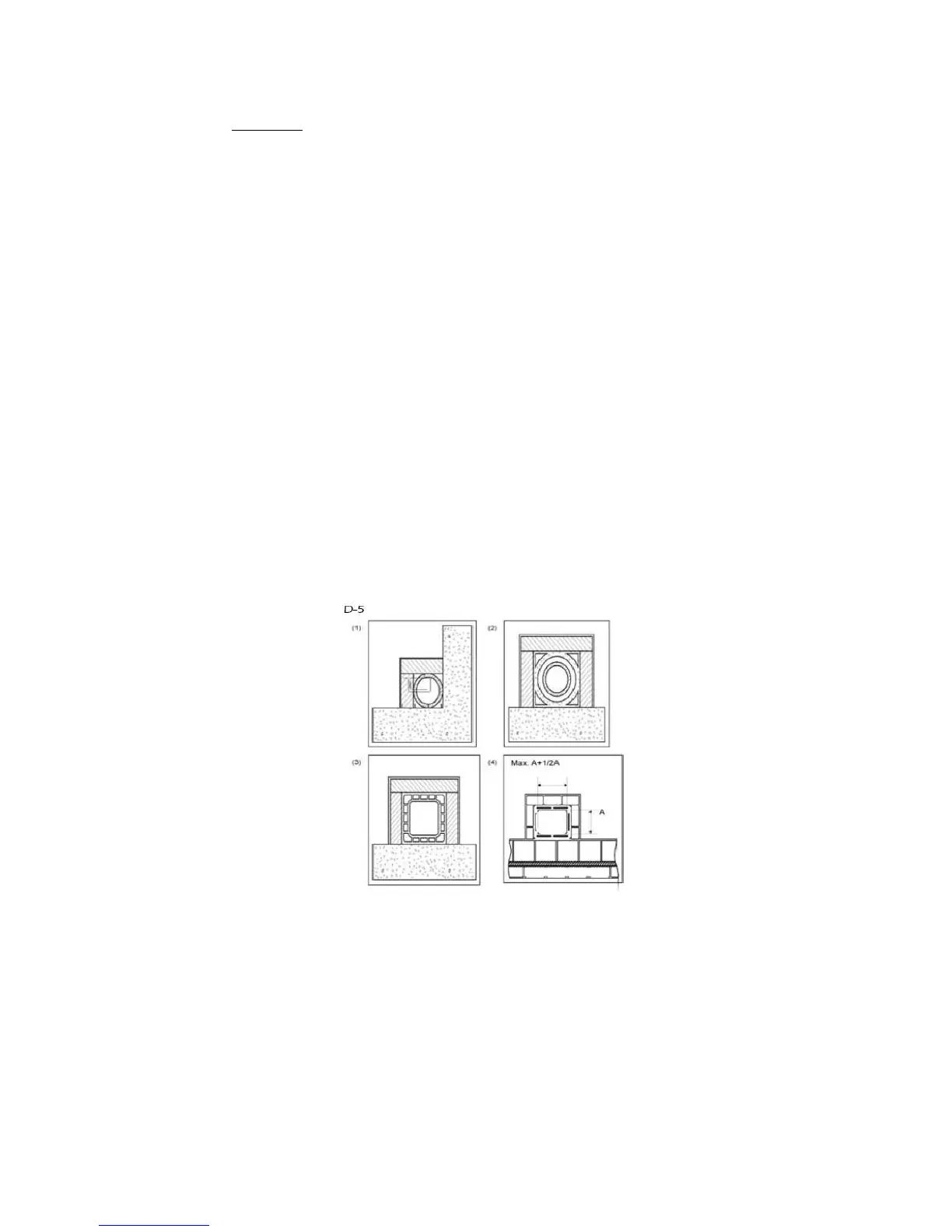
are forbidden and lead to poor functioning of the equipment. Some solutions to this problem are
suggested on the following drawing.
(1) Pavement chimney AISI 316 with double wall insulated with resistant material to 400º C. Efficiency 100 %
ideal.
(2) Traditional chimney of clay section squared in hollows. Efficiency 80% ideal.
(3) Chimney of refractory material with double insulated wall and exterior revetment of lightened concrete.
Efficiency 100% ideal.
(4) Avoid chimneys with rectangular interior section which relation is different from the drawing. Efficiency
40% mediocre.
Each stove must have it own dedicated chimney to eliminate fumes and gasses. The same chimney must
The same chimney must The same chimney must
The same chimney must
never be used for more than one appliance. (See drawings D3 and D4 (Page 1
never be used for more than one appliance. (See drawings D3 and D4 (Page 1never be used for more than one appliance. (See drawings D3 and D4 (Page 1
never be used for more than one appliance. (See drawings D3 and D4 (Page 14
44
4). The minimum cross
). The minimum cross). The minimum cross
). The minimum cross-
--
-
sectional area of the chimney must be 4 dm2 (e.g. 20 x 20 cm) for appliances having flue pipes with a
sectional area of the chimney must be 4 dm2 (e.g. 20 x 20 cm) for appliances having flue pipes with a sectional area of the chimney must be 4 dm2 (e.g. 20 x 20 cm) for appliances having flue pipes with a
sectional area of the chimney must be 4 dm2 (e.g. 20 x 20 cm) for appliances having flue pipes with a
di
didi
diameter less than 200 mm or 6,25 dm2 (e.g. 25 x 25 cm) for the appliances having flue pipes with a diameter
ameter less than 200 mm or 6,25 dm2 (e.g. 25 x 25 cm) for the appliances having flue pipes with a diameter ameter less than 200 mm or 6,25 dm2 (e.g. 25 x 25 cm) for the appliances having flue pipes with a diameter
ameter less than 200 mm or 6,25 dm2 (e.g. 25 x 25 cm) for the appliances having flue pipes with a diameter
over 200 mm.
over 200 mm.over 200 mm.
over 200 mm.


 To Next Page