SEWING THE STITCHES
76
f
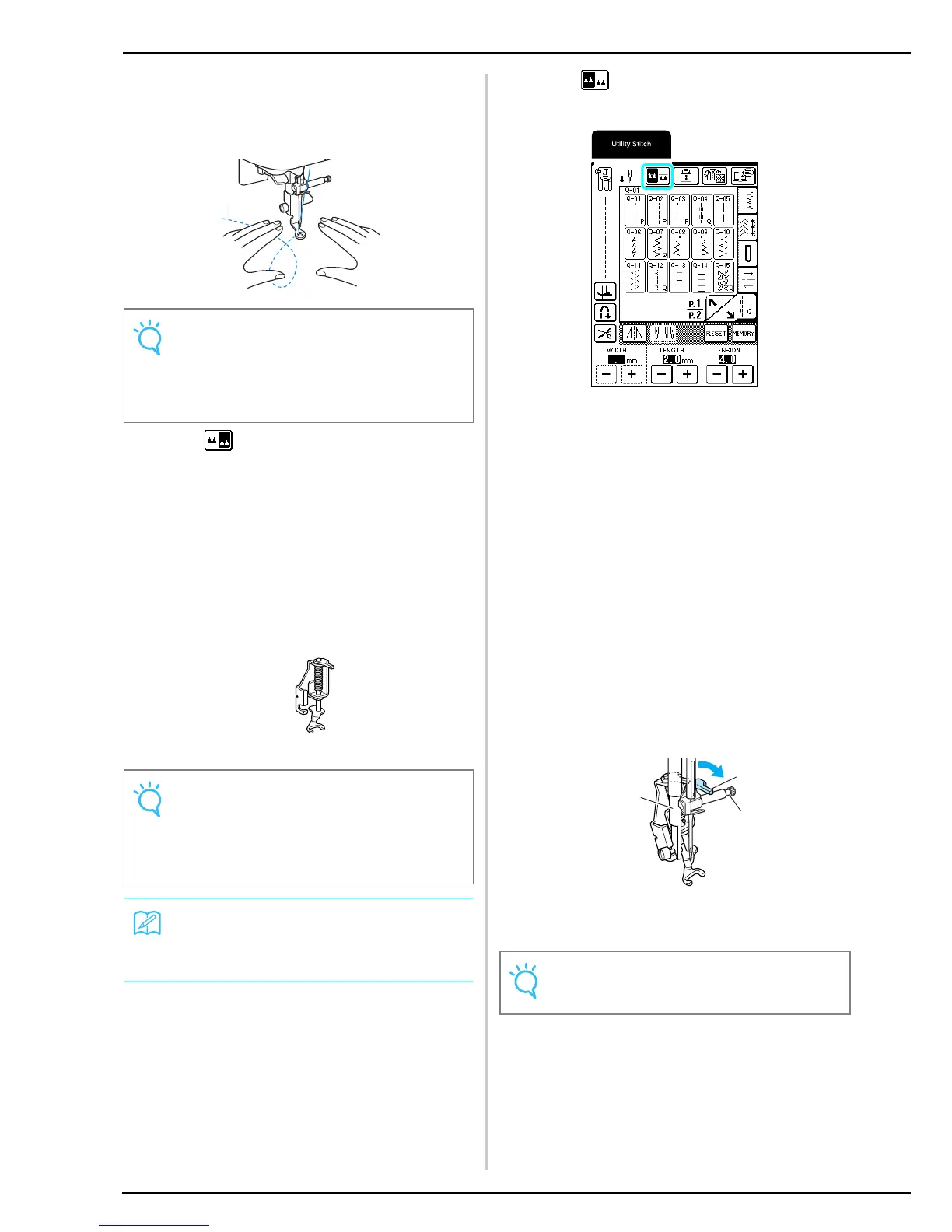
Use both hands to stretch the fabric taut, and
then move the fabric at a regular pace in
order to sew uniform stitches roughly 2.0-2.5
mm (approx. 1/16 - 3/32 inch) in length.
a Stitch
g
Press to cancel the free-motion sewing
mode.
■ Free-motion Quilting Using Free-motion
Open Toe Quilting Foot “O”
The free-motion open toe quilting foot “O” is used
for free-motion quilting with zigzag or decorative
stitches or for free-motion quilting of straight lines
on fabric with an uneven thickness. Any stitch can
be sewn with the free-motion open toe quilting foot
“O”.
Free-motion open toe quilting foot “O”
a
Press to lower the feed dogs and to set
the machine to free-motion sewing mode.
→ The feed dogs are lowered, and the quilting foot is
raised to the necessary height for free-motion
sewing.
b
Select a stitch.
→ When stitch Q-01 or 1-30 is selected, free-motion
quilting foot “C” is indicated in the upper-left corner
of the screen. When the other stitches are selected,
free-motion open toe quilting foot “O” is indicated
in the screen.
c
Remove the presser foot holder (see page 72).
d
Attach free-motion quilting foot “O” by
positioning the pin of the quilting foot above
the needle clamp screw and aligning the
lower-left of the quilting foot and the presser
bar.
a Pin
b Needle clamp screw
c Presser bar
Before beginning to do free-motion embroidery, follow
the directions on page 27 for pulling up the bobbin
thread. Grasp the upper and lower threads and sew a
few stitches to lock threads. Continue the process of
free-motion embroidery.
Free-motion open toe quilting foot “O” can also be
used with stitches used with free-motion foot “C” (Q-01
or 1-30). We recommend using free-motion quilting
foot “O” with free-motion sewing of fabrics of uneven
thicknesses.


 To Next Page
 Loading...