13
6.0 Mains Power Connection
Voltage: The TCS-80X operate on voltages specifies in the earthing
requirements section (Refer to section 3). If the unit(s) are accidentally
connected to an AC supply giving in excess of 132V AC, refer to section 19,
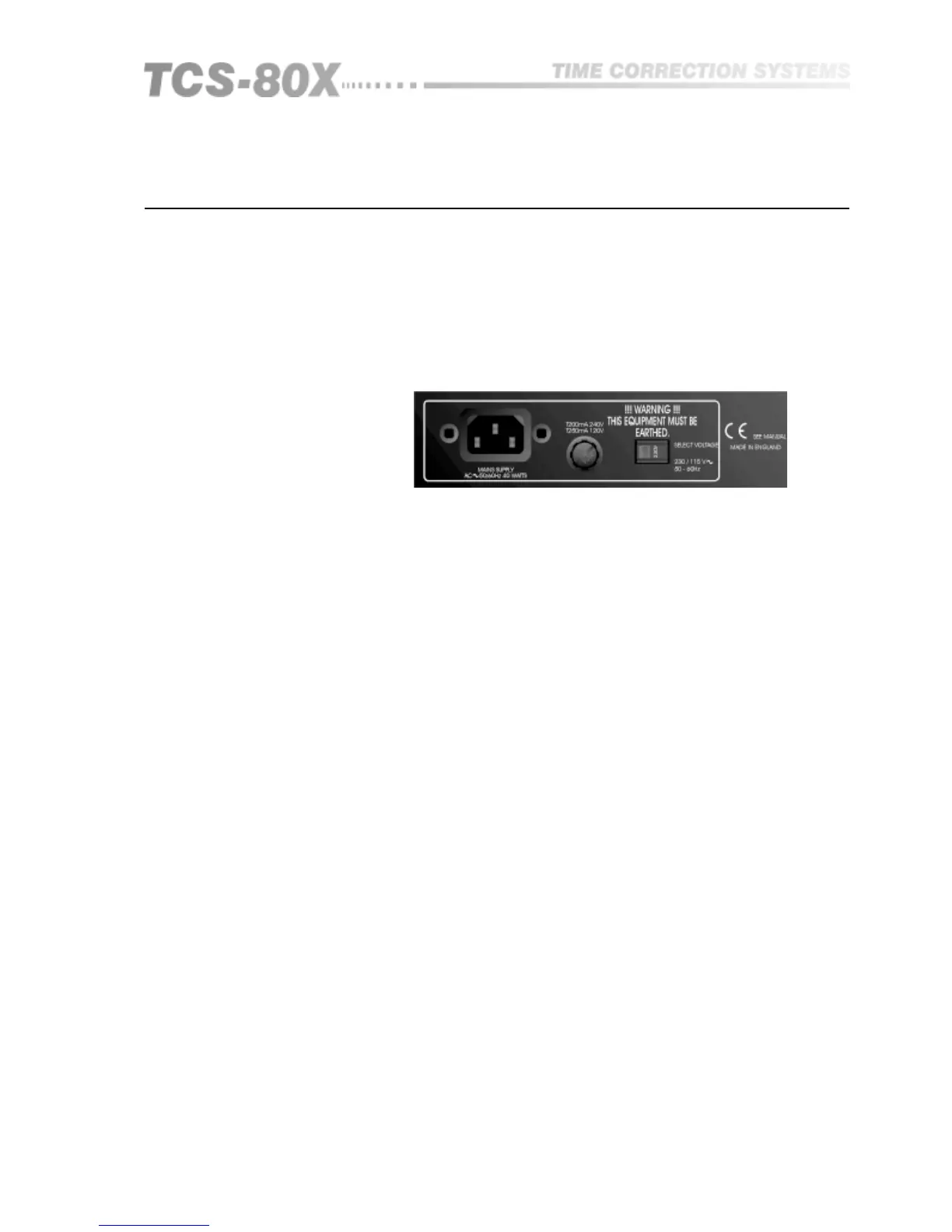
(See Figure 6.1).
Frequency: Both 60Hz and 50Hz are acceptable.
Fig 6.1 Mains fuse on
rear panel.
Connecting to Power
Grounding: The TCS-80X must always be connected to a 3-wire grounded
('earthed') AC outlet. The rack framework is assumed to be connected to the
same grounding circuit. The unit(s) must NOT be operated unless the power
cables' ground ('earth') wire is properly terminated - it is important for
personal safety, as well as for proper control over the system grounding.
Connections: The AC power cable has a moulded 3-pin utility plug attached
to the free end to facilitate the correct and proper connections.
AC Power Fusing: The incoming line power passes through a 150mA (for 240V
only) anti-surge ('T') fuse, accessible from the rear panel (The fuse is rated at
250mA for 120V and 150mA for 240V). If the fuse blows without good reason,
refer to section 19. Always replace with an identical 20mm x 5mm T rated
fuse for continued protection from equipment damage and fire.
It is unlikely that a fuse will fail during normal use, and must be treated with
some caution to the cause, if it should do so. One of the most likely reasons
for failure is the incorrect setting of the voltage switch on the rear of the unit.
Another reason could be the inadvertent connection of line to line rather than
line to neutral phase voltages when using three phase power supplies. In
either case, internal transient suppressor can be damaged, and consequently
replacement fuses will continue to blow, providing protection for your unit.
The damaged suppressors must be removed from the unit to allow further use,
and should be replaced as quickly as possible to provide continued protection.
Refer to section 16 for information on replacing these suppressors.


 To Next Page