14
Input Connections
7.0 Input Connections
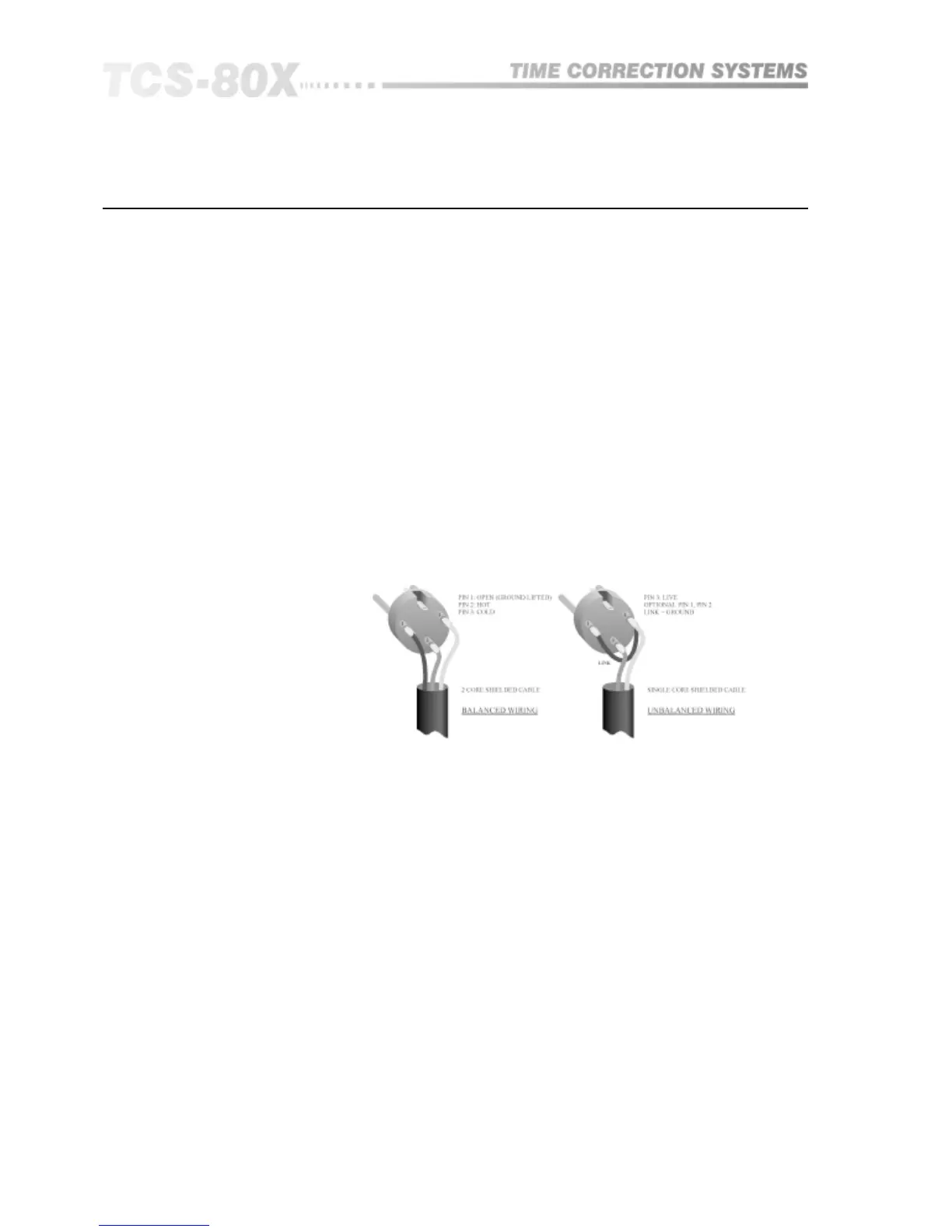
The input signals are 10k ohm active balanced on a standard 3 pin 'female'
XLR which will accept levels up to +20dBv, and can drive into loads of
600ohms or greater. The wiring convention is as follows: (See Figure 7.1):
Pin 1: No connection (the shield of the drain wire can be terminated
here if desired).
Pin 2: Signal '+', in phase or 'HOT'.
Pin 3: Signal '-', out of phase or 'COLD'.
For unbalanced sources (See figure 7.1):
Pin 1: Leave open, or link to pin 2.
Pin 2: Shield, braid, or screen wire.
Pin 3: Signal '+' or 'HOT' (inner core).
There is no internal ground connection to Pin 1 of the female XLR to avoid
possible interconnection earth loops. The input signal cable shield must
therefore be tied to ground, or signal 0V, at the source end.
7.1 XLR Plugs.
Fig 7.1 XLR Plug Wiring
If the equipment driving the TCS-80X has only unbalanced outputs then you
will need to add a wire jumper such that the screen connection on Pin 1 of the
XLR is shorted to either Pin 2 or Pin 3, depending on system convention.
If the equipment being connected to the TCS-80X outputs have only
unbalanced inputs, then we recommend that you still use a balanced (i.e. 2
core shielded) cable. You should ground the shield from the pin 1 connection,
whilst the cold connection should be used as the 0v ground and the hot
connection for the live, on the unbalanced input. The cable screen should not
be connected through to the chassis/0V. Strict adherence to this will help to
eliminate potential ground loop hums.
Strict adherence to the wiring conventions noted above within a fully
balanced signal system will yield the best possible results with none of the
problems normally associated with interconnected audio equipment.
Wherever possible, cable screens should not be connected to any signal pin,
but rather left to perform a cable shielding function only.
Under no circumstances should the safety ground wire be removed from the
mains AC power connector as an interim measure to achieve similar results.
Please refer to section 16 for information on this procedure.


 To Next Page