1.5 F
ILM TRANSPORT
(1) Overview
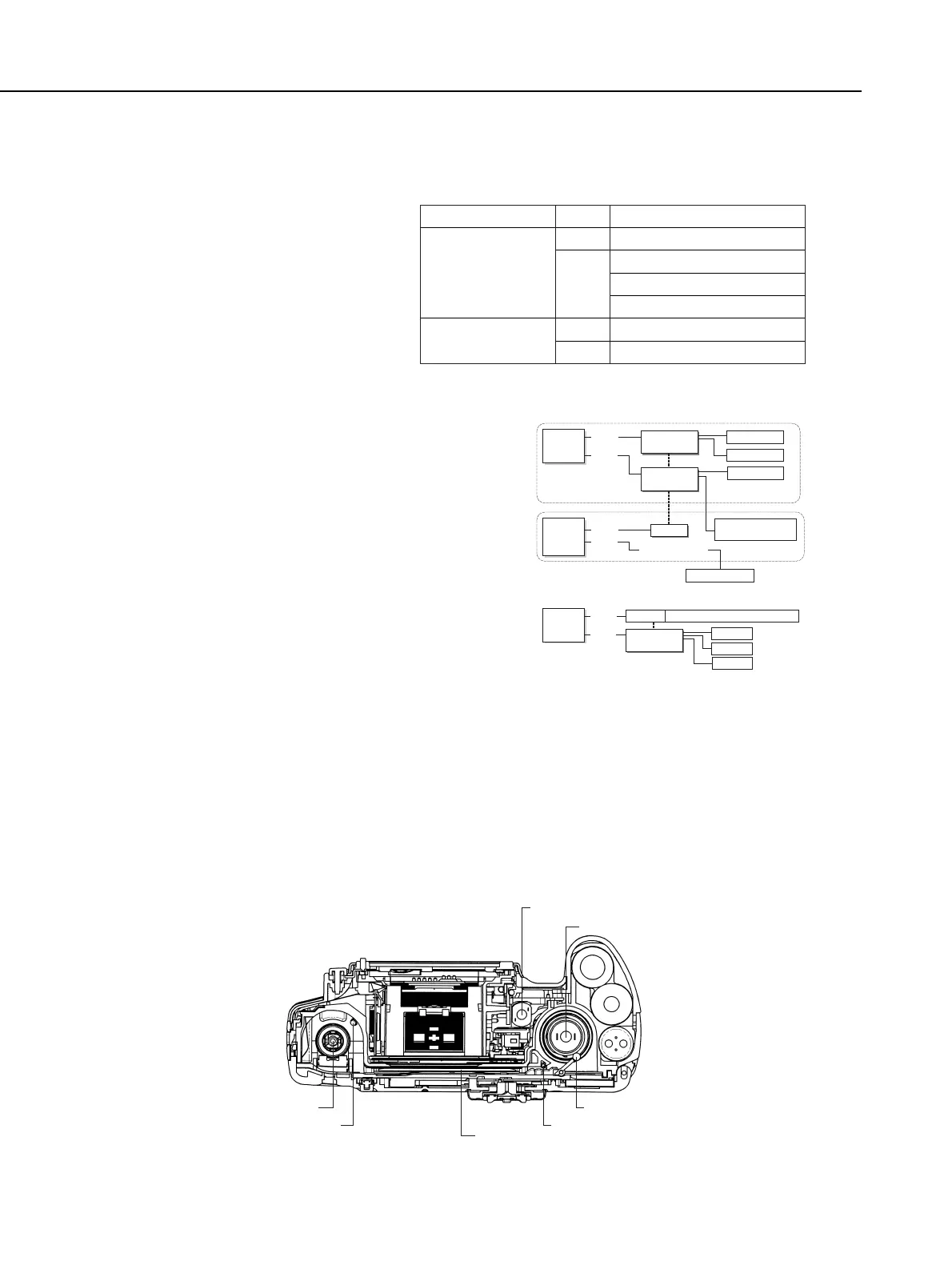
As shown in Fig. 2-16, the film
transport system consists of the
main motor (M1) and secondary
motor (M2). By running forward
or in reverse, the respective
motor executes the operations
listed in Table 12.
Figure 2-19 shows a time chart
of how the M1 motor's running
direction (forward or reverse) drive
a series of operations such as the reflex mirror
up/down movement, shutter cocking, and film
advance. The M1 motor's driving power is
relayed to the film advance mechanism. The
film advance mechanism's two-speed (High
and Low) gear ratio and film rewind mode are
selected by the drive transmission mechanism
relayed by M2. With the EOS Elan II/Elan II
E/50/50 E/55, one motor drives everything.
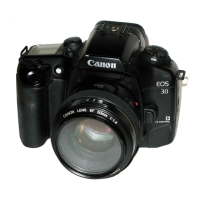
With the EOS ELAN 7 E / EOS 30, the M2
motor switches the driving so that the M1
motor does not need to do it. As a result, the
film advance speed is faster and the film
transport is quieter.
Also, as mentioned above, the EOS ELAN 7 E
/ EOS 30's film advance mechanism has a two-speed (High and Low) gear. By
making the High gear's gear ratio small, the film advance time is greatly shortened.
Also, in low temperatures and other conditions which exhaust the batteries faster,
the mechanism switches from High gear to Low gear automatically to ensure that the
film transport can be driven.
The M1 and M2 motors and almost all the driver units are concentrated in the grip
portion of the camera. This makes the driving more efficient and the camera more
compact (the distance between the optical axis and grip is almost the same as the
EOS 300/Rebel 2000/EOS Kiss III's).
Part 2: Technical Information
2-12


 To Next Page