19
Duct Drains
Drains are used to provide a point at which low points in the duct system can be drained. Condensation
and low lying water left over from duct cleaning can be drained easily with the installation of a ball valve
drain. Drains are designed to aid in duct cleaning and can be used to drain accumulation into an approved
collection reservoir. Drains can be hard piped to an approved collection reservoir, remove the cap and
connect to the 1-1/2” NPT threads.
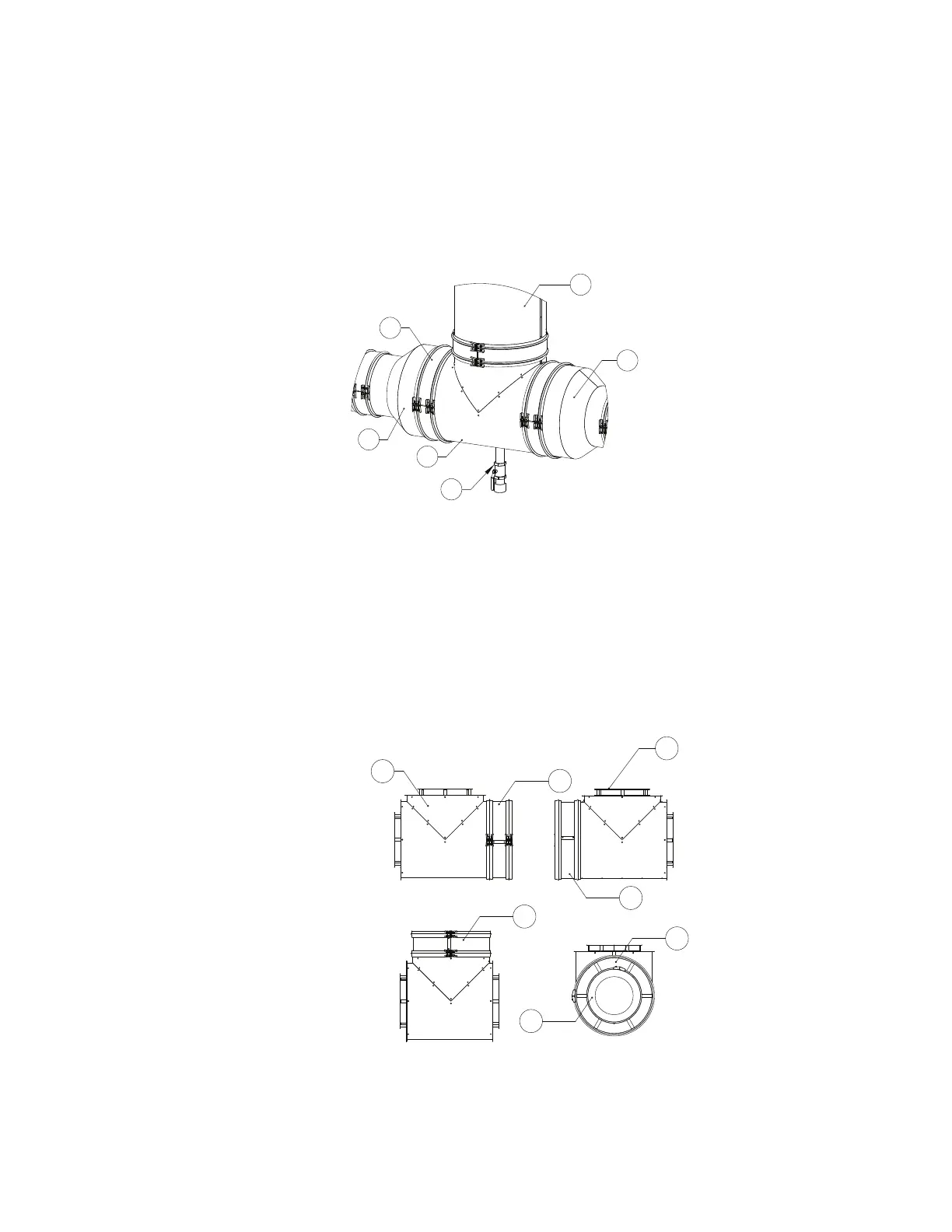
Figure 10 - Duct Drain
Manifold Tee
The manifold tee is used to provide access for clean-out to comply with NFPA 96 requirements. It is
equipped with an internal blank that acts as a grease dam and gasket. The access port is then closed with
a clean-out cap or tee cap. The tee cap is then covered with layers of insulation that is covered in an outer
shell called the access door collar. The location of the access port in the tee is dependent on the
orientation of the tee in the final installation. The access port location in the manifold tee can be orientated
as required. Access ports should never be located where grease can build up and fall out once the clean-
out cap is removed or where the access door collar cannot be removed to gain access to the inner duct.
Figure 11 - Tee Position
1. V-band
2. Duct Section
3. Adapter Section
4. Drain
5. Tee
1. Outer Duct Shell
2. Access Door - Right Side
3. Inner Duct Shell
4. Access Door - Left Side
5. Access Door - Top Side
6. Grease Dam and Gasket
7. Insulation


 To Next Page