12
Double Wall Adjustable Duct, Chimney and Transition Plate
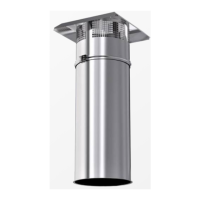
Adjustable duct sections may be used in conjunction with transition plates when they terminate at the fan.
The adjustable duct section is fully welded to the transition plate, and then connected to the standard duct
length using non-welded connections. Double wall adjustable duct sections are assembled in the field, as
the exact length needed for the application is not known. Components for outer shell and insulation ship
loose. Once fully assembled, the transition plate is secured to the curb using the method referenced in
Figure 13. When a Model 2R Type HT chimney system is used in positive pressure applications, it must
be fitted with an internal joint collar and sealed as shown in Figure 3. When a chimney system is used in a
negative or neutral pressure application, it does not need to be sealed per the listing report; although,
sealing the system is recommended for commercial cooking appliances where grease is present. Refer to
Figure 4 for assembly details.
1. The 7” standard duct section in the adjustable assembly is installed the same as the “Grease Duct
and Chimney Joint Assembly” on page 11.
2. When adjustable duct assemblies are used with transition plates, the 7” standard section is connected
to the mating duct section. The adjustable duct with single flange is welded to the transition plate.
3. The adjustable collar is slipped onto the adjustable section. Make sure the adjustable collar flanges
are opposite the adjustable duct section flange.
4. The adjustable section is pushed inside the 7” standard section. Verify the minimum overlap is set
correctly, refer to Table 3.
5. If the protruding section interferes with mating parts in the duct run, you will need to cut the adjustable
section that is interfering with mating parts, refer to Figure 5.
NOTE: For Positive Pressure Applications - If the adjustable section is used in a positive pressure
chimney application, the adjustable section may need to be cut to length. This will prevent
interference with the internal joint collar. Refer to Figure 4 for adjustable section installation.
6. Once the overlap is set correctly, apply 3M Fire Barrier 2000+ Silicone to the flanges of the duct
section and the adjustable collar.
7. Apply 3M Fire Barrier 2000+ Silicone to the single V-band groove. Install single V-band around
adjustable collar flange and standard duct flange. Tighten the single V-band hardware to 40-60 in-lbs.
8. Once the single V-band has been installed, tighten the adjustable collar hardware to 40-60 in-lbs.
9. Measure the distance between mating duct flange and transition plate prior to installing insulation and
outer shell cover.
10. Subtract 1” from the measured distance and cut the pre-rolled shell to this dimension.
11. After the single wall adjustable section has been installed, wrap the assembly using blanket insulation
provided. Make sure all voids are adequately filled.
12. Wrap the pre-rolled outer shell cover around the insulation. Ratchet strap(s) may be used around outer
shell to aid in compressing insulation.
13. Install the double wall V-band on either end of the assembly. Make sure the double wall V-band is
secured onto the mating duct flange and overlapping onto the shell before tightening hardware.
14. The double wall V-band will close the pre-rolled shell as they are tightened. Once closed, secure the
outer shell cover along the seam using the 1” sheet metal screws that have been provided.
15. Use 3M Fire Barrier 2000+ Silicone to seal the outer shell, if required or installed outside.
NOTE: Outer Shell Must Extend Behind the Double Wall V-band.


 To Next Page