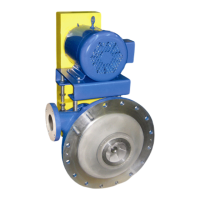
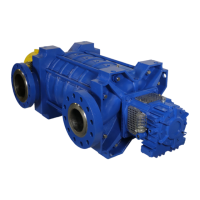
RS – Multi-Stage, I-280
Centrifugal Pump 280 – 16.03.EN
6
Pump liquids over 225˚F (107˚C); pumps
must be equipped with auxiliary cooling.
Pumps of high temperature construction are provided
with cooled ball bearings for a unit operating in
temperature range between 225˚ F and 300˚ F (107˚ C
and 149˚ C). Cooling water flows through cavities of the
bearing frame and keeps temperature of the ball
bearings within acceptable limits. Refer to Table 13 for
cooling flow rates of water temperature of 60˚ F (140˚C)
for ball bearings.
K.6 Maintenance.
Only a pumping unit which is properly
serviced and maintained in perfect technical
condition will give safe and reliable operation.
This also applies to the reliable function of the thrust or
radial ball bearings whose actual lifetime largely
depends on the operating mode and operating
conditions. Regular checks of the lubricant and the
running noises will prevent the risk of excessive
temperatures as a result of the thrust or radial ball
bearings running hot or defective bearing isolators.
The correct function of the bearing isolators must be
checked regularly. Any auxiliary systems installed must
be monitored, as necessary, to make sure that they
function correctly.
K.7 General Safety Instructions.
Various federal, state, and local laws affect
installation, use, and operation of pumping
equipment. Compliance with such laws relating
to proper installation and safe operation of
pumping equipment is the responsibility of the
equipment owner.
Prior to working on pump or driver, ensure all
switches and circuit breakers have been locked
in the open (off) position and tagged, “Out of
Service.”
All circuits NOT known to be dead must be
considered live at all times.
DO NOT wear loose or torn clothing around
rotating machines.
While working near electricity, DO NOT use
metal rules, flashlights, metallic pencils, or any
other objects having exposed conducting
material.
Make sure you are NOT grounded while
adjusting electrical equipment or using
measuring equipment.
In general, use only one hand when servicing
live electrical equipment.
Make sure to de-energize all electrical
equipment before connecting or disconnecting
meters or test leads.
For connecting a meter to terminals for
measurement, use a range higher than the
expected voltage.
Check to make sure that the frame of the driver
and starter panel are securely grounded before
operating pumping unit or performing any tests
or measurements.
If a test meter must be held or adjusted while
voltage is applied, ground case of meter before
starting measurement. DO NOT touch live
equipment while holding the meter. Some
moving vane-type meters should not be
grounded nor held during measurements.
DO NOT use test equipment known to be
damaged or in poor condition.
The following specific safety precautions apply to the
pumping unit:
Hydro suction case separately on RS-9 units.
Isolate pump for system hydro.
DO NOT exceed maximum rated suction
pressure unless otherwise rated.
DO NOT exceed maximum rated discharge
pressure.
Table 2. Maximum Allowable Pressures


 To Next Page