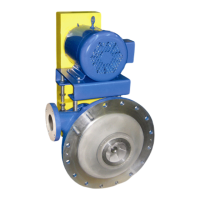
RS – Multi-Stage, I-280
Centrifugal Pump 280 – 16.03.EN
8
suction (9) and discharge (1) casings. Interstage
casings are provided with wear rings (7X). O-rings (89D)
seal the individual interstage casings. A one stage pump
does not have an interstage case.
IV. EFFECTS OF FLUIDS.
Solids in the fluid pumped may cause
internal damage to pump casing and damage
to the seal faces with resulting Hazardous
conditions. Care is to be taken to ensure that
the process fluid is clear of solids and debris.
A. NET POSITIVE SUCTION HEAD (NPSH). Any
liquid, hot or cold, must be pushed into the impeller of
the pump by some absolute pressure, such as the
atmosphere or the vessel pressure from which the pump
takes its action.
The head in feet of liquid necessary to maintain the
required flow into the pump is called the Net Positive
Suction Head (NPSH). This value is measured above
the vapor pressure of the liquid at the pumping
temperature.
NPSH is commonly expressed in two ways: the NPSH
required by the pump, and shown on the pump curve, is
the head needed to cover the losses in the pump
suction and the energy required to enable the liquid to
climb onboard the leading edge of the impeller vane.
The NPSH available is that inherent in the system,
taking into account friction losses in suction piping,
valves, fittings, etc. In all cases, the NPSH available,
measured above vapor pressure, must exceed the
NPSH required in order to push the liquid into the pump.
B. CHANGING PUMP SPEED. Changing the speed of
a centrifugal pump affects the capacity, total head,
NPSH required and the brake horsepower. In general
the capacity will vary in a direct ratio with the speed,
whereas the total head and NPSH required will vary as
the ratio of the speed squared. The brake horsepower
will vary as the ratio of the speed cubed.
C. EFFECTS OF VISCOSITY. The pump is designed
to deliver rated capacity at rated head for a liquid with a
particular viscosity. When pump is handling heavy
viscous liquid, the viscosity of the liquid must allow it to
be pumped easily. The liquid may have to be heated
prior to starting the pump. When contemplating
operation at some viscosity other than that for which the
pump was originally designed, check with Carver Pump
Company.
D. EFFECTS OF SPECIFIC GRAVITY. The capacity
and total head in feet of liquid developed by a centrifugal
pump are fixed for every point on the curve and are
always the same for the same speed. Neither capacity
nor total head will be affected by a change in the
specific gravity of the liquid pumped. However, since the
discharge pressure in Pounds per Square Inch (PSI)
and the brake horsepower required driving the pump are
functions of the specific gravity of the liquid, both will be
affected in direct proportion by any change in specific
gravity. Therefore, an increase in specific gravity will
raise the discharge pressure and is dangerous as it
might overload the pump's driver, or exceed the pump
casing allowable pressure.
V. TECHNICAL DATA.
Specifications and operating limits should be recorded
on a Service Record Page; an example is located in the
front matter of this manual. Record the necessary
information upon receipt of the pumping unit.
Noise Levels. Noise levels may exceed 85dBa at 1
meter during operation. Ear protection must be worn
whenever working in high noise locations.
Axial Impeller Alignment Control Dimensions. Axial
impeller alignment control dimension are located in
Table 3 and are arranged by pump size.
Seal Chamber Dimensions. Standard seal chamber
dimensions are located in Figure 1 and are arranged by
pump size.
Basic Design Features. Basic design features of the
pump are located in Tables 3, 4, 5, 6, 7, 10, and Figures
2 and 3 and are arranged by pump model.
Key Mechanical Data. Key mechanical data for the
pump is located in Table 8 and is arranged by pump
model.
Permissible Nozzle Loads. The forces and moments
in Table 9 are to be understood as the limit for a single
acting force or moment along the particular coordinate
axes or any resultant of two or more forces and
moment.


 To Next Page