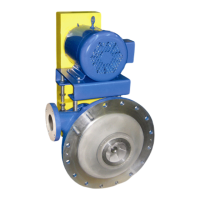
RS – Multi-Stage, I-280
Centrifugal Pump 280 – 16.03.EN
23
C. STARTING THE PUMP.
CAUTION
Do NOT operate pumping unit against a
closed discharge system. If pump has any
chance of seeing operation against a closed
system, a bypass system allowing a minimum
design flow should be installed. This bypass will
be satisfactory for short periods of operation.
For extended periods of operation the bypass
should be sized for the minimum continuous
flow required by the pump, refer to Table 10.
Refer to Section VIII, Paragraph E for
minimum/maximum flow calculation.
1. Confirm pumping unit is ready to start.
Complete Section VIII, Paragraphs A and B.
2. If unit is equipped with mechanical seal cooling
lines, turn on mechanical seal cooling water.
3. Fully open the suction valve.
4. Open discharge valves slightly, about 1 to 1 ½
turns if pump is being started for the first time or
from being turned off for overhaul. Start the
pump.
5. Slowly open discharge valves and adjust
pressure and flow to the appropriate operating
conditions. Refer to pump nameplate and
system operating procedures for design point
condition.
D. TURBINE APPLICATIONS. For turbine
applications, consult your local distributor or a
representative from Carver Pump Company.
E. MINIMUM/MAXIMUM FLOW CALCULATION.
Unless otherwise specified in the characteristic curves
or on the data sheets, the following applies.
Q
min
= 0.1 x Q
opt
for short operation
Q
min
= 0.3 x Q
opt
for continuous operation
Q
max
= 1.1 x Q
opt
for 2-pole operation
Q
max
= 1.25 x Q
opt
for 4-pole operation
Q
opt
= optimum efficiency
The data above refers to water and water-like liquids.
However, if the physical properties of the fluids handled
are different from water, the calculation formula below
must be used to check if an additional heat build-up may
lead to a dangerous temperature increase at the pump
surface. If necessary, the minimum flow must be
increased.
T o = T f + Δ T
g * H
ΔT = * ( 1 - η )
c * η
c Specific heat [J / kg K]
g Acceleration due to gravity [m/s_]
H Pump head [m]
T f Temperature of fluid handled [°C]
T o Temperature of casing surface [°C]
η Pump efficiency at duty point [ - ]
Δ T Temperature difference [°C]
F. OPERATING CHECKS.
1. Check for undue vibration or noise. If any
occurs and does not stop within a short period
of time, turn off the pump. For determination of
the cause and its remedy refer to
Troubleshooting in Section IX or consult Carver
Pump Company.
2. Check and record flow and pressure readings.
The flow and pressure readings should be
within the operating system guidelines and
similar to number stamped on the pump
nameplate.
3. Check and record power input to the motor.
4. Check for leakage at mechanical seals.
G. STOPPING THE PUMP.
1. If the pump is being stopped for overhaul, slowly
close the discharge valve. Otherwise leave
discharge valves set at condition.
2. Stop the pumping unit in accordance with the
directions on the electrical power supply.
3. Tagout and lockout power to motor according to
OSHA Standard 1910.147.
4. Close discharge and suction valves and any
auxiliary fluid lines.
5. The pumping unit is now off.


 To Next Page