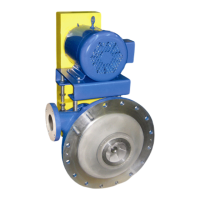
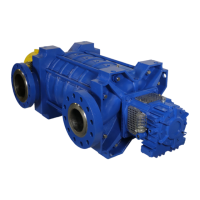
RS – Multi-Stage, I-280
Centrifugal Pump 280 – 16.03.EN
22
VIII. OPERATION.
A. PRE-START CAUTIONS.
CAUTION
Before activating the pumping unit, check to
make sure there are no personnel working on
the unit. Serious injury or death to personnel
could result if the unit is activated while being
worked on.
1. Before starting or operating the pump, read this
entire manual, especially the following
instructions.
2. Observe all caution or danger tags attached to
the equipment.
CAUTION
Pumps are shipped without oil in the
bearing frame and should be filled with oil
before starting the pumping unit. Operation of
the unit without proper lubrication can result in
overheating of the ball bearings, ball bearing
failures, pump seizures and actual breakup of
the equipment, exposing operating personnel to
injury.
3. Fill bearing frame with oil, refer to Section X,
Paragraph A and Table 12. Pumps are shipped
with no oil in the bearing frame.
CAUTION
Never run the pump dry. Close running fits
within the pump are liquid lubricated. Dry
running will result in pump seizure or damage.
4. Before starting the pump, fill the pump and
suction line with liquid. The pump may be
primed by using an ejector or vacuum pump.
5. Before starting a mechanical seal pump
equipped with external flush lines, turn on
mechanical seal water, and confirm the
mechanical seal water is at sufficient pressure.
Refer to Table 13 for minimum cooling flow
rates.
6. Check final alignment of pump and driver. Both
shafts must turn freely by hand. If necessary,
check coupling alignment.
7. Jog starter switch on motor to check that the
direction of rotation must agree with the arrow
stamped on the pump frame or base.
8. Before starting the pump, install closed guards
around all exposed rotating parts.
9. If excessive vibration or noise occurs during
operation, shut the pump down and rotate shaft
by hand. If excessive vibration or noise
continues, consult a Carver representative.
B. PRIMING. Dry running a centrifugal pump can
result in extensive damage and possible seizing. It is,
therefore, imperative that the pump be primed prior to
initial start-up and that prime must be maintained
through subsequent start-stop cycles.
The priming procedure is different for positive and
negative suction head systems. Follow the procedure
listed below.
Positive Suction Head:
1. Open the vent on the highest point on the pump
casing.
2. Open all suction valves.
3. Allow liquid to flow from vent hole until all air
bubbles are vented. Then close the vent.
4. The pump is now primed.
Negative Suction Head:
1. Install an ejector or vacuum pump on the vent at
the highest point on the casing.
2. Close the discharge valve.
3. Open the suction valve.
4. Start the ejector or vacuum pump.
5. Allow liquid to flow until a continuous flow is
exhausted from ejector. Then close the valve to
the vent.
6. The pump is now primed.


 To Next Page