Linear Glass Scale Installation
IM-ChipEncoder-Series-Rev. 2 Page 16 ©2022 Celera Motion
ChipEncoder Series
Installation Manual and Reference Guide
5.4 Mounting the Scale
There are two different methods for attaching linear scales to a surface:
Permanently attach scale using epoxy and RTV silicone (recommended)
Permanently attach scale using double-sided tape
5.4.1 Epoxy Mounted Scale
Linear scale is permanently attached to the mounting surface using epoxy and silicone adhesive on the
back of the scale. This method is recommended for best encoder accuracy as it ensures the best
flatness.
Note: Use talc-free gloves or finger cots to handle the scales.
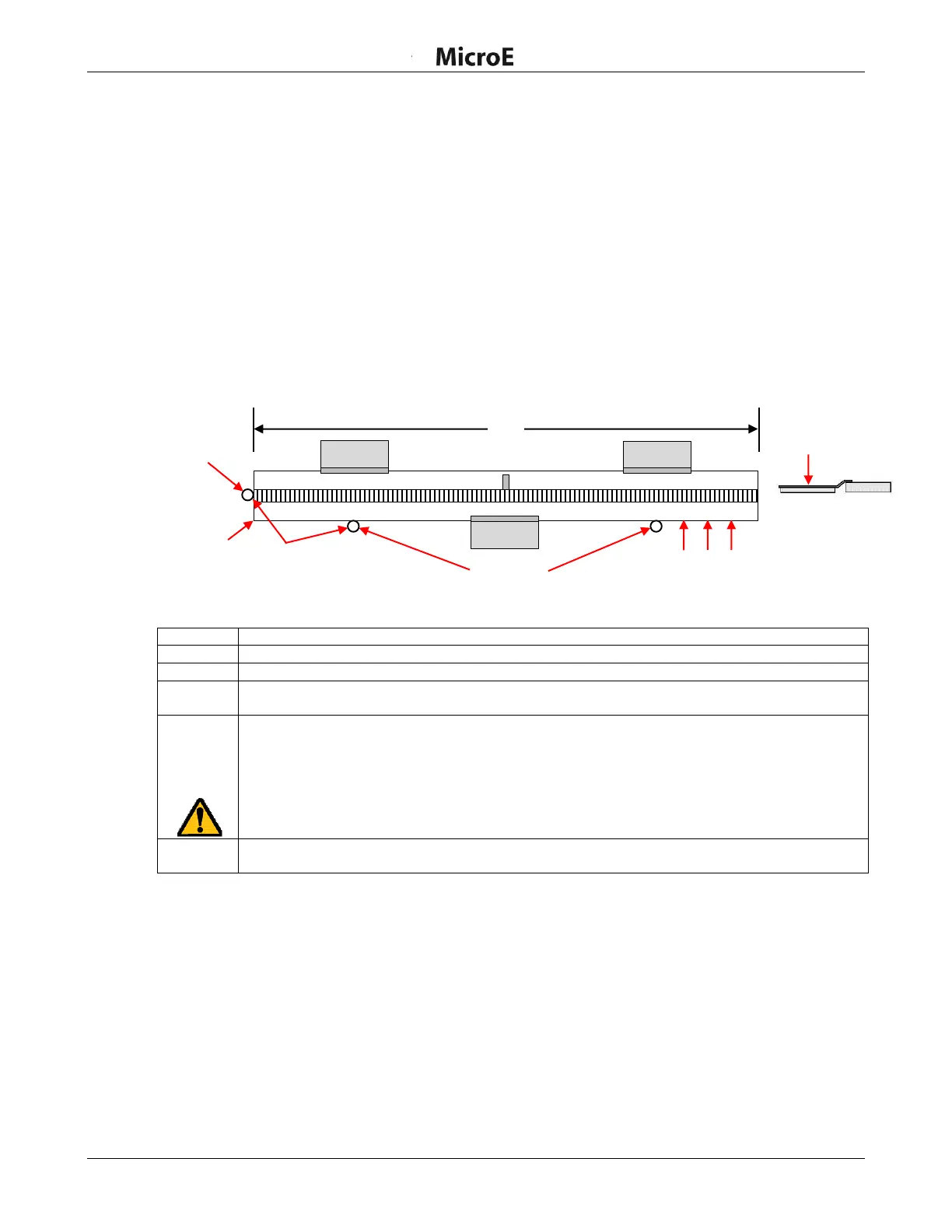
Refer to the following drawing for this procedure:
Make sure that the mounting surface is dry and clean.
Align the scale by placing the edges against the benching pins.
Optionally, scale clamps
1
may be used to secure the scale while the adhesive cures. Avoid
damaging the top surface when using clamps.
Apply a hard epoxy, such as Tra-Bond 2116, at the end of the scale at the end benching pin. Apply
100% Silicone RTV adhesive around the edges of the scale. This method allows thermal
expansion from the benched end of the scale.
Note: If an end benching pin is not used, then applying epoxy at the index mark is suggested.
Caution: Do not allow epoxy to seep under the scale; this will affect scale flatness and therefore
encoder accuracy.
After the adhesive cures, remove the scale mounting clamps, or, if permanently installing the
clamps, make sure that the clamps do not interfere with the encoder or encoder mounting.
Note
1
: See Section 8.0 Order Guide for details on ordering clamps.
optional scale clamp
and scale. Space
clamps every 75mm
on scales over
RTV around entire
outside edge of scale
Scale clamp
with adhesive
Hard epoxy at one
corner, this end only



 To Next Page