EasyManua.ls Logo

Cessna 210B - Landing Emergencies; Forced Landing (Precautionary); Forced Landing (Engine Failure)

Cessna 210B
42 pages
Print Icon
To Next Page IconTo Next Page
To Previous Page IconTo Previous Page
Loading...
Emergency
Procedures
(3)
Operate
the
hand
pump
up and down
until
the
down
indicat
or
(('I
light
comes
on,
and
continue
pumping
until
the
landing
g
e,lr
hlltHf
returns
to
neutral.
NOTE
The
landing
gear
cannot
be
retracted
with
the
emergen
cy
hllfl,I
pump.
If
the
gear
will not
retract
normally,
extend
the
gear,
ln
nll
and
have
the
malfunction
corrected.
If
the wing
flaps
fail
to
extend
normally,
plan
to
make
a
fla
ps
-I
ll'
I i
ing,
unless
there
is
another
person
aboard
to
assist.
It
is
impr.1I
II
for
the
pilot
alone
to
hold
down
the
spring-loaded
flap
handle,
optlr.iI. I
hand
pump,
and
fly
the
airplane
at
the
same
time.
LAN
DI
NG
EMER GENCIES
{Except
Ditchin
g
}.
FORCED
LANDING
(Precautionary
Landing
with
Power).
(1)
Drag
over
selected
field with
flaps
20°
and
90
MPH
air
sp
ol'd.
11011
type
of
terrain
and
obstruction.
(2)
If
surface
is
smooth
and
hard
(pasture,
frozen
lake
, etc).
I"
wheels-down
landing
using
full
flaps
and
keeping
nose
whe
el
tllf
I'
"
as
long
as
practical.
(3)
If
surface
is
rough
or
soft,
plan
a
wheels-up
landing
ali Ifill
a.
Approach
with
flaps
down
at
75
to
85
MPH.
b.
Turn
off
all
switches
except
ignition
switch.
c.
Unlatch
cabin
door
prior
to
flare
-out.
d.
Reduce
power
to
a
minimum
during
flare-out.
e.
Prior
to
contact,
turn
ignition
switch
"OFF.
"
f.
Land
in
a
slightly
tail-low
attitude.
g.
Attempt
to
hold
the
tail
low
throughout
slide.
FORCED
LANDING
(Complete
Engine
Failure).
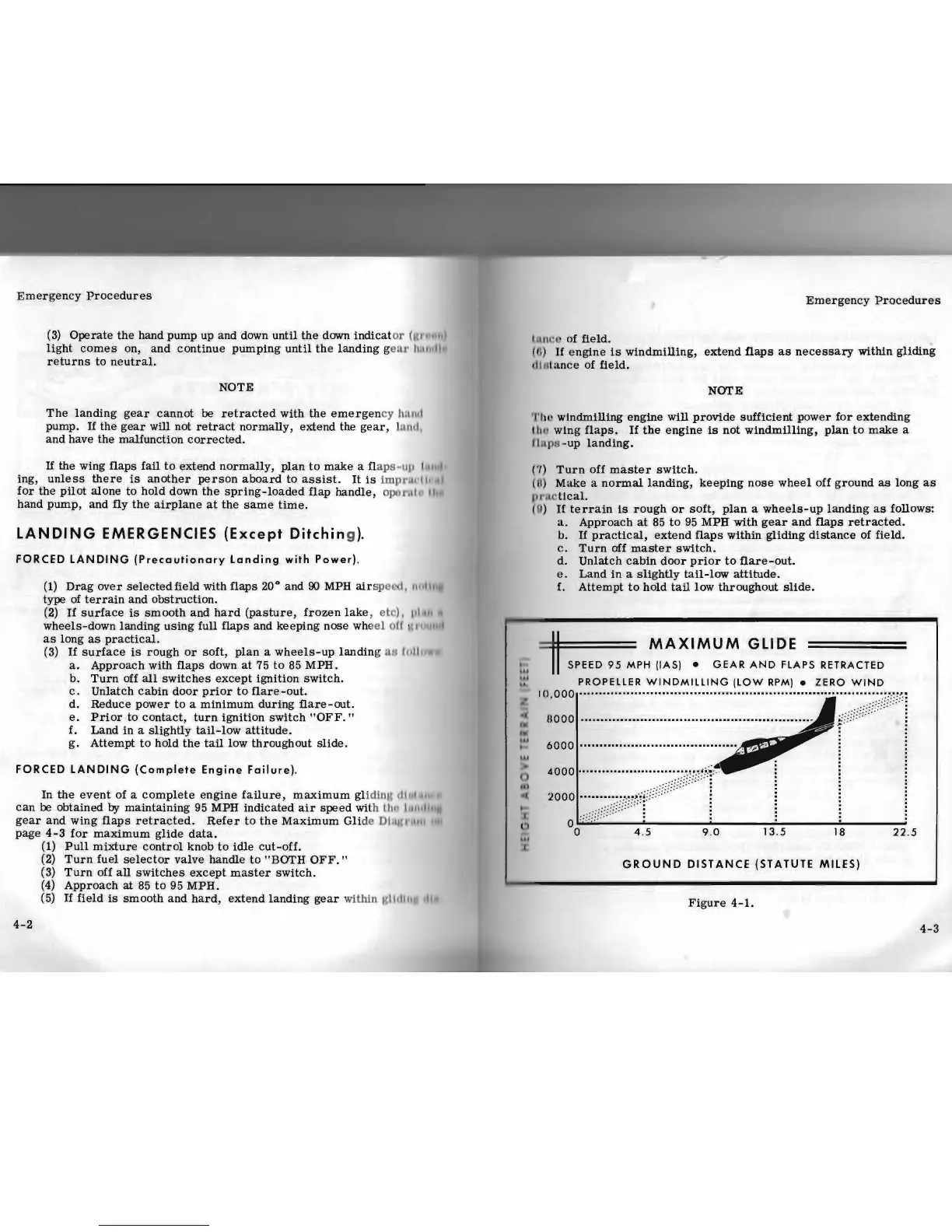
In
the
event
of a
complete
engine
failure,
maximum
g
li
dillt~
til flU
can
be
obtained
by
maintaining
95 MPH
indicated
air
speed
with f
h.
' I
UIII
gear
and
wing
flaps
retracted.
Refer
to
the
Maximum
Gli
de
Dill'
,.01
page
4-3
for
maximum
glide
data.
(1)
Pull
mixture
control
knob
to
idle
cut-off.
(2)
Turn
fuel
selector
valve
handle
to
"BOTH
OFF."
(3)
Turn
off
all
switches
except
master
switch.
(4)
Approach
at
85
to
95
MPH.
(5)
If
field
is
smooth
and
bard,
extend
landing
gear
within
",1I.lff.
Emergency
Procedures
I.IIII·U
of
field.
IJ)
If
engine
is
windmilling,
extend
flaps
as
necessary
within
gliding
,lln
l.mee
of
field.
NOTE
T h
,'
wlndmilling
engine
will
provide
sufficient
power
for
extending
illI
,
wing
flaps.
If
the
engine
is
not
windmilling,
plan
to
make
a
n"ps
- up
landing.
(
'7
)
Turn
off
master
switch.
(II)
Make
a
normal
landing,
keeping
nose
wheel
off
ground
as
long
as
I'
.·Ilr
llcal.
(
II
)
If
terrain
is
rough
or
soft,
plan
a
wheels-up
landing
as
follows:
a.
Approach
at
85
to
95
MPH
with
gear
and
flaps
retracted.
u.
If
practical,
extend
flaps
within
gliding
distance
of
field.
c.
Turn
off
master
switch.
d.
Unlatch
cabin
door
prior
to
flare-out.
c.
Land
in
a
slightly
tail-low
attitude.
£.
Attempt
to
hold
tail
low
throughout
slide.
II
MAXIMUM
GLIDE
II
SPEED
95
MPH
(lAS)
GEAR
AND
FLAPS
RETRACTED
PROPELLER
WINDMILLING
(LOW
RPM)
ZERO
WIND
I
c:;::::
..........................................................................
~
..
~
.......................
.
·.~·.·.·.·.·.·:~··;·;;:~j;;::~lr!!.·
6000
w
: :::
:·····::·::··;::·~:::·;;······-;;;:':"r·
C)
o
4.5
9.0
13.5
18
22.5
w
GROUND
DISTANCE
(STATUTE
MILES)
Figure
4-1.
4-3
4-2

Table of Contents

Related product manuals