EasyManua.ls Logo

Cessna 210B - Operational Data; Cruise Performance

Cessna 210B
42 pages
Print Icon
To Next Page IconTo Next Page
To Previous Page IconTo Previous Page
Loading...
Care
of
the
Airplane
@
ENGINE OIL SCREEN
Remove
and
wash
screen
(located
on
right
rear
side
of
engine
accessory
section)
with
Stoddard
solvent
(Fed.
Spec.
P-S-
661)
whenever
engine
oil
is
changed.
(On
aircraft
equipped
with
an
optional
oil
filter,
the
engine
oil
screen
has
been
removed
and
replaced
with
an
adapter
unit
for
oil
filtration.
)
@
BATTERY
Check
level
of
electrolyte
every
25
hours
(or
at
least
every
30
days),
oftener
in
hot
weather.
Maintain
level
by
adding
dis-
tilled
water
. DO
NOT
overfill.
Immediately
neutralize
spilled
electrolyte
with
baking
soda
solution,
then
flush
with
water.
Keep
battery
clean
and
connections
tight.
Neutral-
ize
corrosion
deposits
with
baking
soda
solution,
then
rinse
thoroughly.
<8>
HYDRAULIC SYSTEM
FILTER
Every
500
hours,
separate
filter
body
by
removing
four
screws;
then
remove
and
clean
the
two
screens
in
filter.
Use
new
O-ring
seal
when
reassembling
filter
after
clean-
ing.
Safety
wire
screws.
The
military
specifications
listed
are
not
mandatory,
but
are
intended
as
guides
in
choosing
satisfactory
materials,
Products
of
most
reputable
manufacturers
meet
or
exceed
these
specifications.
Figure
6
-1
(Sheet
6 of 6).
.....
The
operational
data
charts
on
the
following
pages
are
presented
for
Iwo
purposes:
first,
so
that
you
may
know
what
to
expect
from
your
air-
plane
under
various
conditions; and
second,
to
enable
you
to
plan
your
flights
ill
detail
and
with
reasonable
accuracy.
A
power
setting
selected
from
the
range
charts
usually
will
be
more
I'fficient
than
a
random
setting,
since
it
will
permit
accurate
fuel
flow
settings
and
your
fuel
consumption
can
be
estimated
closely.
You
will
find
I
hat
using
the
charts
and
your
Power
Computer
will
pay
dividends
in
over-
all
efficiency.
The
data
in
the
charts
has
been
compiled
from
actual
flight
tests
with
Ihe
airplane
and
engine
in
good
condition
and
using
average
piloting
tech-
niques.
Note
also
that
the
range
charts
make
no
allowances
for
wind,
navigational
errors,
warm-up,
take-off,
climb,
etc.
You
must
estimate
these
variables
for
yourself
and
make
allowances
accordingly.
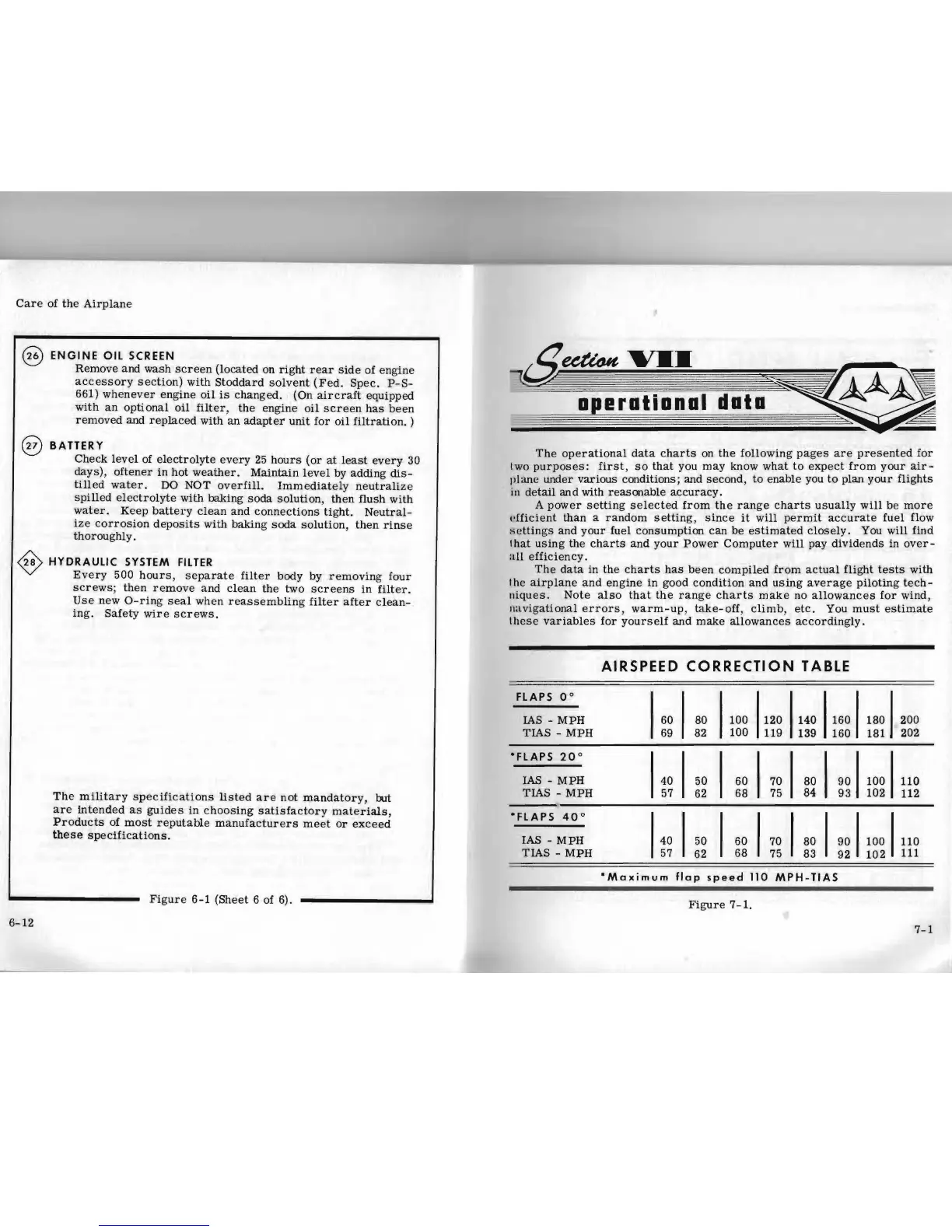
AI
'RSPEED
CORRECTION
TABLE
0
0
FLAPS
lAS -
MPH
100 160
12080
180
I
140
I
60
100
TlAS
-
MPH
69
82
119
139 160 181
'FLAPS
20
0
40
50 100
TlAS
-
MPH
57
62
102
'FLAPS
40
0
lAS -
MPH
40 50
60
70
80
90
I 100
1110
TlAS
-
MPH
57 62
68
75 83 92
II
102
111
"Maximum
flap
speed
110
MPH-TIAS
Figure
7-1.
6-12
7-1

Table of Contents

Related product manuals